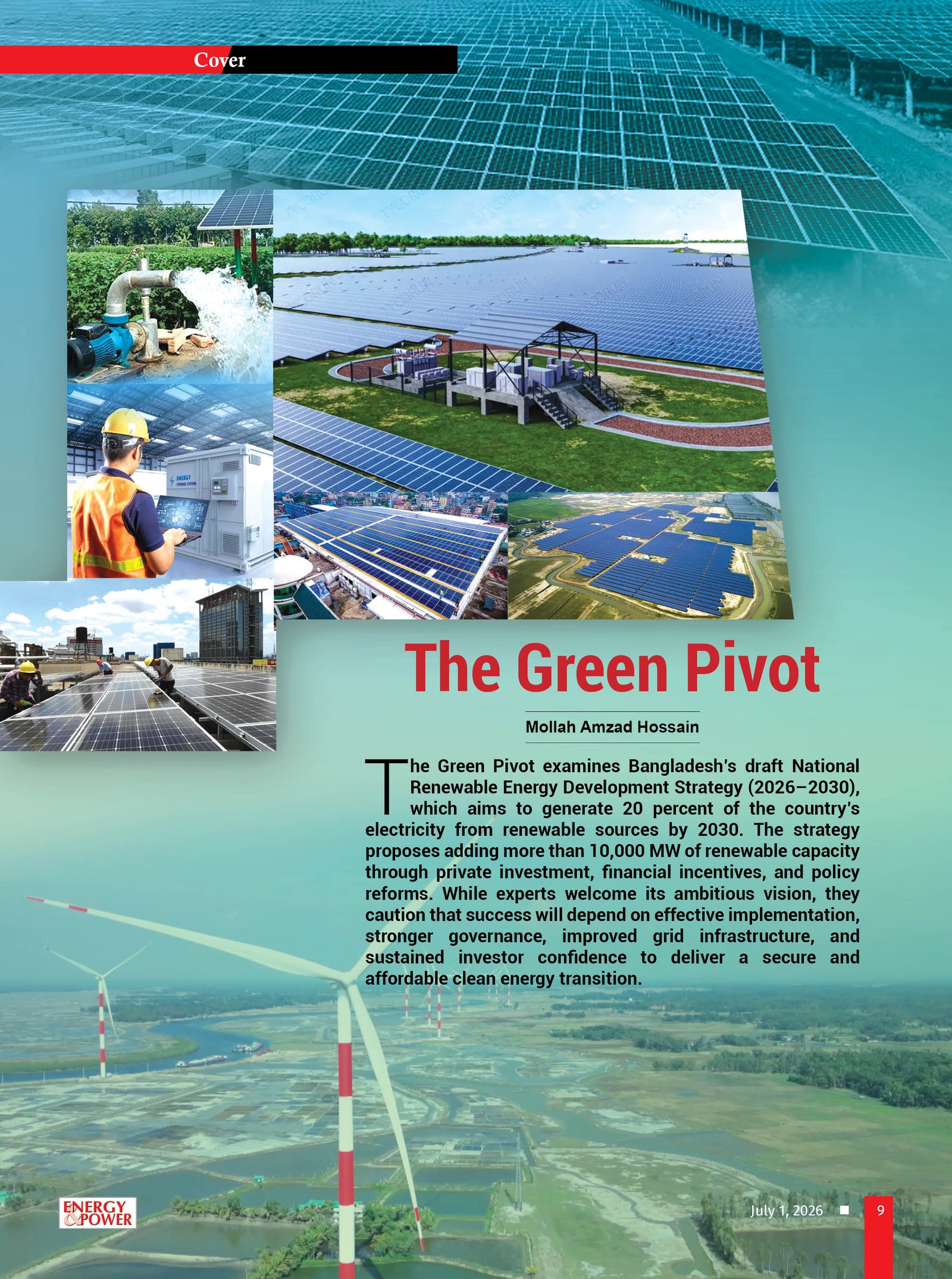
Bangladesh is preparing for its most ambitious renewable energy expansion yet. Through the draft National Renewable Energy Development Strategy (2026–2030), the government aims to reshape the country's energy landscape by significantly expanding renewable electricity generation, reducing dependence on imported fossil fuels, and strengthening long-term energy security. If successfully implemented, the strategy could mark a turning point in Bangladesh's transition toward a cleaner and more resilient power system.
Prepared by the Power Division following recommendations from a government-appointed committee, the draft strategy supports the country's commitment under the Renewable Energy Policy 2025 to generate 20 percent of total electricity demand from renewable sources by 2030. The document has been opened for stakeholder consultation until July 6, with a final review meeting scheduled for July 7 before formal approval.
A Bold Expansion Plan
At the heart of the strategy is an ambitious target to add approximately 10,450 megawatts (MW) of renewable energy capacity by 2030, increasing Bangladesh's total installed renewable capacity to between 12,000 MW and 14,000 MW.
Recognizing that public resources alone cannot finance such an expansion, the government intends to rely heavily on private sector participation. To encourage investment, the strategy proposes financial incentives, easier access to financing, sovereign payment guarantees, and the establishment of a Renewable Energy Development Fund.
Solar power will remain the cornerstone of Bangladesh's renewable energy transition. The strategy envisions installing:
· 5,500 MW of rooftop solar systems;
· 4,500 MW of utility-scale ground-mounted solar plants; and
· Around 500 MW from wind, floating solar, and waste-to-energy projects.
Given Bangladesh's limited land availability, rooftop solar has been identified as the most practical option for rapid expansion.
Meeting Rising Electricity Demand
Bangladesh's growing economy continues to drive higher electricity consumption. Government projections indicate that peak electricity demand will reach between 24,000 MW and 25,000 MW by 2030, while annual electricity consumption is expected to rise to approximately 135,000 gigawatt-hours (GWh).
Meeting the Renewable Energy Policy target means renewable sources must generate around 27,000 GWh of electricity annually by 2030—compared with only about 2,300 GWh today. Achieving that objective will require a dramatic increase in renewable electricity generation over the next five years.
Energy economist Engr. Shafiqul Alam welcomed the strategy's decision to define targets in terms of electricity generation rather than installed capacity.
According to him, measuring renewable energy by actual electricity produced provides a far clearer picture of the amount of installed capacity Bangladesh must build to meet its 2030 target.
.jpg)
Current Progress
According to the Sustainable and Renewable Energy Development Authority (SREDA), Bangladesh currently has more than 1,800 MW of installed renewable energy capacity, including over 1,500 MW of solar power and approximately 230 MW of hydropower.
Industry sources, however, estimate that total installed renewable capacity has already exceeded 2,000 MW because rooftop solar installations under the net-metering system remain significantly underreported. Private sector estimates suggest rooftop solar capacity alone may already exceed 1,000 MW, considerably higher than official figures indicate.
Building the Policy Framework
The draft strategy proposes an extensive package of reforms to accelerate renewable energy deployment.
Among the major initiatives are:
· Expanding rooftop solar through mandatory net metering;
· Promoting floating solar and agro-photovoltaic (Agro-PV) projects;
· Converting diesel-powered irrigation pumps to solar energy;
· Developing waste-to-energy facilities that generate both electricity and organic fertilizer;
· Integrating solar-powered charging infrastructure for electric vehicles;
· Modernizing the national grid through smart grid technologies and Battery Energy Storage Systems (BESS); and
· Improving energy efficiency by reducing electricity consumption by at least 15 percent across industrial and residential sectors.
The strategy also recommends establishing a national carbon credit trading framework, enabling renewable energy projects to access international climate finance through global carbon markets.
Financing the Transition
The government identifies financing as one of the greatest obstacles to expanding renewable energy.
To overcome this challenge, the strategy proposes creating a Renewable Energy Development Fund supported by domestic and international financial institutions, development partners, climate funds, and private investors. The fund would provide long-term, low-interest financing for renewable projects, while the Ministry of Finance would offer sovereign guarantees for eligible investments. Development partners would also be allowed to extend additional financial guarantees.
The strategy further proposes concessional financing, loan guarantees, tax incentives, and simplified approval procedures to attract both domestic and foreign investors.
To encourage greater private sector participation, the government also plans to reduce import duties and taxes on solar panels and related equipment, expand Bangladesh Bank's Green Refinance Scheme, and simplify financing for small and medium-sized enterprises investing in renewable energy.
The draft additionally proposes a one-stop service for project approvals and a digital net-metering system to streamline rooftop solar integration into the national grid.
Private Sector Takes Center Stage
The strategy identifies private investment as the principal driver of Bangladesh's renewable energy expansion.
Renewable energy projects are expected to be implemented through Public-Private Partnership (PPP) and Merchant Power Plant models. However, the document does not clearly define the future role of the existing Independent Power Producer (IPP) framework.
Industry stakeholders argue that this omission could discourage both domestic and foreign investors, particularly those interested in developing grid-connected solar projects.
Strengthening Energy Security
A central objective of the strategy is to reduce Bangladesh's growing dependence on imported fossil fuels.
The draft notes that reliance on imported energy has increased the country's exposure to volatile international fuel markets, placing pressure on electricity prices, foreign exchange reserves, and government subsidy requirements.
By expanding renewable energy, the government aims to improve energy security, reduce fuel imports, lower carbon emissions, and build a more resilient and affordable electricity system over the coming decade.
Implementation Challenges
While experts have broadly welcomed Bangladesh's first National Renewable Energy Development Strategy, many caution that achieving its ambitious targets will ultimately depend on implementation rather than policy aspirations.
One of the principal concerns is the absence of a clear roadmap for reducing the cost of renewable electricity. Zakir Hossain Khan, Chief Executive of Change Initiative, said the strategy presents an ambitious vision but provides limited guidance on how renewable power can become more affordable. He also questioned whether the proposed Renewable Energy Development Fund could become overly bureaucratic unless supported by strong governance, transparency, and accountability.
Financing remains another critical challenge. Although the strategy proposes concessional loans, sovereign payment guarantees, tax incentives, and long-term financing, experts note that investor confidence will depend largely on the effectiveness and predictability of these mechanisms.
Reforming the Investment Environment
The strategy acknowledges that Bangladesh's renewable energy sector has expanded more slowly than anticipated because of limited access to affordable financing, policy uncertainty, weak institutional coordination, and an investment climate that has not been sufficiently supportive.
To address these constraints, it recommends replacing traditional contractual arrangements with government-backed payment guarantees, thereby reducing financial risks for investors.
The draft also proposes reducing import duties and taxes on renewable energy equipment to as low as one percent and expanding Bangladesh Bank's Green Refinance Scheme. Small and medium-sized enterprises investing in renewable energy would receive simplified financing procedures and easier access to credit.
Although the FY2026–27 national budget introduced duty concessions for renewable energy equipment, industry representatives argue that the incentives remain conditional and are not universally available.
Professor Ijaz Hossain, former Dean of the Bangladesh University of Engineering and Technology (BUET), believes these tax benefits should be extended to all renewable energy investors, even for a limited period, to accelerate rooftop solar development.
Rooftop Solar Takes Priority
Given Bangladesh's limited availability of land, rooftop solar occupies a central place in the proposed strategy.
The government plans to expand rooftop solar installations across ministries, government offices, and public institutions through private investment, allowing investors to recover their costs under the net-metering system.
The strategy also recommends making net metering mandatory for industries operating in Economic Zones (EZs) and Export Processing Zones (EPZs).
In addition, amendments to the Bangladesh National Building Code (BNBC) are proposed to require that between 30 and 70 percent of rooftop space in new residential, commercial, and industrial buildings be reserved for solar photovoltaic installations.
For utility-scale renewable energy projects, the strategy emphasizes competitive bidding, Public-Private Partnership (PPP) implementation, merchant power projects, and mandatory Battery Energy Storage Systems (BESS) to enhance grid stability.
Beyond Solar
Although solar energy dominates the strategy, the government also intends to diversify renewable energy sources.
The draft highlights the significant wind energy potential of Bangladesh's coastal regions while promoting floating solar and waste-to-energy projects.
Another major proposal involves gradually converting approximately 1.2 million diesel-powered irrigation pumps and 400,000 electric irrigation pumps to solar-powered systems. Besides reducing diesel imports and easing pressure on the national grid, the transition could lower government subsidies while enabling farmers to sell surplus electricity back to the grid through net metering.
What the Experts Say
Energy experts generally view the strategy as an important milestone toward a more structured and coordinated clean energy transition.
Professor Ijaz Hossain believes the strategy can attract substantial private investment only if Bangladesh reforms its land-use policy for renewable energy projects. He recommends that the government identify suitable land, ensure transmission connectivity, establish benchmark tariffs, and allocate projects through transparent competitive auctions. Such measures, he argues, would both improve transparency and reduce electricity costs.
He also cautions that technical challenges could become increasingly important as renewable capacity expands. During winter months, Bangladesh's electricity demand falls to around 10,000 MW, while approximately 7,000 MW of baseload generation from coal and nuclear power plants must remain in operation. Consequently, the grid may be unable to absorb more than about 3,000 MW of solar generation during off-peak periods without adequate battery storage capacity.
Engineer Shafiqul Alam also views the strategy positively, noting that it extends beyond renewable electricity generation by incorporating energy efficiency, demand-side management, and proposals such as adjusting office hours to improve electricity demand management.
He particularly welcomed the proposal to establish a dedicated Renewable Energy Development Fund and introduce government-backed payment guarantees, saying these initiatives could help restore investor confidence. However, he stressed that several provisions require greater clarity before the strategy is finalized.
Conclusion
Bangladesh's National Renewable Energy Development Strategy (2026–2030) represents the country's most comprehensive blueprint yet for accelerating the clean energy transition. It combines ambitious renewable energy targets with policy reforms, financial incentives, private sector participation, and investments in modern grid infrastructure and energy storage.
Yet the strategy also underscores that setting targets is only the beginning. Questions remain over the governance of the proposed Renewable Energy Development Fund, the implementation of payment guarantees, and the broader investment framework needed to mobilize private capital.
Experts also recommend simplifying Power Purchase Agreements (PPAs), Implementation Agreements (IAs), and tendering procedures while developing a broader Green Energy Transition Roadmap that provides a clear pathway toward lower carbon emissions and reduced dependence on imported fossil fuels.
Equally important is the need to strengthen the electricity system itself. As renewable capacity expands, Bangladesh will have to modernize its transmission network, deploy large-scale battery energy storage, and improve the management of variable renewable generation. Without these investments, surplus renewable electricity could become stranded, undermining both financial sustainability and energy security.
Ultimately, the green transition is about far more than increasing the share of renewable energy in the national electricity mix. It reflects Bangladesh's effort to build a more secure, resilient, and affordable energy future. Whether that vision becomes reality will depend not only on the ambition of the strategy but also on the government's ability to translate policy into projects, attract sustained private investment, and implement reforms with transparency and consistency.
Download Cover As PDF/userfiles/EP_24_02_Cover.pdf