The International Energy Agency (IEA) has projected a gradual recovery in the global oil market, while warning that renewed tensions in the Gulf region could derail supply growth and keep energy markets volatile.
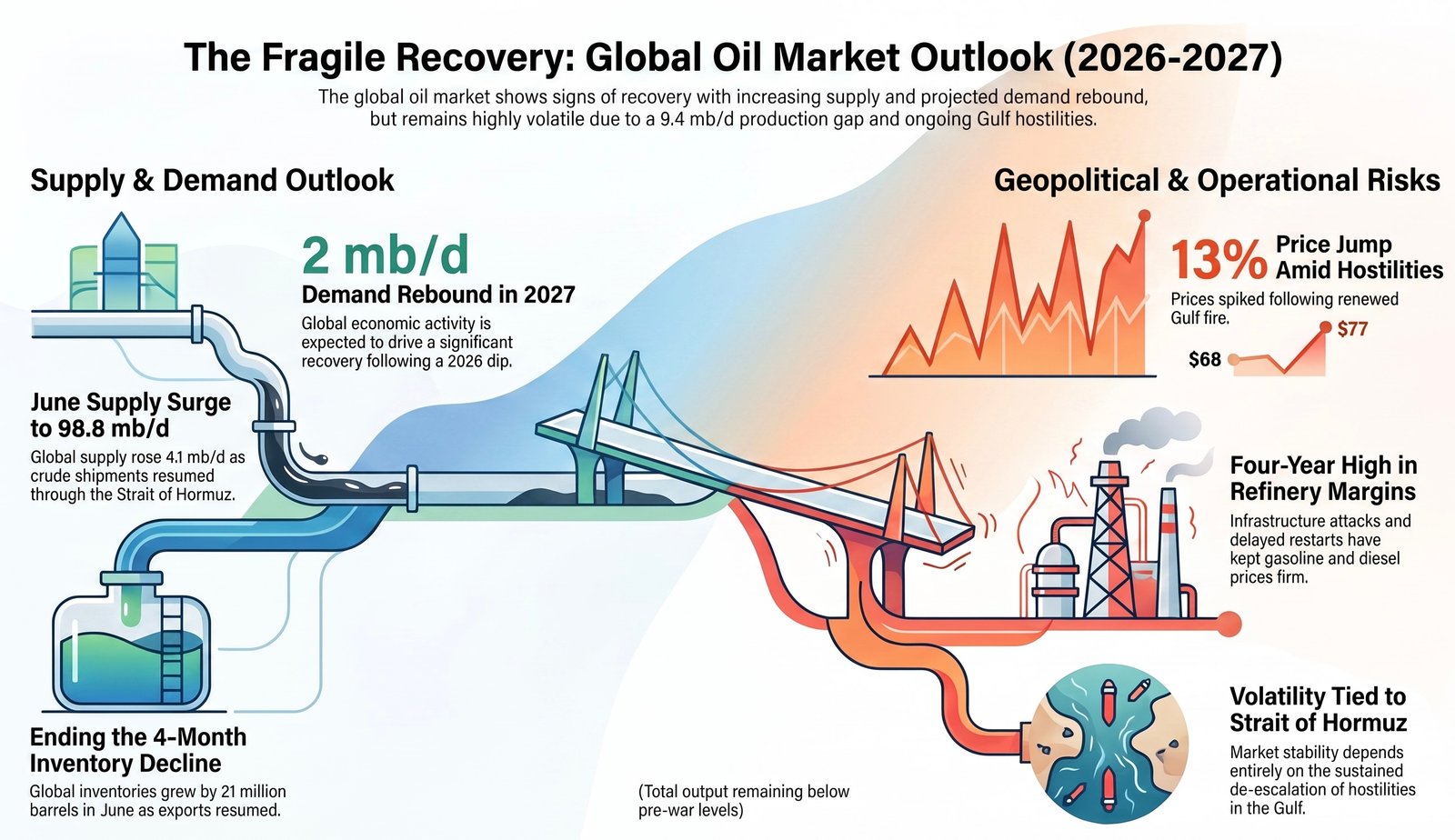
In its July 2026 Oil Market Report, the Paris-based agency said global oil demand is recovering from a sharp slowdown earlier this year, driven by seasonal consumption and improving fuel availability. Although global oil demand is forecast to decline by 1 million barrels per day (mb/d) in 2026, it is expected to rebound by 2 mb/d in 2027, reflecting a gradual recovery in economic activity.
The report noted that global oil supply increased by 4.1 mb/d in June to 98.8 mb/d, largely due to the resumption of crude shipments through the Strait of Hormuz following an easing of disruptions. However, world oil production remains 9.4 mb/d below pre-war levels, highlighting the lingering impact of the recent conflict in the Middle East.
The IEA cautioned that its outlook depends heavily on a sustained de-escalation of hostilities in the Gulf.
“The global oil market balance looks set to swing back to surplus towards the end of the year, but the forecast hinges on the assumption that tanker flows through the Strait of Hormuz gradually recover,” the agency said.
Benchmark crude prices fell sharply in June as oil exports resumed, with North Sea Dated crude dropping to around US$68 per barrel, the lowest level since January. However, prices rebounded to approximately US$77 per barrel after renewed exchanges of fire in the Gulf on 7-8 July, underscoring the market’s vulnerability to geopolitical risks.
The report also highlighted a widening gap between crude oil and refined fuel markets. While crude supplies have improved, refinery operations remain constrained due to delayed restarts in the Middle East and attacks on Russian refining infrastructure. As a result, prices for gasoline and diesel have remained firm, pushing refinery margins to their highest levels in four years.
According to the IEA, global oil inventories increased by 21 million barrels in June, ending a four-month decline, mainly because of higher volumes stored aboard tankers as Gulf exports resumed.
The agency emphasized that a lasting peace in the Middle East remains essential for restoring normal oil flows, stabilizing energy markets and ensuring reliable global fuel supplies.