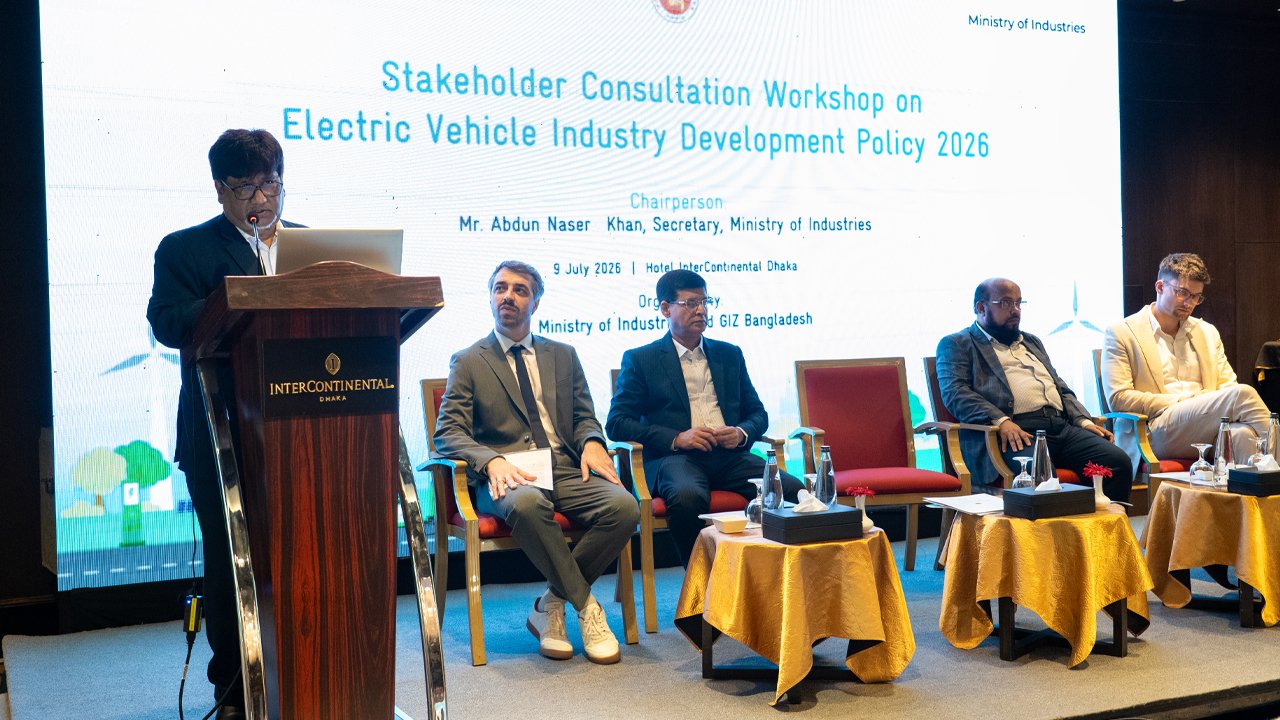
DHAKA, July 9, 2026: The Ministry of Industries, in collaboration with GIZ Bangladesh, has launched a stakeholder consultation to formulate the Electric Vehicle (EV) Industry Development Policy 2026, aiming to establish a comprehensive roadmap for the country’s fast-growing electric mobility sector.
The consultation workshop, held at a hotel in Dhaka on Thursday, focused on developing a supportive industrial and regulatory framework to help Bangladesh achieve its target of ensuring that 30 percent of all transport vehicles are electric by 2030.
The workshop was chaired by Industries Secretary Abdun Naser Khan, according to a press release issued by GIZ Bangladesh.
Addressing the event, Khan said Bangladesh must act now to secure its place in the global EV value chain.
“If we fail to prepare adequately today, we risk missing not only a promising industrial opportunity but also falling behind in the global value chain,” he said. “Our goal is not merely to import electric vehicles, but to establish Bangladesh as an EV manufacturing nation.”
The consultation highlighted the urgency of accelerating e-mobility as road transport accounts for around 81 percent of emissions from the country’s transport sector, making the transition critical from both environmental and economic perspectives.
Representatives of the German Embassy in Dhaka and GIZ Bangladesh reaffirmed Germany’s commitment to supporting Bangladesh’s transition to sustainable transport. Deputy Head of Cooperation Yanis Hussein and GIZ Bangladesh Country Director Mark Gombart emphasized continued collaboration in developing the country’s EV ecosystem.
The proposed policy is being prepared with technical and advisory support under the Transition to Sustainable E-Mobility (Trans2SMo) project, implemented by GIZ with funding from Germany’s Federal Ministry for Economic Cooperation and Development (BMZ).
The workshop also addressed concerns over electricity supply for large-scale EV adoption. While renewable and other low-carbon sources contributed only about two percent of Bangladesh’s electricity generation in 2025, experts said the national power grid is capable of accommodating the expected increase in EV demand through strategic grid planning, smart charging systems and smart grid technologies.
The draft policy proposes a range of fiscal incentives to encourage domestic assembly and manufacturing. It recommends setting the Total Tax Incidence (TTI) on completely built-up (CBU) imported electric vehicles at 37 percent until 2030, while maintaining a significantly lower 15.25 percent TTI on completely knocked down (CKD) EV imports until 2035 to promote local assembly.
The policy also proposes a 10-year corporate income tax exemption for companies investing in EV charging infrastructure, aiming to accelerate the development of a nationwide charging network.
Additional Secretary (Policy, Law and International Cooperation) A.K.M. Benjamin Riazi and Additional Secretary (Administration) Md. Nuruzzaman also addressed the workshop. The event brought together automobile industry leaders, climate experts, policymakers and international development partners to provide recommendations on the proposed EV policy.