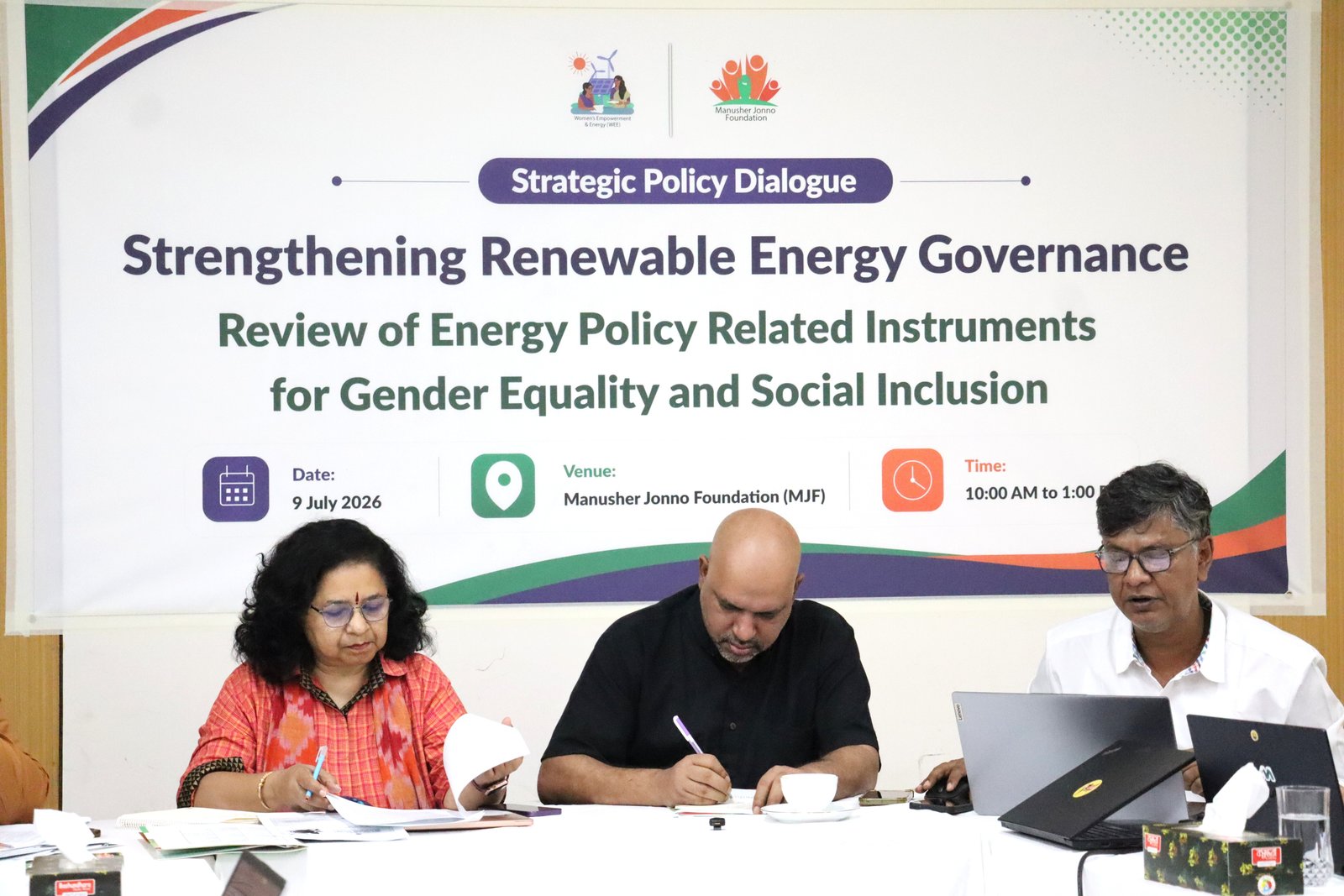
DHAKA, July 9, 2026: Renewable energy policies in Bangladesh must go beyond electricity generation and ensure the meaningful participation of women and marginalized communities, speakers said at a policy dialogue on Thursday, calling for stronger gender equality and social inclusion in the country’s emerging clean energy framework.
The dialogue, titled “Strengthening Renewable Energy Governance: Review of Energy Policy Related Instruments for Gender Equality and Social Inclusion,” was organized by Manusher Jonno Foundation (MJF) under its Women’s Empowerment and Energy (WEE) project.
The discussion reviewed two key draft policy instruments—the National Renewable Energy Development Strategy (2026–2030) and the Rooftop Solar Operation and Maintenance Guidelines—to assess how effectively they address gender equality and social inclusion.
.JPG)
Speaking at the event, Banasree Mitra Neogi, Director of Rights and Governance Programs at MJF, said the draft documents do not adequately recognize the role of women entrepreneurs and marginalized communities in Bangladesh’s renewable energy transition.
She emphasized that while policies provide strategic direction, a stronger legal framework is needed to ensure compliance. She also urged the government to make draft policies publicly available to enable broader public consultation and stakeholder participation.
Presenting the keynote paper, Wasiur Rahman Tonmoy, Lead for Youth and Social Cohesion at MJF, said the review found that key stakeholders had not been sufficiently consulted during the preparation of the draft documents. He called for targeted incentives, easier access to finance and greater representation of women and marginalized groups in renewable energy policies through inclusive consultations involving government agencies, civil society, the private sector, development partners and technical experts.
Participants stressed that renewable energy governance should measure success not only by installed generation capacity but also by its social impact, including the number of people benefiting from clean energy initiatives.
Sazzad Hossain, Assistant Vice-President of Infrastructure Development Company Limited (IDCOL), said the draft strategy had largely been developed from a technical perspective. He recommended incorporating social impact indicators alongside megawatt-based targets and expanding financial support for women and disadvantaged communities.
A.S.M. Munir, Company Secretary of the Bangladesh Sustainable and Renewable Energy Association (BSREA), urged policymakers to adopt a comprehensive approach covering the entire renewable energy value chain, including manufacturing, distribution, users and broader socioeconomic impacts.
Several speakers highlighted the importance of integrating renewable energy education into school curricula and introducing practical laboratory training to encourage greater participation of young women in the sector.
Sadia Jahan Rothi of the Centre for Climate Change and Environmental Research (C3ER) at BRAC University proposed hands-on renewable energy education to inspire girls to pursue careers in clean energy, while Shahnaj Siddiqui, General Secretary of the Bangladesh Nari Sangbadik Kendra (BNSK), called for policy assessments that clearly demonstrate the benefits of including marginalized communities and the costs of exclusion.
Transparency International Bangladesh’s Md. Newazul Moula emphasized the need for implementation roadmaps, social audits, public participation, transparency and accountability within renewable energy policies. Meanwhile, representatives from ActionAid Bangladesh and the Coastal Livelihood and Environmental Action Network (CLEAN) underscored the importance of battery waste management, local employment, women’s entrepreneurship, safe working conditions, land access for renewable projects and labour-based maintenance systems.
The dialogue concluded that renewable energy policymaking should involve not only government officials and technical experts but also local communities, farmers, women’s organizations, entrepreneurs, civil society and the private sector to ensure practical and inclusive implementation.
MJF said the recommendations emerging from the consultation will be consolidated into a policy brief and submitted to the relevant government authorities to support the development of more inclusive renewable energy policies in Bangladesh.