The allegation that the Bangladesh Energy Regulatory Commission (BERC) does not place adequate importance on consumer interests is incorrect. Consumer welfare was given due consideration in the latest electricity tariff adjustment. That is why only a small portion of the gap between the Bangladesh Power Development Board’s (BPDB) production cost and selling price has been adjusted. Several directives have been issued to reduce electricity generation costs, including lowering capacity charges and improving management efficiency.
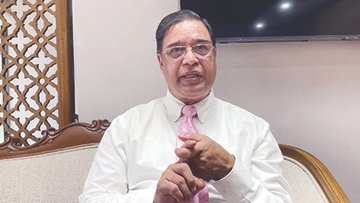
BERC Chairman Jalal Ahmed made these remarks in an interview with Mollah Amzad Hossain, Editor, Energy & Power.
After a 28-month gap, the Bangladesh Energy Regulatory Commission increased electricity tariffs on June 3. However, the Consumers Association of Bangladesh and several civil society groups have questioned its justification. Some have alleged that despite recommendations made during the public hearing to reduce the deficit without raising prices, the Commission did not accept those proposals. What is your response?
A public hearing is not an isolated event; it is part of a comprehensive process. The licensed utility companies first submit their revenue demand or tariff adjustment proposals. These proposals are then analyzed by a technical committee and presented to the Commission. Only after that is a public hearing held, where both supporting and opposing views are heard.
 copy.jpg)
Scan the QR Code to Watch the Full Interview
We analyze all available data, cost structures, and the financial conditions of the utilities before reaching a balanced decision, so that consumers are not subjected to excessive pressure while ensuring that the utilities remain financially viable.
This time, the electricity sector requires subsidies of around Tk 56,000 crore. Through the wholesale tariff adjustment, it has been possible to reduce a portion of that deficit. We estimate that BPDB’s subsidy requirement will decrease by approximately Tk 12,000 crore. However, a substantial deficit remains, which the government will have to cover through subsidies.
Consumer rights groups, business associations, and others have questioned the rationale behind the tariff increase. What would you say to them?
It would not be appropriate to view this simply as a price increase. Electricity tariffs have been adjusted many times over the past 15 years. International fuel prices, exchange rate fluctuations, and inflation have all increased electricity generation costs.
We increased the wholesale tariff by an average of Tk 1.39 per unit. According to BPDB’s proposal, a much larger increase was necessary to reduce the deficit. However, considering the burden on consumers, we adopted a middle-ground approach. Even then, an estimated deficit of around Tk 41,000 crore will remain, which the government will have to bear as subsidies.
Wholesale electricity tariffs have been increased by Tk 1.39 per unit, which will raise BPDB’s annual revenue by Tk 14,000 crore. Yet, a deficit of Tk 41,000 crore will remain. Did the Commission recommend that the government increase subsidies to bridge this gap?
BPDB’s proposal estimated an annual deficit of Tk 56,000 crore. However, it is not possible to transfer the entire burden onto consumers. Therefore, the wholesale tariff was increased by Tk 1.39 per unit, which is expected to generate an additional Tk 12,000 crore in annual revenue.
Alongside subsidies, BPDB must reduce electricity generation costs. Necessary directives have already been issued for that purpose.
Has the Commission held any discussions with the government regarding subsidies?
There has been no separate policy-level discussion with the government. However, the utility companies’ proposals clearly identified a substantial subsidy requirement.
Our tariff adjustment will reduce some of that burden, allowing the government to allocate resources to other productive and development sectors. Since the government has continuously provided subsidies to the power sector, it is expected to continue doing so to address the remaining deficit.
At the retail level, electricity tariffs were initially increased from Tk 9.11 to Tk 10.63 per unit. However, following requests from the utilities, the increased rates for lifeline consumers using up to 50 units and consumers using up to 75 units were withdrawn the next day. As a result, the average retail tariff became Tk 10.40 per unit. How will the Commission address the resulting deficit for the distribution companies?
The first order increased retail tariffs in line with wholesale tariff adjustments and applied the increase to all categories of consumers.
However, following discussions with the utilities and considering their requests, tariffs for lifeline consumers and consumers using up to 75 units were kept unchanged. This will increase the financial deficit of the Rural Electrification Board (REB). Therefore, the Commission has asked BPDB to support REB by offering discounts on wholesale electricity prices to compensate for the shortfall.
It is well known that whenever electricity tariffs are increased, the Commission also issues directives to the utilities. BPDB’s average generation cost is now over Tk 13 per unit. Many believe that the entire burden cannot be shifted onto consumers and that waste, irregularities, and corruption must be reduced. What kind of directives has the Commission given to BPDB?
Alongside the tariff order, we have issued directives to BPDB and other utilities specifying the actions they must undertake and requiring them to report their progress to the Commission.
Although capacity charges are an internationally recognized concept, in our case, they have become a major burden due to excessive installed capacity. To reduce this burden, utilities have been instructed not to renew power plants once their operational terms expire.
We have also instructed them to improve plant availability, heat rates, operational efficiency, fuel mix, and management practices to reduce overall costs. Regular monthly and quarterly reports on these matters will be submitted to the Commission.
Furthermore, directives have been issued to reassess power plants that have become obsolete or ineffective and to gradually retire them.
Protecting consumer interests is one of BERC’s major responsibilities. However, there is a perception that the Commission has not taken effective initiatives in this regard since its establishment. How do you respond, and what is the current Commission doing?
The allegation is not accurate. We are working with the highest priority given to consumer interests, and the extent of the recent tariff increase itself demonstrates that.
There have been complaints regarding prepaid electricity meters. To verify these concerns, BERC is conducting a study in collaboration with BUET. Based on its findings, the Commission will take appropriate measures.
At the same time, to prevent unnecessary expenditures from being transferred to consumers in the future, we have issued an order requiring all licensees to obtain prior approval from the Commission before undertaking any projects.
Failure to comply with this order will constitute a violation of the law, and in such cases, the costs of those projects will not be allowed to be passed on through tariffs.
Moreover, the Commission has initiated financial, managerial, and technical audits for all licensees. Since BERC currently lacks adequate manpower to conduct these audits internally, third-party services will be engaged initially.
Once this process begins, it will create opportunities to identify financial irregularities and management weaknesses in the energy and power sectors and take corrective action. Ultimately, consumers will benefit from these measures.
Is there any opportunity to renegotiate or buy back old power purchase agreements?
The government formed two committees to examine this issue. Some reviews have already been conducted, although I am not aware of the final decisions.
However, if the government wishes, certain agreements can certainly be reconsidered. Decisions should be based on a comprehensive assessment of the costs and benefits associated with each contract.
What role will the Rooppur Nuclear Power Plant play? Will it help reduce generation costs?
The addition of 1,200 MW of electricity from Rooppur NPP to the national grid will provide significant relief to the system.
If its production costs remain comparatively low, it will help stabilize electricity tariffs in the future. It will also play an important role in strengthening Bangladesh’s energy security.
What is BERC’s position regarding renewable energy?
We attach great importance to renewable energy. The government also has clear targets to advance this sector.
Large areas of land, such as those in Moheshkhali and Matarbari, could be utilized for renewable energy projects. Utilities are also being encouraged to gradually increase their investments in renewable energy sources.
Bangladesh is heavily dependent on energy imports, with import dependency currently standing at around 65 percent. Prices of gas, electricity, oil, and LPG are therefore heavily influenced by international markets. Since LPG and fuel oil prices are adjusted monthly under a formula, should a similar formula-based mechanism be introduced for electricity and gas?
At this stage, the Commission is not considering monthly adjustments for electricity and gas prices under a formula similar to LPG and petroleum products.
This is because it is not possible to transfer the full burden of actual gas and electricity costs onto consumers. Instead, the sector must remain financially sustainable through limited price increases while continuing subsidies.
At the same time, the Commission has already issued directives aimed at reducing electricity generation costs.
Download Interview As PDF/userfiles/EP_24_01_Interview.pdf