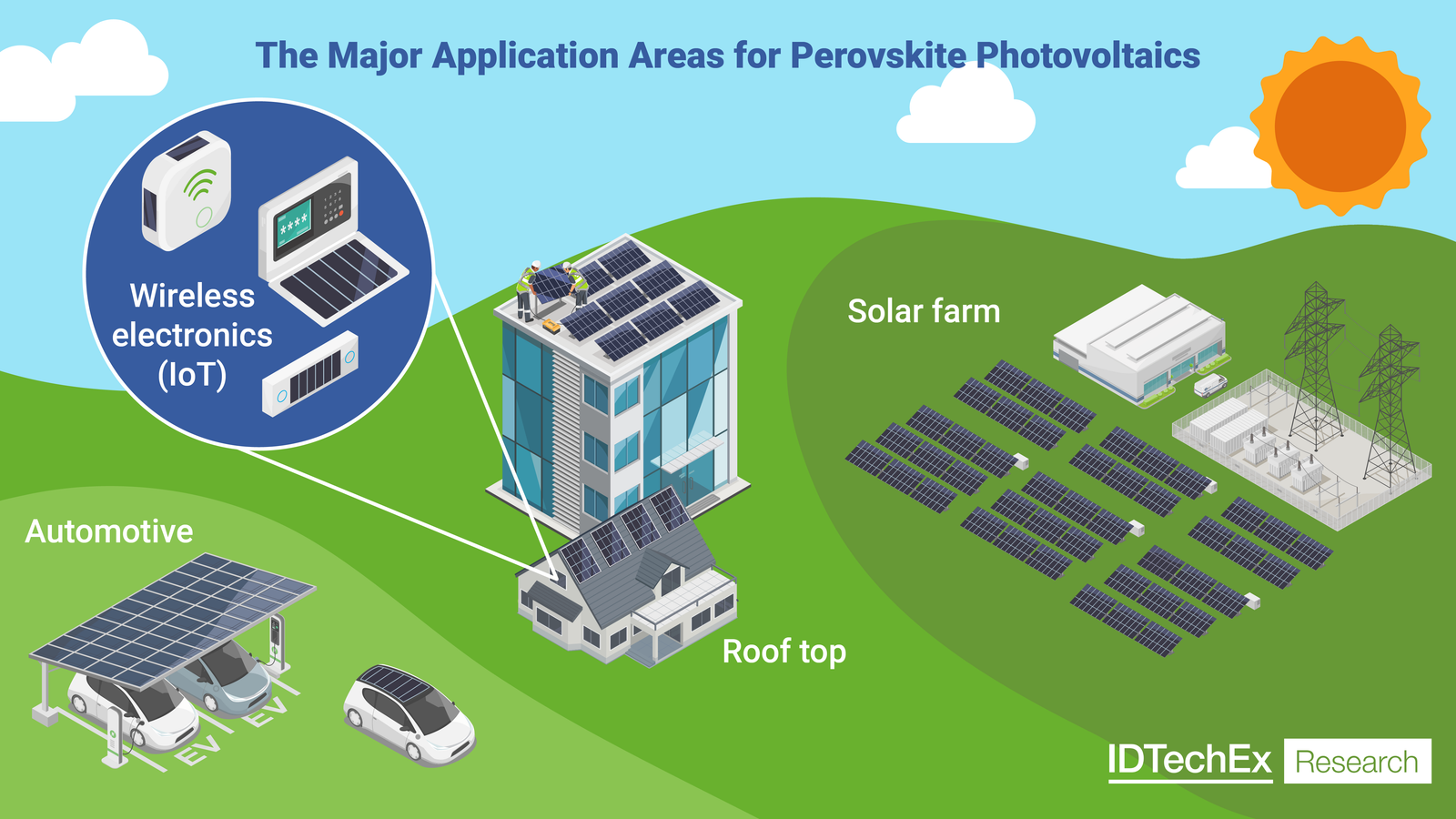
CAMBRIDGE, UK, July 1, 2026 (PR) - Perovskite photovoltaics (PV), one of the most promising next-generation solar technologies, is entering a new phase of development as the industry’s focus shifts from achieving record laboratory efficiencies to overcoming the challenges of large-scale commercial deployment, according to a new report by research firm IDTechEx.
The report, Perovskite Photovoltaics 2027–2037: Technologies, Markets & Trends, highlights growing confidence in perovskite solar cells, driven by strong government support, increasing private investment, and the global transition toward low-carbon energy systems.
Perovskite solar technology has attracted worldwide attention over the past decade because of its rapid improvements in power conversion efficiency, compatibility with conventional silicon solar cells through tandem cell architecture, and its potential for low-cost manufacturing using solution-based thin-film processes.
However, IDTechEx says the industry’s priorities are evolving. While efficiency improvements remain important, successful commercialization now depends on several critical factors, including manufacturing scalability, production yields, supply chain development, cost competitiveness, and long-term environmental sustainability.
The report notes that manufacturers are increasingly focused on scaling production from small laboratory cells to large-area commercial modules without sacrificing performance or reliability. Ensuring stable supplies of specialized materials and developing effective recycling solutions—particularly for lead-containing perovskite materials—are also emerging as key industry priorities.
According to IDTechEx, the global market for perovskite photovoltaics is unlikely to develop uniformly. Different regions are pursuing different commercialization strategies based on national energy policies, manufacturing capabilities, and market requirements. While some countries are prioritizing high-efficiency perovskite-silicon tandem modules for utility-scale solar farms, others are investing in flexible and lightweight perovskite modules for building-integrated solar systems and distributed energy applications.
The report identifies several high-growth application areas where perovskite technology could offer significant advantages over conventional silicon panels. These include building-integrated photovoltaics (BIPV), low-load-bearing rooftops, vehicle-integrated photovoltaics (VIPV), indoor energy harvesting for Internet of Things (IoT) devices, agrivoltaics, roadside and noise barrier solar installations, aerospace applications, and utility-scale solar generation.
Looking ahead, IDTechEx forecasts strong growth in the perovskite PV market over the next decade, supported by continued technological advances and expanding commercial deployment. The study provides market forecasts through 2037 across nine application segments and three major technology categories—single-junction, tandem, and flexible perovskite modules.
The report concludes that perovskite photovoltaics are approaching a pivotal stage in their evolution. While technical and commercial challenges remain, continued innovation and targeted investment could enable the technology to become a major contributor to the global renewable energy transition during the coming decade.