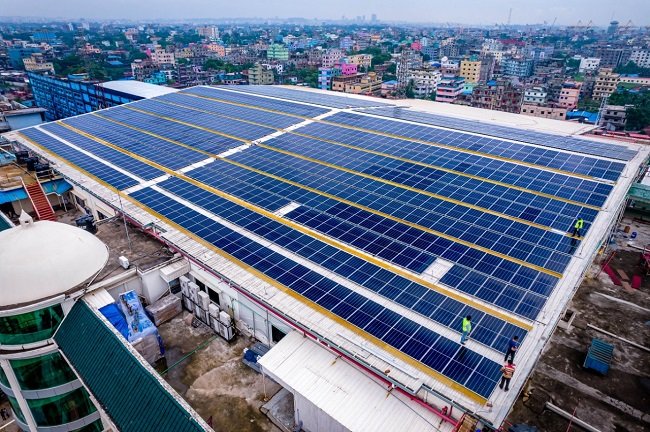
Bangladesh has proposed a zero-percent import duty on solar power equipment in the FY2026-27 national budget, marking what experts describe as a significant policy shift to accelerate renewable energy deployment, reduce dependence on imported fossil fuels, and strengthen long-term energy security. Report BSS
The proposal, unveiled by Finance and Planning Minister Amir Khosru Mahmud Chowdhury, seeks to eliminate import duties on solar equipment until 2035 and introduce a 5% tax rebate for consumers paying solar electricity bills. The measures are expected to substantially lower the cost of solar installations and encourage investment across residential, commercial, industrial and agricultural sectors.
Presenting the budget, the finance minister said the government considers renewable energy a key pillar of Bangladesh’s future energy strategy.
“The government has set a target of meeting 20 percent of the country’s electricity demand from renewable sources by 2030, with the long-term goal of increasing the share to between 30 and 50 percent by 2050,” he said.
As part of the strategy, Bangladesh plans to install around 10,000 MW of solar power capacity by 2030, alongside promoting rooftop solar systems and renewable energy use in industries and agriculture.
The policy comes as Bangladesh faces growing pressure from rising energy import costs. More than 40% of the country’s electricity generation currently depends on natural gas, while declining domestic reserves have increased reliance on imported liquefied natural gas (LNG), coal and petroleum fuels.
Industry stakeholders say import duties, VAT and other taxes—reaching up to 67% on solar panels, inverters, batteries and related equipment—have significantly increased project costs, discouraging investment in the sector. The proposed duty exemption is expected to make solar systems more affordable for businesses and households.
Alongside tariff reductions, the government is also considering incentives to promote local manufacturing of solar panels, batteries, inverters and other renewable energy equipment, a move expected to create jobs and strengthen domestic industrial capacity.
According to the Sustainable and Renewable Energy Development Authority (SREDA), Bangladesh currently generates around 1,805 MW of renewable electricity, including 1,512 MW from solar power, making solar the country’s largest renewable energy source.
Engineer Ataur Rahman Sarkar Rozel, Secretary General of the Bangladesh Sustainable and Renewable Energy Association (BSREA), welcomed the government’s recognition of the renewable energy sector but said broader support is needed.
“While the proposed budget recognizes the importance of the renewable energy sector, it does not fully reflect the expectations of all stakeholders. To accelerate rooftop solar expansion, taxes should be reduced to zero for all products used by investors, importers and small consumers, alongside appropriate financial incentives,” he said.
Energy expert Dr. Ijaz Hossain, former professor at Bangladesh University of Engineering and Technology (BUET), described the proposed tax reduction as a long-awaited reform.
“Reducing taxes and tariffs on solar equipment is a highly positive decision. This type of policy support has long been demanded but was never implemented by previous governments. If introduced, it will boost investment in solar energy and significantly accelerate the country’s renewable energy transition,” he said.
He added that expanding renewable energy is critical not only for electricity generation but also for strengthening energy security, protecting the environment and supporting sustainable economic growth.
Experts believe Bangladesh can further accelerate its solar expansion by complementing the tax incentives with easier access to financing, wider implementation of net metering, incentives for domestic manufacturing and faster project approvals. They also point to Pakistan’s recent success in expanding rooftop solar through supportive fiscal policies as a model worth considering.