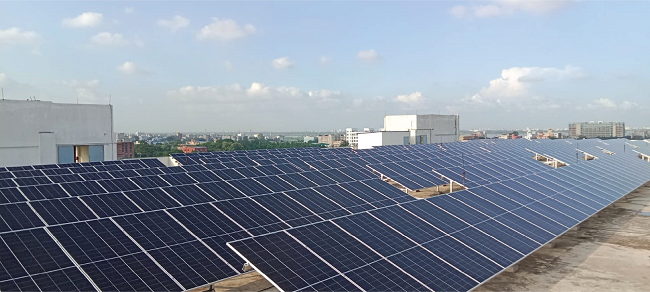
Dhaka, July 10, 2026: The University Grants Commission (UGC) has launched a major initiative to expand rooftop solar power generation across Bangladesh’s public universities, aiming to reduce electricity costs and promote clean energy through private sector investment.
According to a UGC press release issued on Friday, the initiative was discussed at a review meeting on rooftop solar power installations held at the Commission on Thursday.
Under the first phase of the program, around 60 MW of rooftop solar capacity is planned for 31 public universities through an Operational Expenditure (OPEX) model, under which private investors will finance, install, operate and maintain the solar systems.
UGC said feasibility studies have already been completed at 47 public universities and one international university. The assessment identified the potential to generate 52.5 MW of rooftop solar power at 31 public universities, with the capacity expected to increase to nearly 60 MW through future infrastructure expansion.
The Commission noted that while the current cost of solar electricity generation is around Tk 15 per unit, the OPEX model could reduce the cost by more than half.
Presenting the findings, Professor Dr. M. Shamsul Alam of Daffodil International University said a pilot project under the OPEX model produced solar electricity at Tk 7.50 per unit, with the tariff expected to decline further to Tk 7.00 as project capacity expands.
He also highlighted regional comparisons, noting that solar tariffs stand at approximately Tk 3.69 per unit in India and Tk 3.93 per unit in Pakistan. With supportive policies, rationalized duties and tax incentives, Bangladesh could reduce rooftop solar generation costs to around Tk 6.50 per unit, he added.
UGC Chairman Professor Dr. Mamun Ahmed said the proposed financing model would eliminate the need for upfront government investment, as private companies would be responsible for financing, installation, operation and maintenance. Universities would only pay for the electricity they consume.
He added that a centrally managed procurement, monitoring and quality assurance mechanism would encourage greater private investment, reduce electricity expenditure at universities and lessen the country’s dependence on imported energy.
UGC said the OPEX model has already been successfully piloted at one university, and preparations are underway to scale up the program based on the project’s positive outcomes. So far, 14 private companies have expressed interest in investing in the initiative.
The Commission aims to reduce public universities’ dependence on grid electricity by 20 percent by 2030 while improving energy efficiency to lower overall electricity demand by 5–10 percent.