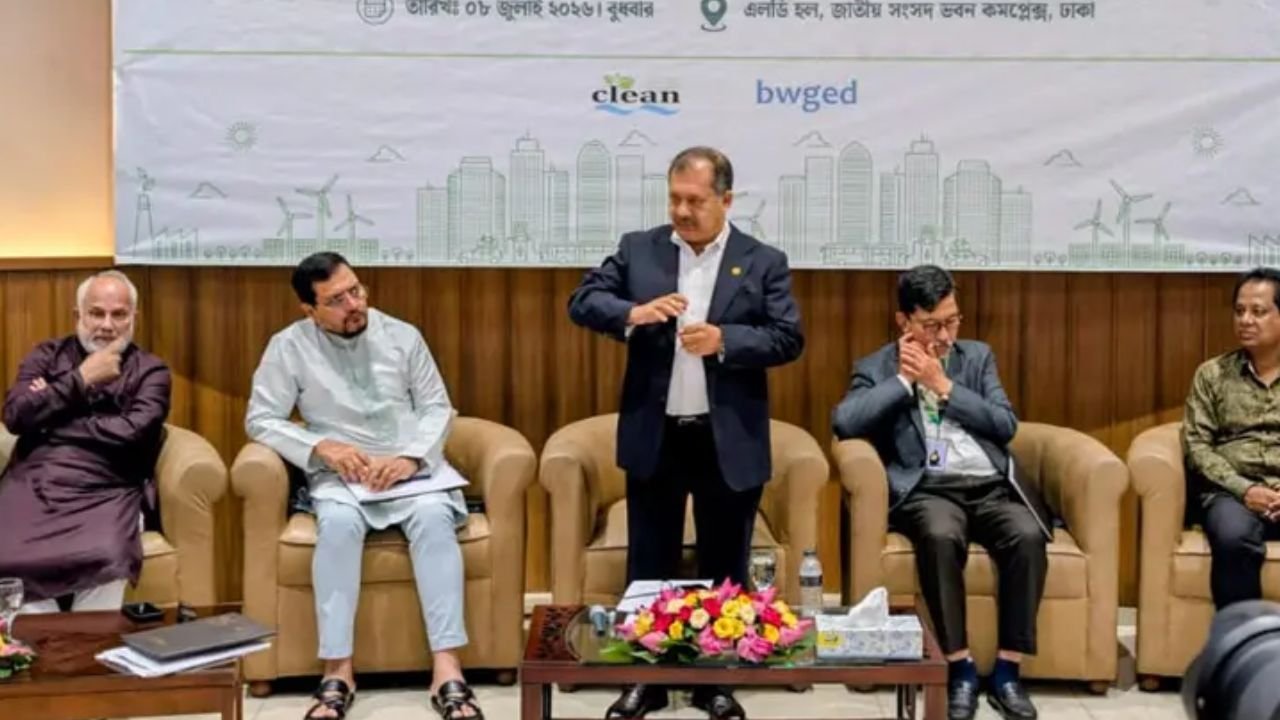
DHAKA, July 8, 2026 – Information and Broadcasting Minister Zahir Uddin Swapon has stressed the need for strong political commitment and long-term policy support to accelerate the expansion of renewable energy in Bangladesh and strengthen the country’s energy security.
He made the remarks on Wednesday while addressing a policy dialogue organized by the Bangladesh Working Group on Ecology and Development (BWGED) at the Jatiya Sangsad Bhaban.
The minister said energy security is not limited to ensuring an uninterrupted electricity supply but is also closely linked to Bangladesh’s economic independence and sustainable development. He emphasized that achieving a successful energy transition would require consistent political commitment, strategic planning and sustained investment in renewable energy.
“Expanding the use of renewable energy, particularly solar power, is essential for reducing dependence on imported fuels while enhancing the country’s economic resilience,” he said.
A study presented by BWGED at the dialogue highlighted the economic benefits of solar energy, estimating that every kilowatt of installed solar capacity could save around Tk 30,000 annually in imported fuel costs. Over the estimated 20-year lifespan of a solar power system, the cumulative savings could reach approximately Tk 550,000.
Speaking at the event, Hasan Mehedi, Chief Executive of the Center for Natural Resource Studies (CLEAN) and a representative of BWGED, said government support for rooftop solar should be viewed as a long-term investment rather than a subsidy.
He said wider deployment of rooftop solar systems would help reduce Bangladesh’s fuel import bill, improve energy security and support the country’s transition toward greater energy independence.
According to BWGED, Bangladesh will require an estimated Tk 217.5 billion annually to achieve its renewable energy targets by 2030. Of this amount, approximately Tk 67.5 billion would need to be provided by the government as direct financial support.
The organization also recommended introducing an additional 10 percent incentive for renewable energy projects led by women, Indigenous communities and marginalized groups to promote inclusive participation in the country’s clean energy transition.