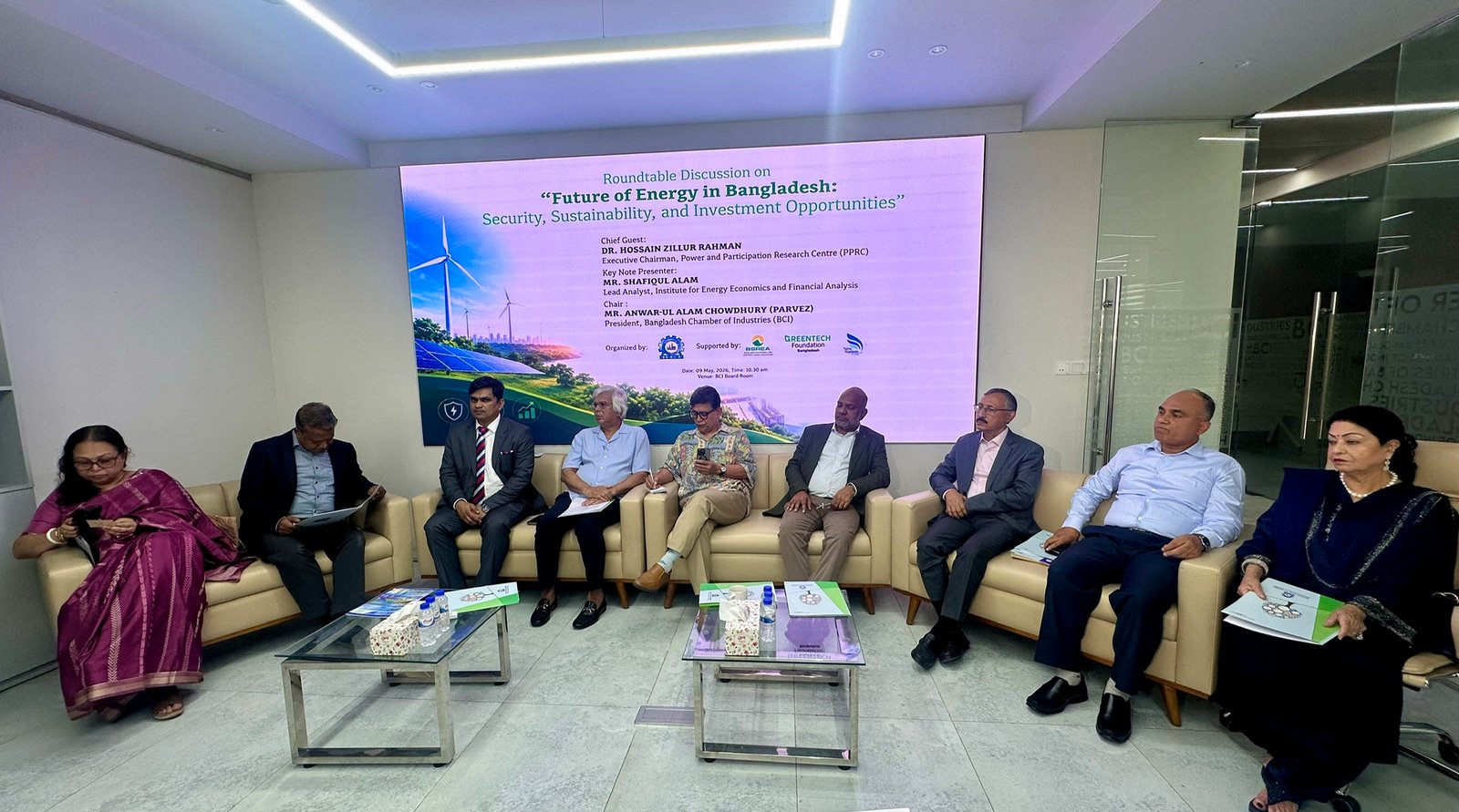
Bangladesh is not merely facing an energy crisis; it has become trapped in an energy lock-in driven by continued dependence on imported fuel and power, speakers said at a seminar on Tuesday.
They warned that unless the country uses its own energy resources in a planned way and adopts the right strategy for the energy transition, its efforts to achieve middle-income status could be put at risk.
The comments came at a seminar titled “Future of Energy in Bangladesh: Security, Sustainability and Investment Opportunities” organized by the Bangladesh Chamber of Industries (BCI). Power and Participation Research Centre (PPRC) Executive Chairman and former caretaker government adviser Dr. Hossain Zillur Rahman said Bangladesh has many good energy policies, but the real challenge is to focus clearly on what the country wants to achieve.
He said the private sector must raise its voice to help the country break out of the energy trap, and public-private partnership must be strengthened to ensure proper monitoring and implementation of decisions.
BCI President Anwar-Ul-Alam Chowdhury Parvez said the government has formed a Tk 40,000 crore fund to restart closed industries, but such initiatives will not work unless energy supply to industry is secured. He said LNG terminal installation, both floating and onshore, must be accelerated to increase gas supply, while domestic coal extraction and use should be ensured to reduce gas dependence in power generation. He also stressed the need for practical strategies to expand renewable energy use in electricity generation.
Dr. Hossain Zillur Rahman said there is no alternative to new investment in industry if Bangladesh wants to boost exports and create employment. He said a long-term price signal for energy and electricity is needed so entrepreneurs can plan future investments.
At the event, PPRC also emphasized coordinated action by the government and businesses to tackle the energy crisis. Dr. Rahman said energy security requires not only new and innovative initiatives but also greater use of energy-saving technologies.
The keynote paper was presented by Engineer Shafiqul Alam, Lead Energy Analyst at the Institute for Energy Economics and Financial Analysis IEEFA). He said Bangladesh’s dependence on imported energy and electricity now stands at 65.4 percent, up 14.8 percent from FY2021 to FY2025. During the same period, the revenue deficit in the power sector increased by 372 percent. He said expanding renewable energy can help reduce import dependence. While 33.8 percent of the world’s energy came from renewable sources, Bangladesh’s share last year was only 2.3 percent. A planned green transition away from fossil fuels, he said, would help the country.
Former senior secretary Siddique Zobair said the energy crisis has been known for a long time, but adequate action has not been taken. He said land and transmission infrastructure must be ensured for renewable energy development, along with the right policies to attract investment. That, he said, would allow the private sector to expand renewable energy more quickly.
BIPPA President David Hasnat said Bangladesh’s high electricity generation cost is mainly due to its heavy dependence on imports. He noted that, compared with India, Sri Lanka, Vietnam and Pakistan, Bangladesh’s electricity selling price is still lower, while BPDB is struggling to survive with huge subsidies. He said there is no alternative to adjusting prices in line with production costs.
He added that if coal from Phulbari alone were extracted, it could support 7,000 MW of electricity generation for 30 years, and the government should begin domestic coal extraction and use without further delay.
BGMEA Vice President Inamul Haque Khan said the garments sector currently earns about $40 billion in export revenue and aims to reach $100 billion by 2030. However, uncertainty over energy supply and high power costs are major obstacles to achieving that target. He also said buyers are pressing the sector to reduce its carbon footprint by 2030. Without proper policy support from the government, he said, the garment industry will not be able to overcome the current crisis.
BSREA President Mostafa Al Mahmud said achieving 10,000 MW of renewable energy capacity by 2030 is possible. To do so, Bangladesh should follow successful models from other countries. If the government provides land, grid access and policy support for solar power, the private sector can supply electricity at a lower cost than fossil fuels, he said.
Energy & Power Editor Mollah Amzad Hossain said that to protect industry from the gas crisis, Bhola should be connected to the national grid as quickly as possible. He also called for urgent oil and gas exploration in Chhatak and the Chattogram Hill Tracts, saying new gas discoveries could be possible within two years. For renewable energy, especially solar, he suggested inviting private investment through auctions with land and transmission support from the government. That, he said, could bring the cost of electricity below 6 cents per unit.
Others who spoke at the roundtable included Shahid Alam of BTMA, Dr. Md. Rafiqul Islam, Member (Additional Secretary) of the Bangladesh Energy and Power Research Council, and BCI Vice Chairman Priti Chakraborty.