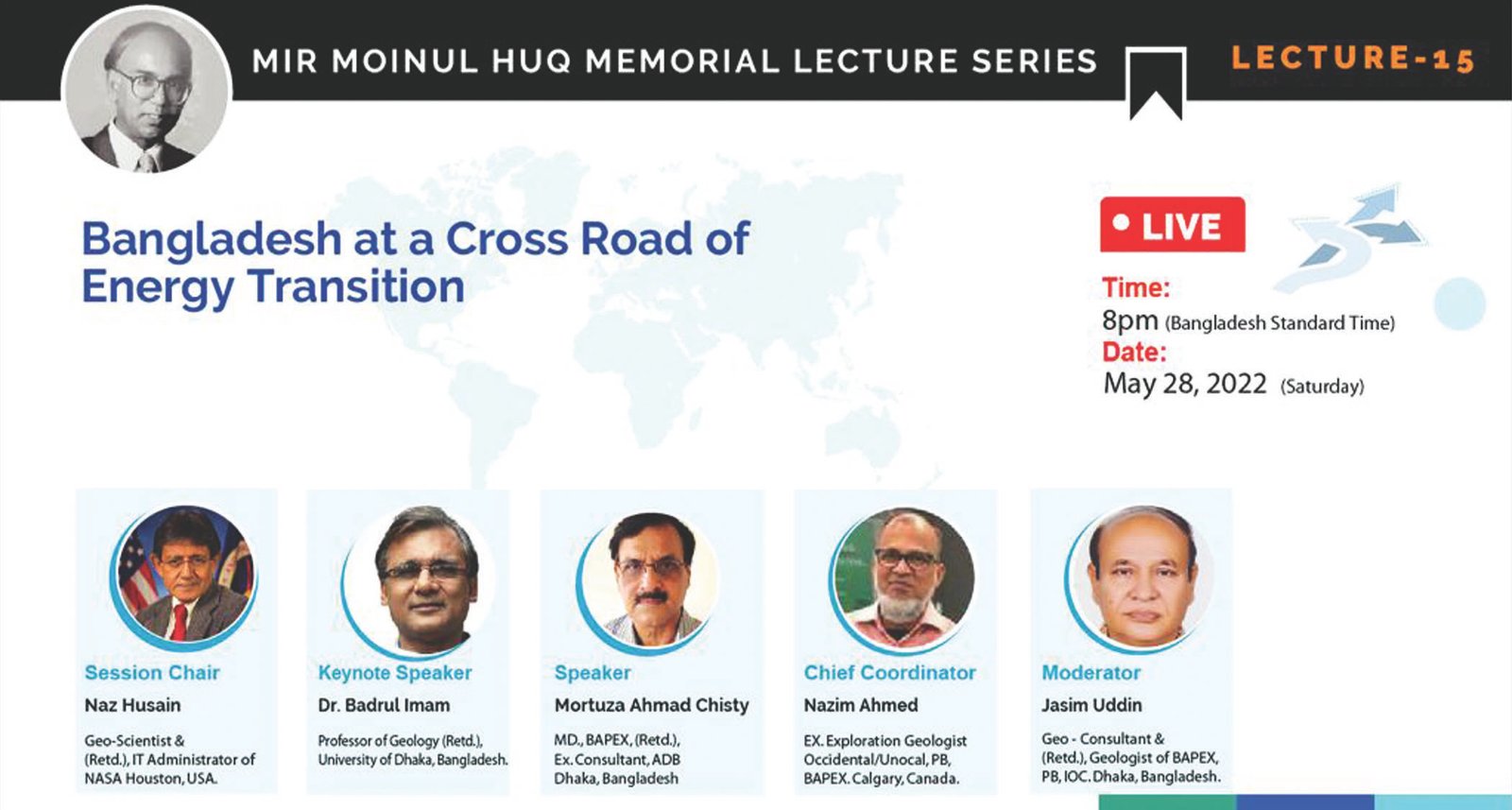
An online technical session on “Bangladesh at a Crossroads of Energy Transition” was held on 28 May 2022 under Mir Moinul Huq Memorial Lecture Series-15. In the session, about 30 geoscientists from the USA, Canada, UK, Brunei and Bangladesh attended. The session chair was Naz Husain from Houston, a retired IT Administrator of NASA. This lecture series is an integral part of remembering Moinul Huq and carrying out his devotion to exploration geology that he left behind. The moderator of the session was Md. Jasim Uddin, Ex Geologist, Petrobangla and Nazim Ahmed, Ex Geologist, acted as Chief Coordinator from Calgary.
The keynote speaker was Prof. Badrul Imam, a Retd. Professor of Geology at Dhaka University. This presentation was an overview of energy transition in Bangladesh in a holistic and a practical point of view. He discussed the prospects, problems and challenges of energy transition. He said that energy is the prime mover of industrialization and development of any country. Bangladesh is fast moving towards industrial development. He gave a briefing on total primary energy mix and commercial primary energy mix scenario of Bangladesh along with world energy transition scenario. In 1990, Prof. Peter Odell predicted that the coal, oil and natural gas will predominate in the world energy market till 2050. Competition between renewables and fossil fuels will run in by 2060. The battle will swing in favor of renewables by 2070. The renewables will almost completely take over the world energy market by 2100. The fossil fuels including coal, oil and gas will only remain in the history book thereafter. He apprised that our commercial energy transition is from almost natural gas-based mono energy with minor oil and hydro in between 2000 to 2015. Thereafter, we will proceed towards multiple energy mixing of gas, LNG, LPG, coal, oil, hydro, solar, wind, cross-border power and nuclear.
Dr. Imam discussed the challenges and alternative energy in view of meeting our energy demand. He pointed out that decreasing supply of gas from local gas fields against increasing demand is a major problem. Bangladesh imports 25% of its total gas supply as LNG which costs approx. Tk 44,000 crore per annum. Remaining 75% gas comes from local production by national companies & IOCs which cost about Tk 6000 crore per annum. He raised the appropriate question on our financial capability for LNG import and how much sustainable will it be? Apart from that, Dr. Imam opined about our indigenous gas reserve. The reserve is depleting and the remaining reserve is about 10 Tcf only which is likely to run out within 10 years provided there will not be any substantial gas discovery in the future. He suggested that a serious drive for exploring new gas reserves may change the energy future which is being contemplated. He differs on the concept that Bangladesh is running out of gas resources, saying it has no scientific merit.
Coal is another area where a major transition is taking place. There are some ongoing coal-based power plants with a total capacity of 8000 MW which are under construction. A huge amount of coal will be imported to run these plants in the near future.
Renewable energy is another area where the government has given prime importance to meet the demand of energy in the future. Bangladesh has a tremendous achievement on solar home systems as well as one of the largest off-grid solar home systems in the world. More than six million solar home systems are already installed. Total generation through solar homes is 349 MW. At present, the power generation capacity from renewables is about only 3% of the total power generation capacity. Bangladesh has a target to achieve 40% of the power generation by solar within 2041 and 10% within 2030.
The Panel Speaker was Mortuza Ahmad Faruque, a gas sector specialist and Retd. Managing Director of BAPEX discussed the supplementary and complementary issues in relation to the presentation of Prof. Badrul Imam. He emphasized on energy mix scenario for power generation along with some necessary way forward to meet our future energy demand. He apprised the meeting that the power generation capacity has increased to 25566 MW including renewables at present from 4942 MW only in 2009. It`s a great achievement made by the present government. He gave a picture on the power generation development plan, PSMP 2016.
Mr. Mortuza presented the state of regional cooperation in the power sector with neighboring countries to enhance electricity supply and meet the present and future demands of the country. At present, 1160 MW of electricity is being imported from India. Initiatives have been taken to import another 500 MW electricity from India, 500 MW hydro electricity from Nepal and 500 MW from Bhutan. A contract has been signed to import 1,600 MW from Jharkhand Coal Based Power Plants of India in 2017. As per PSMP-2016, electricity import may be reached to 9000 MW from cross-border trade in the year 2041.
To meet the growing gas demand of the country, the present government has planned to construct two land-based LNG terminals at Matarbari and Payra with a storage capacity of 8 million tonnes/year and to import 16 million tonnes of LNG per annum within 2030 and 32 million tonnes within 2041.
Mr. Mortuza briefed a scenario of discovering coal deposits in Bangladesh, coal supply projection of PSMP 2016 and sharing information about the world`s top coal producer countries. So far, there are five coal fields in Bangladesh with total estimated reserves of 3300 million tonnes. Coal is being commercially extracted through underground mining from Barapukuria since 2005 with an average annual production of 0.8 million tonnes only. Whereas, India produced 793 million tonnes of coal in 2021 and imported 215 million tonnes to meet their demand. China is the largest coal producing country and produced 3925 million tonnes in 2021.
Mortuza informed about new solar target as per Solar Energy Roadmap prepared by SREDA which is 40 GW by 2041. The target is highly ambitious and not pragmatic. Apart from this, an enormous potential of floating solar has been considered such as utilizing only one-third of the ponds can generate 15 GW of electricity, 10% of the shallow water areas could generate 25 GW, big lakes and long river pockets may add 20 GW which are also very much questionable and incredulous.
Mr. Mortuza opined that oil and gas exploration activities should be expedited in the onshore and offshore by IOCs, under JV and by BAPEX. Considering long term demand for gas, it is necessary to harness possibilities of importing piped gas from Myanmar and from the proposed Turkmenistan-Afghanistan-Pakistan-India pipeline (if constructed). To minimize import dependency on LNG & coal, the government may rethink and give priority to extract local coal through underground and open cut mining.
A question and answer session was held after the presentation, which was participated by Dr. Ahad Newaz Chowdhury (USA), Dr. Aminul Islam (Brunai), Manowar Ahmed (Ottawa), Dr. Nasir Ezaz (UK), Md. Jahangir, Saiful Chowdury, Asaduzzaman and Dr. Yunus Akon in Dhaka.