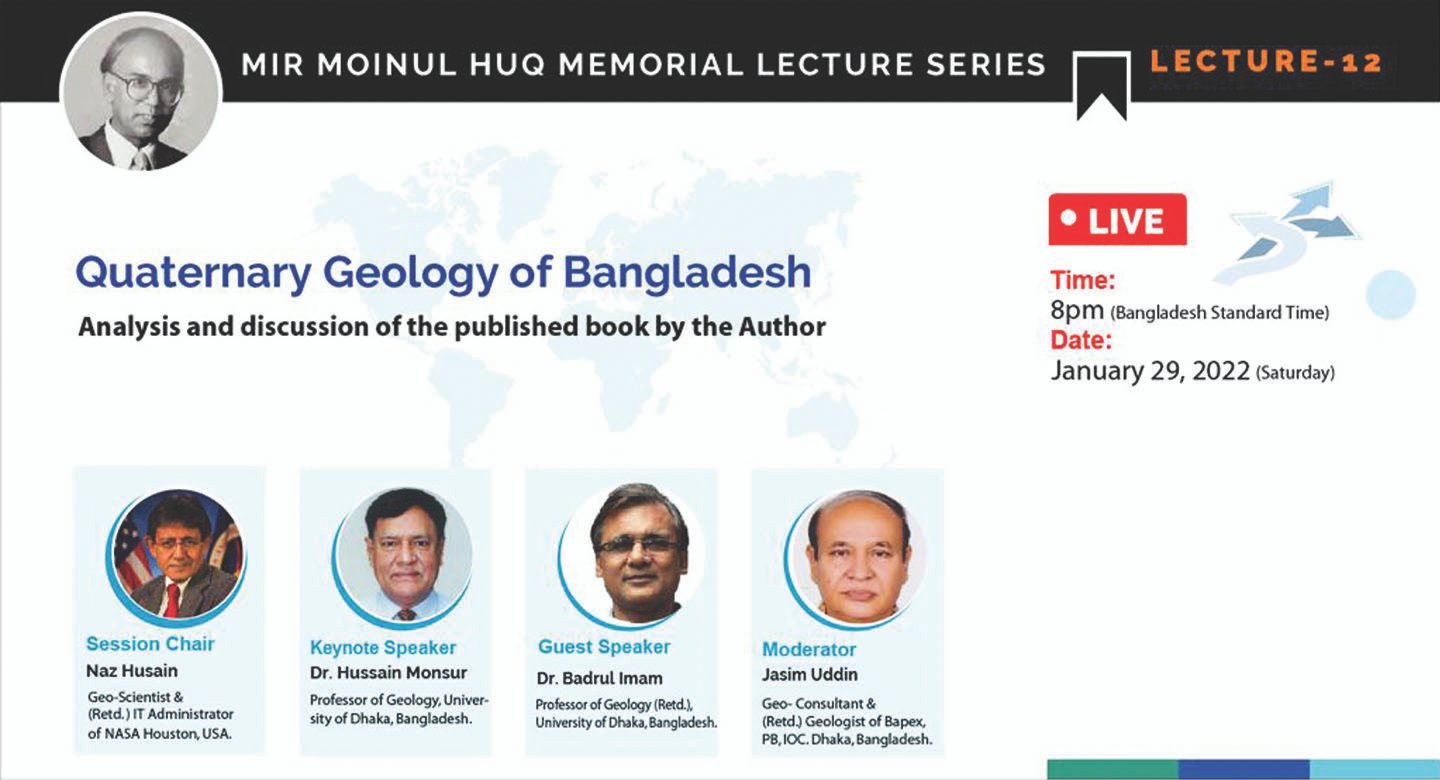
A presentation was made by Prof. Dr. Hussain Monsur on his recently published book “Quaternary Geology of Bangladesh” on 29 January 2022. This was the Keynote Speech of Mir Moinul Huq Memorial Lecture Series-12. His analysis and discussion on the book were commendable. It is an extensive research-based book and qualifies to be a text book of Quaternary Geology. Prof. Monsur is an eminent academician, researcher and a Professor of Geology Department at Dhaka University. Prof. Monsur obtained his M.Sc degree in the field of geology and mineralogy from Moscow Geological Prospecting University. He was awarded second M.Sc and D.Sc degree in Quaternary Geology from Free University of Brussels. He carried out his Post Doctoral research on the sea level changes in the Kingston University of London.
.jpg)
In the technical session, about 45 geoscientists participated from the USA, Canada, Norway, UK, Brunei, Australia and Bangladesh. The session chair was Naz Husain who joined from Houston. The moderator was Jasim Uddin, Ex Geologist, Petrobangla and Nazim Ahmed acted as Chief Coordinator from Calgary.
This is the first publication of a comprehensive research-based text book on the Quaternary Geology of Bangladesh. This book is a major step forward to end the stalemate on the Quaternary Geology studies in Bangladesh. Prof. Monsur has carried out extensive field works on Quaternary sections in various parts of Bangladesh. His extensive field-based experience has been the key to his idea of writing this book.
Quaternary is the latest period in the Geological Time Scale. It is the final episode in the earth`s geological history covering only 2.5 million years. It has been subdivided in the two Epochs: Pleistocene and Holocene. The climatic change and human evolution are the striking characteristics of the Quaternary. Human evolution is the evolutionary process that led to the emergence of anatomically modern humans. The climatic deterioration is marked by repeated Glacial and Interglacial cycles which strongly influenced the mountains and their environment.
Bangladesh covers the major part of the Bengal Basin, one of the largest deltas in the world. A thick sequence of Quaternary deposits is exposed that preserves the evidence of most recent geological history covering only 1.5 million years.
Prof. Monsur started a new dimension in Quaternary research in Bangladesh. This book is composed of the basics, fundamentals and details of Quaternary geology of Bangladesh. It describes the concepts and development of the Quaternary geology, the basic geological framework, stratigraphic divisions and sedimentary succession of Bangladesh. It includes Quaternary geology and depositional history of different areas in Bangladesh such as Madhupur, Sylhet, Mymensingh, Panchagarh, Barind tract, and Chalanbill.
The earth witnessed its past through many tectonic movements, glaciation, de-glaciation, sea level changes and consequently has reached its present state through many physical, geomorphological, structural, stratigraphic and biological changes. The Quaternary period is the history of the earth when the earth became the feature for its physical condition and biodiversity.
Prof. Monsur tried to correlate the Quaternary deposits exposed in Bangladesh, West Bengal and Kathmandu Valley in Nepal. Quaternary deposits are exposed extensively in the Bengal basin, Odisha, Bihar and Kathmandu Valley. Most of the Bengal Basin represents a prograding delta and is covered by Pleistocene and Holocene fluvio-deltaic sediments, eroded from the Himalayan Mountain ranges.
Prof. Monsur has made every effort to illustrate geological matter in a simple way so that students can perceive it at a glance. In the book, long test presentations are avoided, instead a number of images are displayed by which students can easily visualize and contemplate the theme.
This book is ornamented with a large number of good quality illustrations, nice photographs, figures, charts, diagrams, especially on the Quaternary field areas in Bangladesh. The quality of binding and the book cover have made the book more attractive. It’s a high quality international standard of publication considering its every aspect. The author has enriched the book with a lot of figures, clear sketches, bright pictures etc.
Prof. Monsur presented and discussed every chapter of the book in the session. The subject matter of each chapter is organized with introduction on basic principles. This book contains fundamental aspects of the Quaternary geology in the context of Bangladesh. He outlined the quaternary features of different physiographic and stratigraphic units of Bangladesh and described their environment of deposition.
Chapter-1 describes the Quaternary Concept and Development which includes Climatic characteristics of the Quaternary, climatic changes, Glacial and Interglacial Periods, Sea Level Changes, Changes of relief and landscapes, Development of Glacial Theory etc. Chapter-2 deals with Plate Tectonics, Tectonic setup and a brief stratigraphic succession of Bengal basin. The breakup of the Gondwana Land, north-eastward travel of the Indian Subcontinent and its collision with the Tibetan Plate, rise of Himalayas, close up of the Tethys Sea and formation of the Bengal Basin happened over a long geological time. All the events were related to plate tectonics. The tectonics process involves the creation of a new shape of the landscape. The tectonics is a process that controls the structure and properties of the earth`s crust and its evolution through geological time.
Chapter-3 describes physiographic subdivisions of Bangladesh which includes the river and drainage system of the country. Detailed descriptions of areas like Madhupur, Sylhet, Mymensingh, Panchagarh, Barind Tract and Challanbill area with characteristic Quaternary deposits in Bangladesh, have been described in chapter four to nine. Chapter-10 discusses the Quaternary monsoon climate and depositional history with a new concept on erosional and depositional history of Madhupur Tract.
Chapter-11 discusses the aspect of paleosoils. Paleosoils are soils that formed in the past on portions of land surfaces that were sufficiently stable for variable length of time to receive and retain imprints of soil forming factors. Chapter-12 brings forward the application of palynology. Chapter-13 discusses the shorelines and elaborates on the issue of sea level changes focusing on offshore islands including Kutubdia, Moheshkhali and St. Martins. Chapter-14 discusses paleomagnetism and its application in Bangladesh while the chapter-15 pointedly offers the results of foraminifera studies in Cox`s bazar & Teknaf and its implications. Prof. Monsur has tried to correlate the Quaternary deposits exposed in Bangladesh, West Bengal and Kathmandu Valley in the last chapter-16.
Prof. Badrul Imam as a guest speaker, highly appreciated publishing a wonderful and comprehensive book on Quaternary Geology of Bangladesh. He emphasized on chapter-10 of this book which discusses the Quaternary Monsoon Climate and depositional history, which is a new concept and theme related to Mid-Holocene Monsoon Climate Episodes. The erosional and depositional history of the Madhupur surface is introduced which contradicts the conventional old ideas of Morgan & McIntine (1959) as well as the J. Fergusson (1863). Prof. Badrul also discussed Dr. Monsur`s new concept of Madhupur surface which seems to be elevated compared to the adjacent floodplain not by any tectonic or neo-tectonic effect, but by erosional activities during the Early Holocene Climatic Episode. Prof. Monsur explained his new concept with logical arguments, appropriate models and relevant photographs. Prof. Badrul believes, it is not very far that the new concept of Prof. Monsur on Madhupur surface erosional and depositional history to be established as a Monsur`s Theory.
A question-and-answer session was conducted after the presentation, where many of the participants interacted with Prof. Hussain Monsur such as Prof. Ahad Newaz Chowdhury (USA), Dr. Jurgen Lietz (Germany), Dr. Abdus Samad Azad (Dhaka), Manowar Ahmed (Dhaka), Mir Fazlul Karim (USA), Abid Lodhi (Dhaka) and Dr. Mohammed Hossain Tipu (Canada).