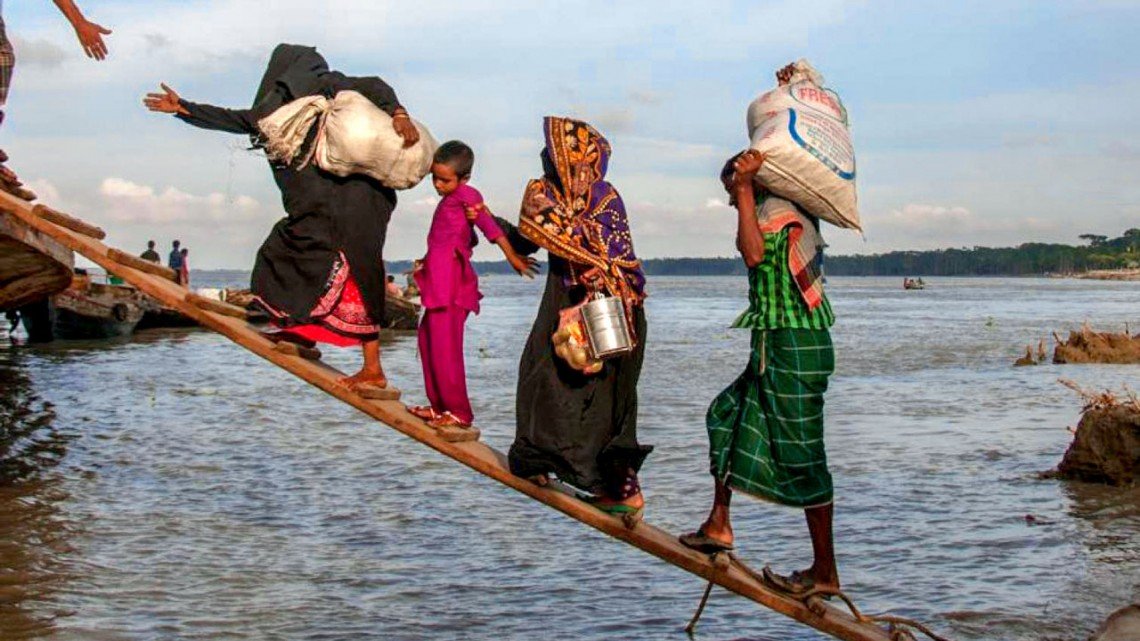
Bangladesh is exceptionally vulnerable to climate change. Its low elevation, high population density and inadequate infrastructure all put the nation in harm’s way, along with an economy that is heavily reliant on farming.
Because of the country’s natural susceptibility to extreme weather, the people of Bangladesh have always used migration as a coping strategy. However, as conditions intensify under climate change, more people are being driven from their homes and land by more frequent and severe hazards. Sea level rise, storms, cyclones, drought, erosion, landslides, flooding and salinization are already displacing large numbers of people.
Two-thirds of Bangladesh is less than five metres above sea level.
28% of the population of Bangladesh lives on the coast, where the primary driver of displacement is tidal flooding caused by sea level rise.
By 2050, with a projected 50 cm rise in sea level, Bangladesh may lose approximately 11% of its land, affecting an estimated 15 million people living in its low-lying coastal region.
The process of salinisation has been exacerbated by rising sea levels. Coastal drinking water supplies have been contaminated with salt, leaving the 33 million people who rely on such resources vulnerable to health problems such as pre-eclampsia during pregnancy, acute respiratory infections and skin diseases.
Agriculture, the mainstay of the Bangladeshi economy, is also badly affected and crops damaged by rising salinity are doubly at risk from the resulting soil degradation. Many regions have already suffered large yield losses and significant price reductions as a result.
In addition to these impacts, coastal regions are suffering increasing frequency and severity of tropical storms, which cause loss of human life, damage to houses, property and infrastructure, and disruption of agriculture and other livelihoods.
In 2016 there were four cyclones – Roanu, Kyant, Nada and Vardah – in the Bay of Bengal, whereas usually there is only one.
Nazmul Huque, an assistant meteorologist, said: “This year, the quantity of signals [storm warnings] was more than any other year in the Bay of Bengal. Two or three depressions occur normally, but this year there were seven or eight, and four cyclones.”
Riverbank erosion is the primary cause of climate displacement inland. Up to 50% of those now living in Bangladesh’s urban slums may be there because they were forced to flee their rural homes as a result of riverbank erosion.
Those who live on Bangladesh’s river islands, known as chars, are especially at risk. Located within some of the world’s most powerful river systems, chars can be formed or completely eroded over weeks or even days. The population of these islands, who the government of Bangladesh refers to as “immediately threatened”, exceeds four million.
River flooding is also a cause of displacement inland, and along with erosion is likely to become more significant under climate change, as rainfall both increases and becomes more erratic, and the melting Himalayan glaciers alter river flows.
Rainfall patterns change, the drier north-western regions of Bangladesh are at risk of drought, which drives people away through destruction of crops and disruption of livelihoods. While not currently a major factor in displacement, this risk is expected to rise as climate change progresses.
Landslides, also induced by increasingly erratic rainfall, affect the hilly north-eastern and south-eastern regions of Bangladesh and can cause displacement by destroying homes and property, and disrupting agriculture.
As with drought, landslides are not currently a primary cause of displacement, but they are predicted to become more severe and frequent as a result of climate change.
The women of Bangladesh are among the first to face the impacts of climate change, and their suffering is disproportionate. In the cyclone disaster of 1991, for example, 90% of the 140,000 people who died in the country were women.
As for women in many other countries, Bangladeshi women have less access to land, resources and decision-making than men, and their wages are lower, making it harder to survive post-displacement.
Women who migrate are often at risk of trafficking. The Indian anti-trafficking charity Prerana has said that the number of women being trafficked from Bangladesh to Mumbai brothels is rising. “The increased numbers dovetail with increased migration from Bangladesh, and migrants are particularly vulnerable to traffickers,” said Priti Patkar, co-founder of Prerana.
In the event of a disaster such as a cyclone or a flood, Bangladesh is sealed on three sides by India, and some may be left with nowhere to go.
Governments must ensure that the development of legal protections and actions are migrant-centred, human-rights based and gender-responsive within a system of global migration governance.
The EU to initiate the creation of an inter-agency taskforce to coordinate the work of the multiple bodies in the Commission, such as Environment, Climate Action and Migration and Humanitarian Affairs, in order to drive a more effective and integrated approach into wider international responses to climate change.
[The writer is indebted to Environmental Justice Foundation for this article]