The ocean’s surface covers a little about 70 percent of the earth surface. It is world’s largest solar energy collector and energy storage system. On an average day, 61 million square kilometers of tropical seas zone collect solar radiation equal in heat content close to 250 billion barrels of oil. If one tenth of one percent of this stored solar energy could be converted into electric power, it would possible to supply more than 20 times equivalent to the total amount of electricity consumed in the United State (263 million inhabitants) on one day.
Mankind has its ability to conquer the forces of nature, and learned to utilize these forces to serve its needs. Energy technology is certainly one of the most important factors in the emergence of Mankind as most dominant species of this planet. The invention of the practical steam engine by James Watt brought about development of large factories, steamships and the steam locomotive. First wood was used, then coal. About the same time, the use of coal instigated advances in metallurgy, which brought about large quantities of cheap steel and copper. This period was the beginning of the Industrial Revolution. Petroleum from natural seepage has been used since ancient times for lighting, lubrication and waterproofing. The introduction of drilling for oil greatly increased the supply of oil. The Industrial Revolution switched into high gear. One problem is that the natural seepage is limited and in a few years the elements will be exhausted. The development of nuclear power was touted as the answer to all of Mankind’s energy woes. It not really turned out that way. The Urals Catastrophe, the Three Mile Island problem, Chernobyl and Fukushima disaster have brought home the risk involved. In addition, government subsidies for nuclear power plants may not be quite unaffordable. When it become so bad no insure in the world will write disaster insurance for nuclear power plant.
The concept of OTEC (Ocean Thermal Energy Conversion) has existed for over a
century as fantasized by Jules Verne in 1870 and conceptualized by French physicist, Jacques Arsene d’ Arsonval, in 1881. But an operating OTEC power facility was not developed until the 1920’s.
What Is OTEC?
OTEC, Ocean Thermal Energy Conversion is an energy technology that converts solar radiation to electric power. OTEC systems use the ocean’s natural thermal gradient, consequently the temperature difference between the warm surface water and the cold deep water below 600 meters by about 20° C, an OTEC system can produce a significant amount of power. The oceans are thus a vast renewable resource, with the potential to help us produce billions of Watts of electric power. The cold seawater used in the OTEC process is also rich in nutrients and it can be used to culture both marine organisms and plant life near the shore or on land.
The total influx of solar energy into the earth is of thousands of times as great as Mankind’s total energy use. All of our coal, oil and natural gas are the result of the capture of solar energy by life of the past. There have been many projects for harnessing solar energy, but most have not been successful because they attempt to capture the energy directly. The problem with this is that huge collectors must be deployed to do this, and resulting in large costs. The Idea behind OTEC is that it uses natural collectors that are sea instead of artificial collectors.
How Does It Work In Real Life?
Warm water is collected on the surface of the tropical ocean and pumped by a warm water pump. The water is pumped through the boiler, where some of the water is used to heat the working fluid, usually propane or some similar material. If it is cooler you can use a material with a lower boiling point like ammonia. The propane vapour expands trough a turbine which coupled to a generator that generating electric power. Cold water from the bottom is pumped through the condensers, where the vapour returns to the liquid state. The fluid is pumped back into the boiler. Some small fraction of the power from the turbine is used to pump the water through the system and to power other internal operations, but most of it is available as net power
Different Kind of OTEC Power Plants
a) Land-Based Power Plant:
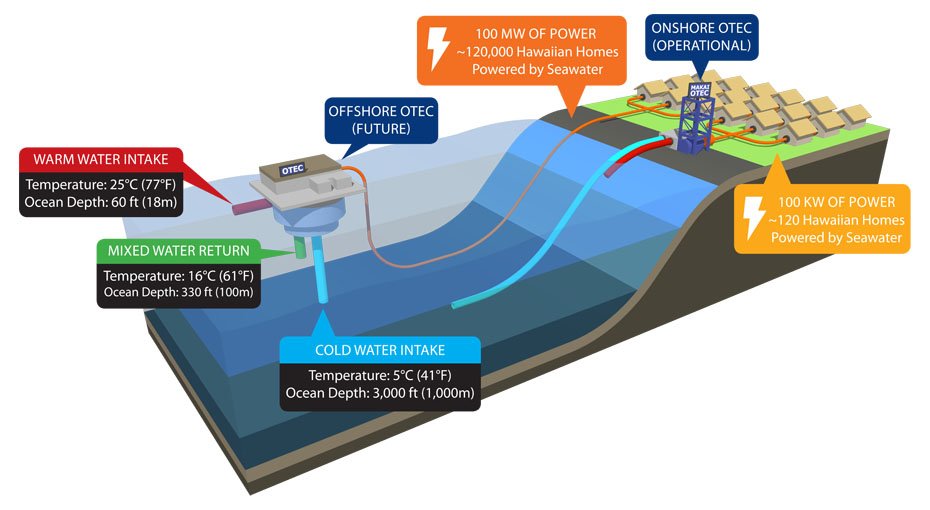
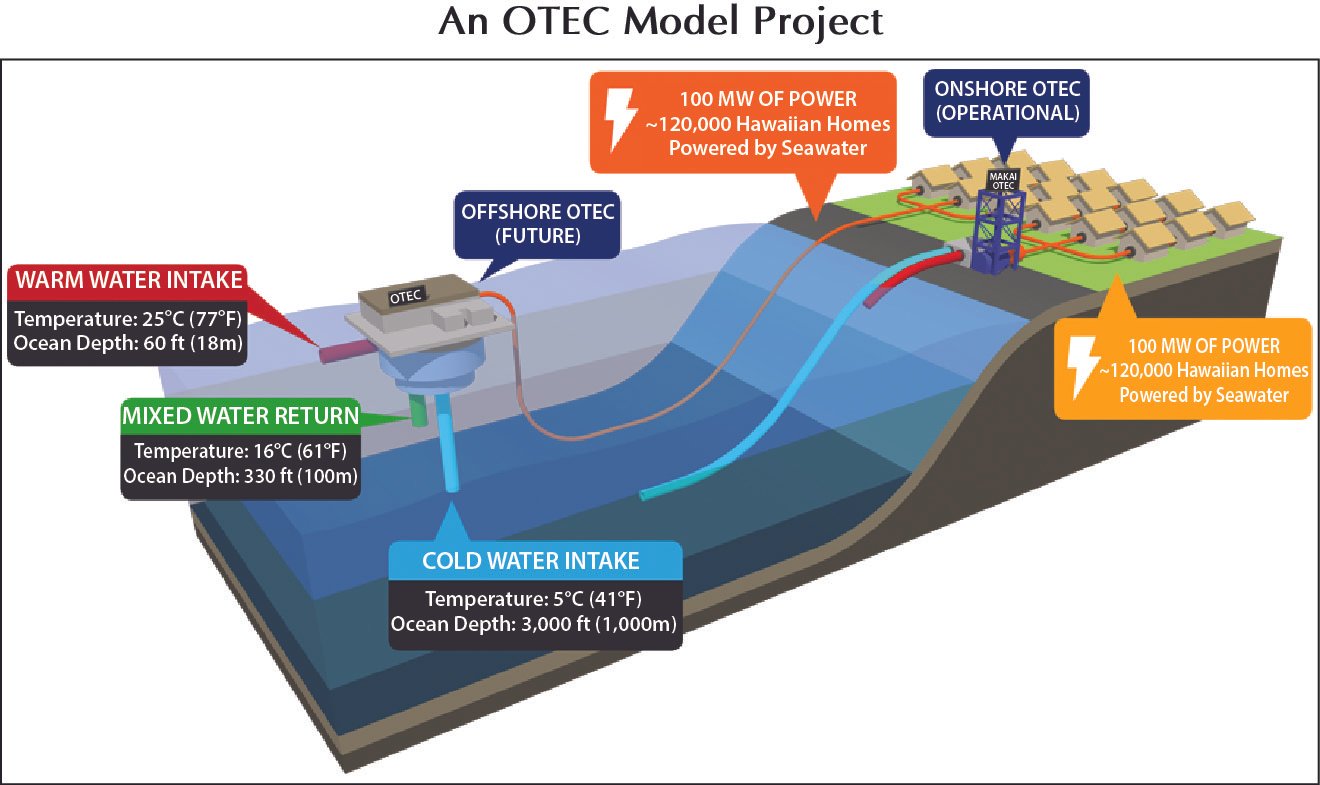
The land based pilot plant will consist of a building. This building will contain the heat exchangers, turbines, generators and controls. It will be connected to the ocean via several pipes, and an enormous fish farm by other pipes. Warm water is collected through a screened enclosure close to the shore. A long pipe laid on the slope collects cold water. Power and fresh water are generated in the building by the equipment. Used water is first circulated into the marine culture pond (fish farm) and then discharges by the third pipe into the ocean, downstream from the warm water inlet. This is done so that the outflow does not reenter the plant, since re-use of warm water would lower the available temperature difference.
b) Floating Power Plant:
The floating power plant works in the same way as the land based the apparent difference is that the floating plant is floating.
Different Types Of OTEC Systems
a) Closed-Cycle OTEC System
The closed-cycle system uses a working fluid, such as ammonia, pumped around a closed loop, which has three components: a pump, turbine and heat exchanger (evaporator and condenser). Warm seawater passing through the evaporator converting the ammonia liquid into high-pressure ammonia vapour. The high-pressure vapour is then fed into an expander where it passes through and rotates a turbine connected to a generator. Low-pressure ammonia vapour leaving the turbine is passed through a condenser, where the cold seawater cools the ammonia, returning the ammonia back into a liquid.
b) Open-Cycles OTEC System
The open-cycle system is generally similar to the closed-cycle system and uses the same basic components. The open-cycle system uses the warm seawater as the working fluid. The warm seawater passing through the evaporator ② is converted to steam ③ which drives the turbine/generator. After leaving the turbine ⑤, the steam is cooled by the cold seawater to form desalinated water. The desalinated water is pure fresh water for domestic and commercial use.
c) Hybrid OTEC System
The hybrid system uses parts of both open-cycle and closed-cycle systems to produce electricity and desalinated water. In this arrangement, electricity is generated in the closed cycle system and the warm and cold seawater discharges are passed through the flash evaporator and condenser of the open-cycle system to produce fresh water.
Plant Design & Location
The location of a commercial OTEC plant has to be in an environment that is stable enough for an efficient system operation. The temperature differential at the site has to be at least 20°C (680F). Generally the natural ocean thermal gradient necessary for OTEC operation is found between latitudes 20 degrees north and 20 degrees south.
Land-based OTEC plants do not require a sophisticated mooring system, lengthy power cables and more extensive maintenance as required with open ocean environment. In addition, the land-based sites allow OTEC to be associated with industries such as agriculture and those needing cooling and desalinated water.
The offshore or floating OTEC plant is another option. There are a number of difficulties with such a facility as it is difficult to stabilize the platform. The need for lengthy cables to deliver power and extra transportation to access the plant is a added expenses. The plant is also more susceptible to damage especially during storms.
OTEC Economics
OTEC power will be cost effective if the unit cost of power is comparable with other power plants such as wave, hydro and diesel. However, it is important that all capital costs and ongoing maintenance/service costs are included so that the individual technologies are compared on a level playing field. Work carried out by Dr Luis Vega and his team in Hawaii has shown that for plants of the 1 MW range, the unit cost is considered competitive.
Advantages & Disadvantages
Advantages
1. OTEC uses clean, renewable, natural resources. Warm surface sea water and cold water from the ocean depths replace fossil fuels to produce electricity.
2. Suitably designed OTEC plants will produce little or no carbon dioxide or other polluting chemicals.
3. OTEC systems can produce fresh water as well as electricity. This is a significant advantage in island areas where fresh water is limited.
4. There is enough solar energy received and stored in the warm tropical ocean surface layer to provide a major amount of present human energy needs.
5. The use of OTEC as a source of electricity will help reduce the country’s almost complete dependence on imported fossil fuels.
Disadvantages
1. OTEC-produced electricity at present would cost more than electricity generated from fossil fuels at their current costs.
2. OTEC plants must be located where a difference of about 20º C occurs year round. Ocean depths must be available fairly close to shore-based facilities for economic operation. Floating plant ships could provide more flexibility.
3. No energy company will put money in this project because it only had been tested in a very small scale.
4. Construction of OTEC plants and lying of pipes in coastal waters may cause localized damage to reefs and near-shore marine ecosystems.
Achievements, The Need For Further Development & The Current Status of The OTEC Technology
Since Jacques D’Arsonval’s idea of tapping the thermal energy of the ocean in 1881, OTEC system development ranges from a 22 kW, gross power, plant in 1930 to a record 255 kW, gross power (103 kW, net power) plant which also produces 23 litres (6 gallons) of desalinated water per minute.
Some of the areas currently being considered in the research and development of OTEC are:
● The improvement of the heat transfer coefficient for heat exchanges over a period of
time; and
● The development of new materials for the cold water pipe. Apart from being able to
withstand the marine conditions, the materials should provide for easy fabrication and
deployment.
The State of Chennai, India is preparing to build and test a 1 MW floating plant offshore. The Sea Solar Power Inc. of USA proposed some 100 MW floating plants around the world including a 10 MW pilot plant in Guam. Currently the bid for funding these proposals has been unsuccessful. Research in OTEC is still being pursued by the Japanese who funded a major symposium on OTEC and Deep Ocean Water Applications (DOWA). The Taiwanese government has a long interest in OTEC with Taipei being the home to the international OTEC/DOWA (IOA). Saga University of Japan is working on research and technological development for power generation by OTEC. The university plans to build an OTEC plant in the future.
Conclusion
Using the temperature difference in the oceans is not a new idea. People have been talked about this for over hundred years. Since fossil fuels will in the near future be consumed, so we had to find some alternative energy sources. OTEC is a source, which uses the renewable solar collector the sea, instead of an artificial collector. This can in the future be an alternative to the nuclear power and the fossil fuels. This invention is still expensive than the fossil fuel based power plants, and it will take more time before investor will put some money in this kind of project and outrival the now existing plants. To develop a sustainable energy solution for coastal regions of Bangladesh we should conduct regular research locally or jointly with international partners. The motivation is as long as the sun heats the waters of the oceans, the potential for power conversion though OTEC will always remain an attractive option.
Saiful Huque;
IE Dhaka University