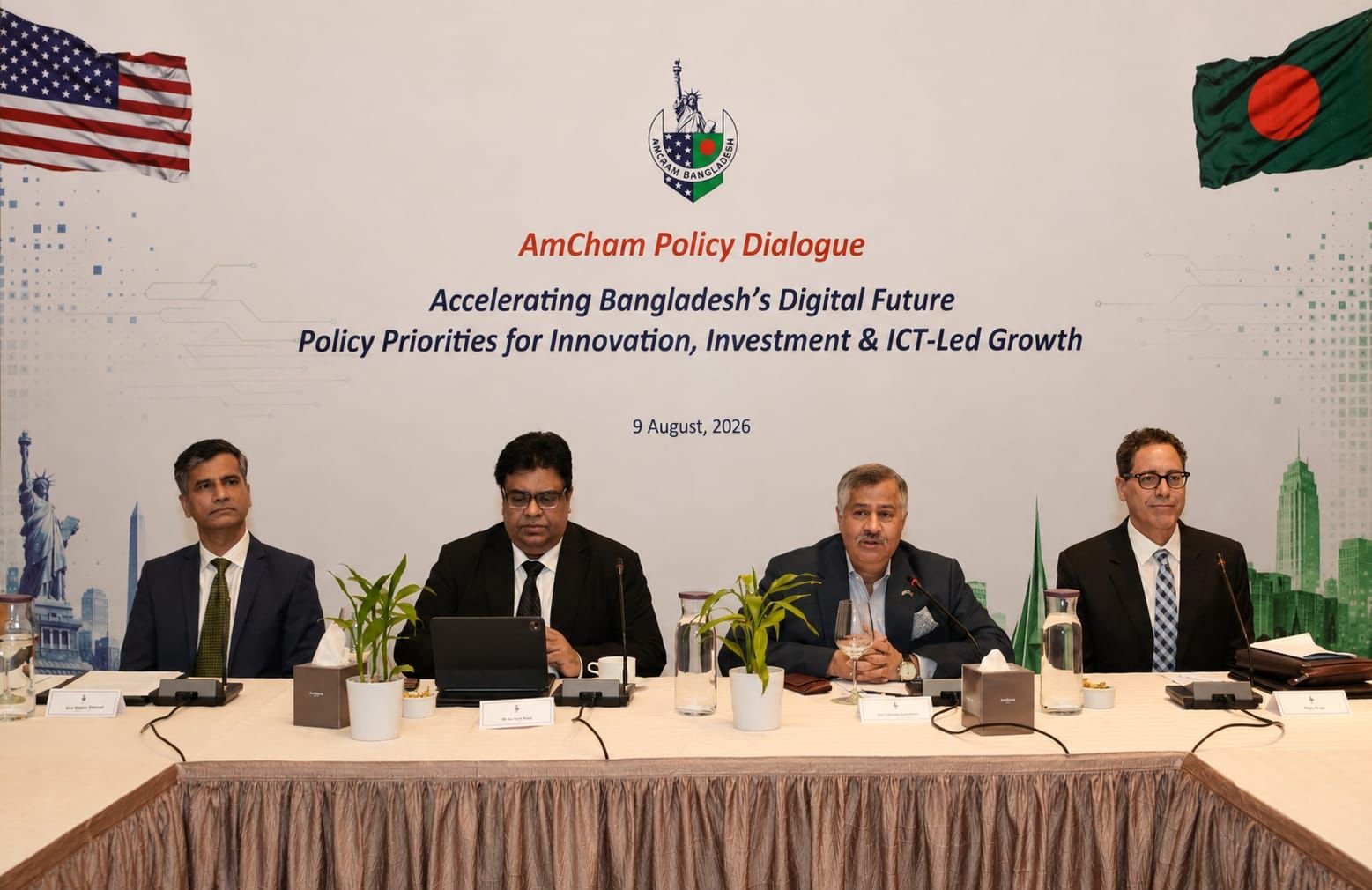
DHAKA, Aug 9, 2026: The American Chamber of Commerce in Bangladesh (AmCham) has called for stronger government-industry collaboration to accelerate Bangladesh’s digital transformation, with a focus on innovation, cybersecurity, digital infrastructure, talent development and efficient governance.
AmCham made the call at a policy dialogue titled “Accelerating Bangladesh’s Digital Future: Policy Priorities for Innovation, Investment & ICT-Led Growth”, held at The Westin Dhaka on Sunday. Prime Minister’s Adviser on Post, Telecommunications, ICT, Science and Technology Rehan Asif Asad attended the event as chief guest.
In his opening remarks, AmCham President and Mastercard Vice President Syed Mohammad Kamal welcomed the government’s ratification of the Personal Data Protection Act (PDPA), saying it reflected many of AmCham’s recommendations. He also welcomed tax and customs measures introduced in the Finance Act 2026 benefiting freelancers, content creators and digital technology-related imports.
Kamal called for greater clarity on the new digital permanent establishment provision, reconsideration of the increase in ISP turnover tax and easier international payment arrangements for technology companies and startups. He also urged greater participation of foreign investors in policymaking and national business forums.
Rehan Asif Asad outlined five government priorities for the ICT and telecommunications sector: predictable policies and taxation, improved connectivity, digital public infrastructure, development of AI and cybersecurity skills, and electronics manufacturing.
He said the government plans to develop a “One Citizen, One ID, One Digital Wallet” system based on Estonia’s X-Road model. The initiative is expected to connect citizens’ digital identities with financial and government services.
The adviser also stressed the need to develop AI-ready talent by equipping Bangladesh’s engineering and science graduates with skills in artificial intelligence, cybersecurity and data science, while introducing these subjects into school curricula.
He said Bangladesh also has significant potential to develop an electronics manufacturing industry through incentives similar to those that helped transform Vietnam’s consumer electronics sector.
The dialogue, moderated by AmCham ICT Subcommittee Chair Rubaba Dowla, focused on four areas: building a competitive digital economy, developing trusted digital infrastructure, accelerating AI and innovation, and strengthening government-industry cooperation.
Representatives of leading ICT and financial-sector companies raised issues including international payment connectivity, digital signatures, cloud services, cybersecurity, data governance, open-loop ticketing, startup taxation and the shortage of AI and data engineering professionals.
Responding to the concerns, the chief guest said RFID-based automated toll collection is being tested and that Bangladesh Bank has agreed to begin opening Bangla QR for inward international payments. He also said the “One Citizen, One ID” platform would be open to both domestic and international payment networks.
He identified national cybersecurity as an immediate priority and said work on a national AI policy would begin in the fourth quarter through collaboration among government, industry, academia and researchers.
The adviser also highlighted the need to expand Bangladesh’s submarine cable capacity. He said current capacity of around six terabytes is insufficient against peak national demand of about 12 terabytes, with traffic doubling roughly every two years.
The dialogue concluded with a call for sustained public-private cooperation to build a secure, innovative and investment-friendly digital economy in Bangladesh.
The event was attended by AmCham executive committee members, ICT-sector representatives, U.S. Embassy officials and other stakeholders. Cisco supported the program.