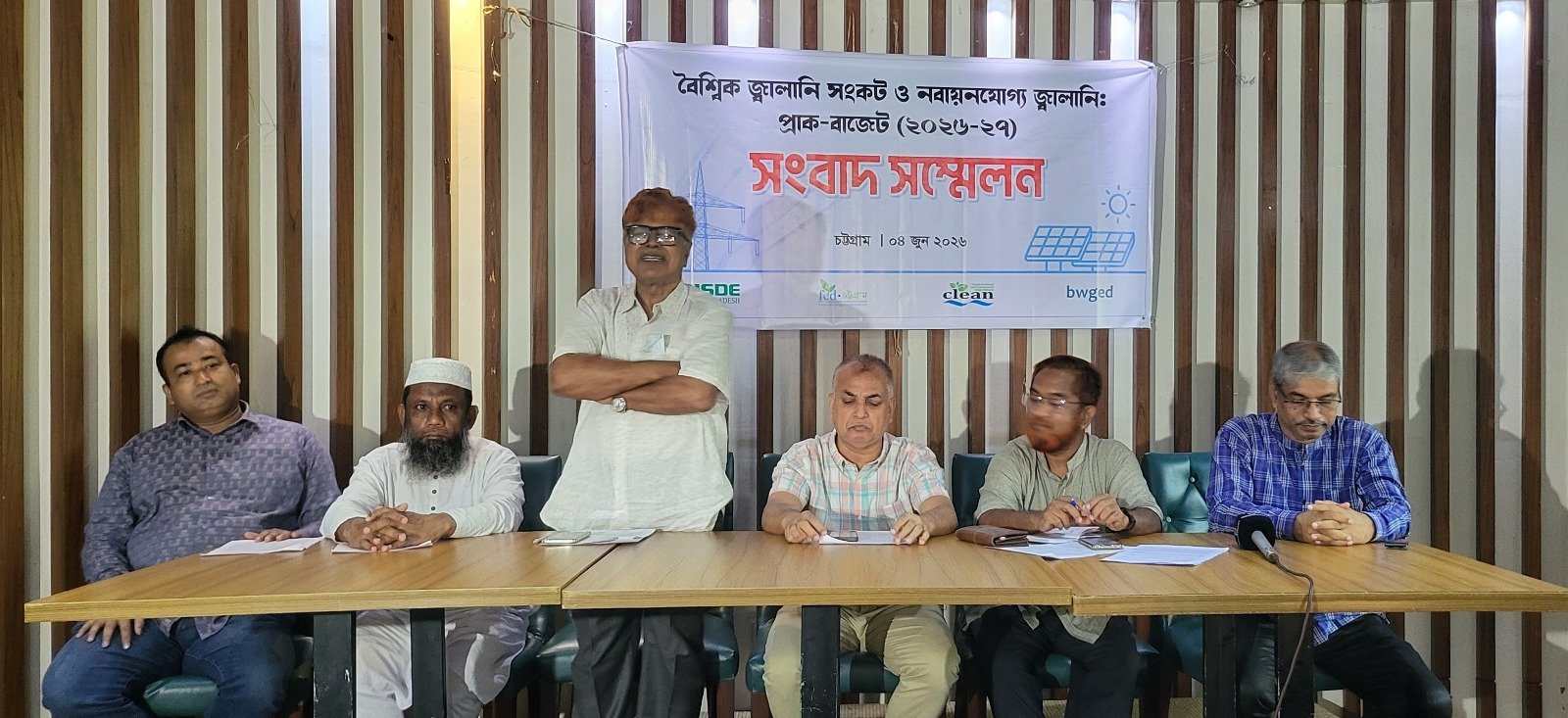
Chattogram, June 4, 2026: Environmental and consumer rights organizations have urged the government to give top priority to renewable energy in the upcoming FY2026-27 national budget, citing growing global energy market volatility, rising fossil fuel costs, and Bangladesh’s long-term energy security needs.
The demand was made at a pre-budget press conference titled “Global Energy Crisis and Renewable Energy: Pre-Budget Dialogue for FY2026-27”, organized by the Centre for Natural Resource Studies and Advocacy (CLEAN), ISDE Bangladesh, and the Bangladesh Working Group on Ecology and Development (BWGED) in Chattogram on Thursday.
The event was chaired by Prof. Dr. Khaled Misbahuzzaman, President of Poribesh Protibesh Forum-Chattogram and Professor at the Institute of Forestry and Environmental Sciences, University of Chittagong. The keynote presentation was delivered by SM Nazer Hossain, Vice President of the Consumers Association of Bangladesh (CAB) and Executive Director of ISDE Bangladesh.
Speakers warned that Bangladesh’s heavy dependence on imported fossil fuels has increased the country’s vulnerability to international price fluctuations and geopolitical uncertainties. They noted that rising costs of oil, LNG and coal have increased electricity generation costs, subsidy burdens and overall living expenses.
Addressing the conference, Prof. Khaled Misbahuzzaman emphasized that renewable energy is essential for ensuring both climate resilience and long-term energy security. He called for increased budgetary allocations for renewable energy research, innovation, technology development and capacity building.
SM Nazer Hossain criticized longstanding policy weaknesses, excessive costs and import-dependent energy strategies, arguing that consumers are bearing the financial burden of inefficiencies in the power sector. He also highlighted persistent disparities in electricity services between urban and rural areas and called for reforms in the Rural Electrification Board (REB) and Palli Bidyut Samities (PBSs) to improve service quality.
The speakers stressed that despite Bangladesh’s significant renewable energy potential, the sector continues to contribute only a small share of total electricity generation. They identified rooftop solar, solar irrigation, agrivoltaics, floating solar systems, net metering and community-owned renewable energy projects as key opportunities to strengthen energy security, reduce foreign currency expenditure, create jobs and protect the environment.
Budget Recommendations
The organizations presented an 11-point proposal for the FY2026-27 budget, including:
• Increased budget allocation for renewable energy;
• Reduction of taxes and duties on solar panels and related equipment;
• Expansion of affordable green financing;
• Wider implementation of net metering;
• Greater use of solar energy in agriculture;
• Discouragement of new fossil fuel-based power projects;
• Modernization of the national power grid;
• Promotion of community-based energy transition initiatives;
• Reform of REB and PBS institutions;
• Establishment of a renewable energy research fund; and
• A clear roadmap and budgetary support to significantly increase the share of renewable energy by 2030.
The conference was attended by environmentalists, energy experts, academics, renewable energy entrepreneurs, students, civil society representatives and journalists.
Speakers concluded that renewable energy must be placed at the center of Bangladesh’s development strategy to ensure economic stability, energy security and a climate-resilient future.