Dhaka, 2 June 2026: The Bangladesh Energy Regulatory Commission (BERC) is expected to issue an order on Wednesday (3 June) increasing electricity tariffs at both the bulk and retail levels. According to sources familiar with the process, bulk electricity prices may rise by around 19 percent, while retail tariffs for consumers could increase by between 15 and 20 percent.
BERC sources confirmed that the proposed increase will apply to all categories of consumers, including irrigation, industrial, residential, and lifeline customers. The revised tariffs are expected to take effect retrospectively from 1 June 2026.
BERC Chairman Jalal Ahmed indicated that the tariff order could be issued on 3 June but declined to comment on the exact magnitude of the increase.
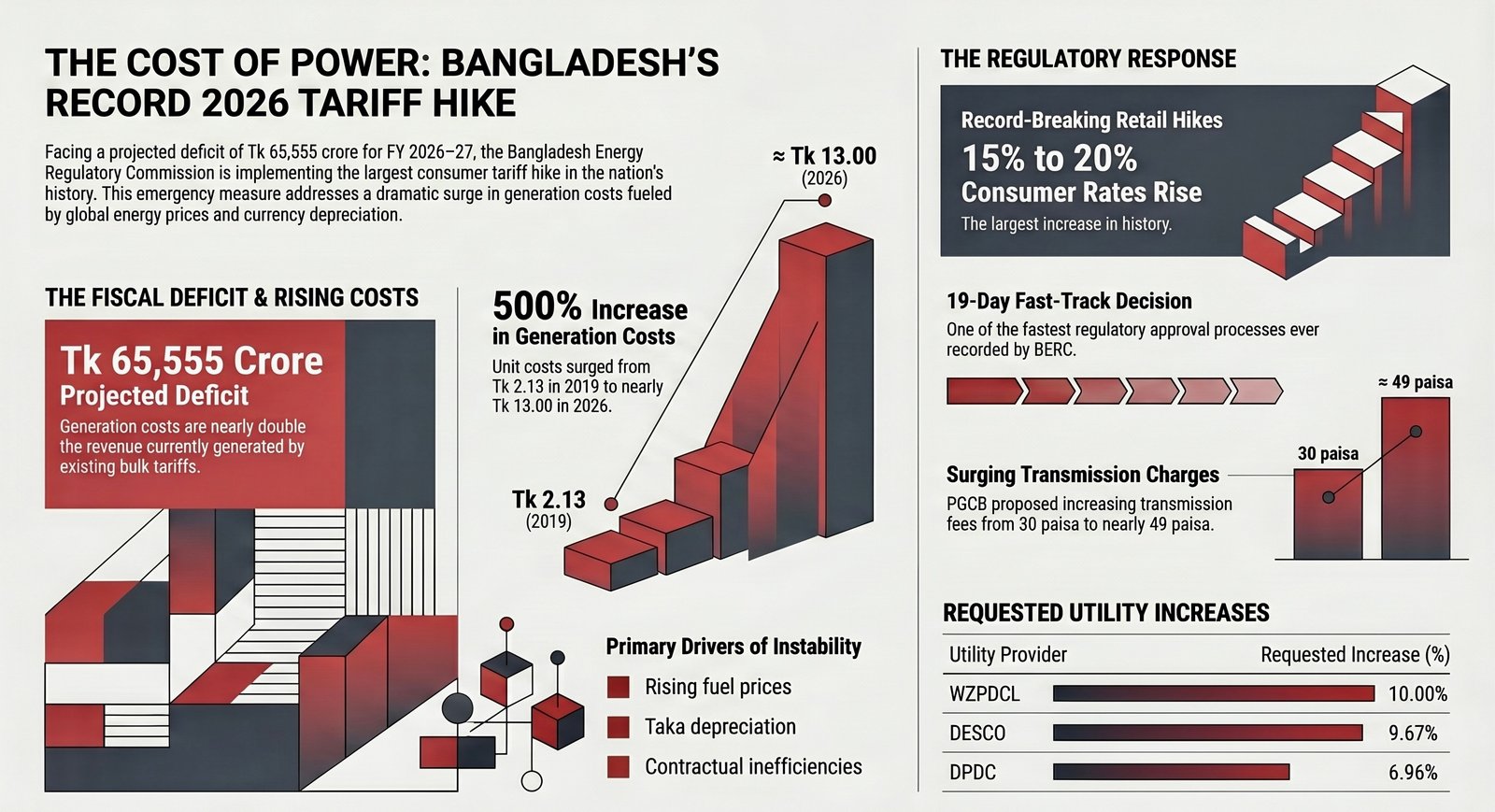
If approved, the decision will set two notable records in the country’s power sector. First, the order will have been issued within just 19 working days of the tariff application, making it one of the fastest regulatory decisions of its kind. Second, the anticipated increase at the consumer level would be the largest in Bangladesh’s history. The previous record was set on 1 December 2011, when bulk tariffs were increased by 21.46 percent and retail tariffs by 14.16 percent.
The speed of the decision-making process has also drawn attention. Public hearings on the tariff proposals were held on 20 and 21 May, leaving only four government working days between the conclusion of the hearings and the expected issuance of the order. BERC reportedly completed the evaluation and preparation process during the intervening holidays.
BPDB Seeks Higher Tariffs to Reduce Financial Deficit
The Bangladesh Power Development Board (BPDB) requested an increase of between Tk 1.20 and Tk 1.50 per unit at the bulk level, equivalent to approximately 17 to 21 percent.
According to BPDB’s submission, the projected cost of electricity generation for fiscal year 2026–27 is estimated at Tk 143,108 crore, translating into an average generation cost of about Tk 12.91 per unit. At current bulk tariff rates, BPDB expects revenue of only Tk 77,553 crore, resulting in a projected deficit of Tk 65,555 crore.
BPDB estimates that a Tk 1.20 per unit increase would reduce the deficit by approximately Tk 1,329 crore, while a Tk 1.50 increase would lower it by around Tk 1,666 crore.
The most recent electricity tariff adjustment occurred on 29 February 2024 through an executive order, which increased the average bulk tariff from Tk 6.70 to Tk 7.04 per unit. BPDB claims that due to differences in company-level sales, the effective average bulk selling price currently stands at Tk 6.99 per unit.
Rising Generation Costs
BPDB data show a dramatic increase in electricity generation costs over recent years. Average generation costs rose from Tk 2.13 per unit in fiscal year 2019–20 to Tk 3.16 in 2020–21, reaching around Tk 8.50 per unit in 2022 and approaching Tk 13 per unit at present.
The utility attributes the increase to higher fuel prices and depreciation of the Bangladeshi taka against the US dollar. However, sector analysts and energy experts have frequently cited governance challenges, contractual inefficiencies, corruption, and operational mismanagement as significant contributors to the sector’s mounting financial burden.
Distribution Utilities Also Seek Retail Tariff Adjustments
Power distribution companies have argued that current retail tariffs are insufficient to cover their operating costs and bulk purchase prices.
Among the proposals submitted to BERC:
• DESCO requested a 9.67 percent retail tariff increase.
• DPDC proposed a 6.96 percent increase.
• WZPDCL sought a 10 percent increase.
• REB requested a 5.93 percent increase.
• NESCO proposed an increase of Tk 0.03 per unit.
• BPDB’s distribution operations sought an increase of Tk 0.29 per unit.
The companies also requested additional adjustments if wholesale tariffs and transmission charges are increased.
Transmission Charges Also Likely to Increase
Power Grid Bangladesh PLC (PGCB), the country’s sole electricity transmission company, proposed raising transmission charges from 30–31 paisa per unit to 48–49 paisa per unit.
BERC sources indicate that an increase in transmission charges is also under consideration and may be reflected in the final order.
Utilities Cite Mounting Financial Losses
DESCO reported that wholesale electricity prices increased by 36.98 percent between December 2022 and February 2024, while retail tariffs increased by only 25.02 percent during the same period. The company claims losses of Tk 1,062 crore in FY2022–23 and projected losses of Tk 952 crore and Tk 596 crore in the following two fiscal years.
Similarly, DPDC reported losses of Tk 643 crore in FY2022–23, Tk 302 crore in the subsequent year, and Tk 136 crore in FY2024–25, arguing that a 6.96 percent tariff increase is necessary to restore financial viability.
The Rural Electrification Board (REB) stated that its 80 rural electricity cooperatives collectively incurred net losses of Tk 1,698 crore during FY2024–25. Without a tariff adjustment, REB projects losses could rise to Tk 2,897 crore in the current fiscal year.
No Major Change Expected in Tariff Slabs
Although several distribution utilities proposed modifications to the existing slab-based tariff structure, BERC sources suggest that significant changes to consumer categories and tariff slabs are unlikely in the upcoming order. The primary focus is expected to remain on increasing tariffs and transmission charges to address mounting sector-wide financial deficits.
The anticipated tariff adjustment comes amid growing concerns over the sustainability of Bangladesh’s power sector finances and is expected to have significant implications for households, agriculture, commerce, and industry across the country.