
The escalating conflict in the Middle East is reshaping global energy investment strategies as governments and companies respond to mounting concerns over energy security, supply chain resilience, and the reliability of international trade routes, according to the International Energy Agency’s (IEA) World Energy Investment 2026 report.
The report identifies the effective closure of the Strait of Hormuz as a major catalyst behind the current global energy crisis, marking the second major energy shock in less than five years following the disruption caused by Russia’s invasion of Ukraine in 2022. The crisis is expected to leave a lasting impact on global investment priorities, particularly across Asia and the Middle East, where disruptions to shipping routes have been felt most severely.
IEA Executive Director Fatih Birol described the situation as “the largest energy security crisis the world has ever faced,” noting that countries are increasingly seeking to diversify both energy sources and trade routes. Efforts are accelerating to expand supply infrastructure, strengthen electricity systems, increase electrification, and improve energy efficiency, while many nations are also turning toward domestically available energy resources, including renewables, nuclear power, natural gas, coal, and oil.
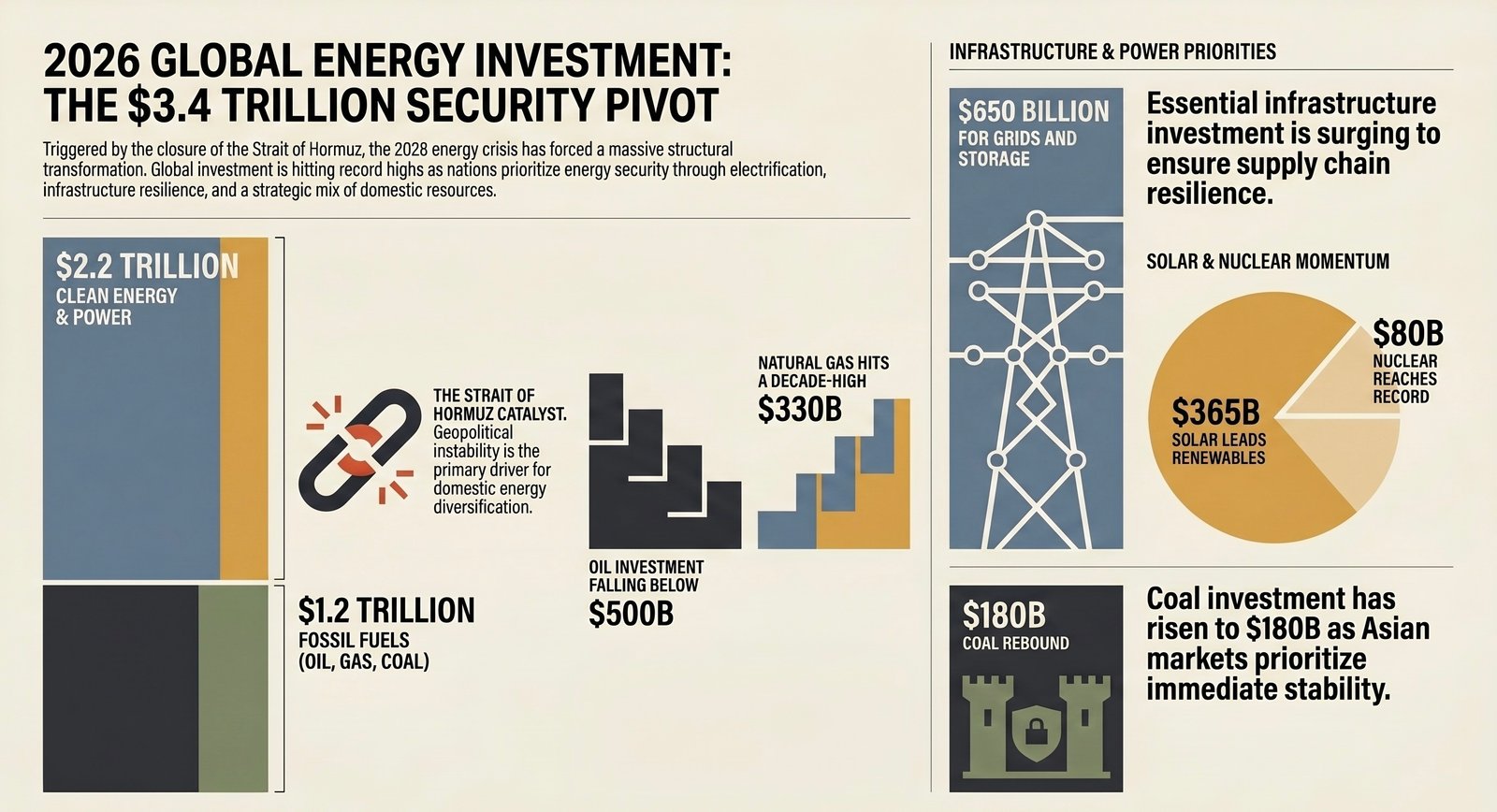
According to the report, global energy investment is projected to reach $3.4 trillion in 2026. Of this total, approximately $2.2 trillion will be directed toward clean energy technologies and electricity infrastructure, including renewables, nuclear energy, grids, battery storage, low-emissions fuels, efficiency, and electrification. Around $1.2 trillion is expected to be invested in fossil fuels such as oil, natural gas, and coal.
Despite elevated oil prices, global oil investment is forecast to decline for the third consecutive year, falling below $500 billion in 2026. The report attributes this trend to uncertainty surrounding the duration of the current price surge, long project development timelines, supply chain bottlenecks, and tightening offshore equipment markets.
In contrast, investment in natural gas is expected to rise significantly, reaching $330 billion — the highest level in a decade — driven largely by new LNG export projects in the United States and Qatar.
Renewable energy investment remains a dominant force within the global power sector. Spending on renewable power projects is projected to total approximately $665 billion in 2026, including $365 billion dedicated to solar energy alone. Low-emissions technologies are expected to account for more than 70 percent of global power generation investment.
Nuclear energy is also experiencing renewed momentum, with annual investment surpassing $80 billion and nearly 80 gigawatts of nuclear capacity currently under construction across 15 countries.
At the same time, coal investment is projected to rise to $180 billion, its highest level since 2012, with China accounting for nearly 70 percent of global coal supply spending. The report notes that several Asian countries impacted by the crisis may extend the operational life of existing coal-fired power plants in an effort to strengthen energy security.
Electricity-related infrastructure continues to dominate global energy spending trends. Investment in electricity supply and infrastructure is expected to approach $1.6 trillion in 2026, increasing to nearly $2 trillion when electrification investments are included. Spending on electricity grids alone is forecast to reach nearly $550 billion, while investment in battery storage is expected to exceed $100 billion.
The rapid expansion of artificial intelligence and data centers is also emerging as a major driver of energy investment, particularly in the United States. Demand from the technology sector contributed to record orders for new gas-fired power plants in 2025, placing additional pressure on global turbine supply chains.
The report further warns that financial market volatility linked to the Middle East conflict could complicate financing conditions for future energy projects, particularly in emerging and developing economies where capital costs are already substantially higher than in advanced economies.
The IEA concludes that the current crisis is accelerating a structural transformation in global energy investment, with energy security, diversification, electrification, and resilience becoming central priorities for governments and industries worldwide.