Dhaka, June 3, 2026 (EP Report): Despite a significant increase in electricity tariffs at the bulk, retail and transmission levels, the Bangladesh Power Development Board (BPDB) is still projected to face a financial deficit of approximately Tk 41,000 crore in fiscal year 2026-27.
The Bangladesh Energy Regulatory Commission (BERC) on Wednesday announced the first electricity tariff adjustment in 28 months, raising bulk electricity prices by 19.85 percent, retail tariffs by an average of 16.68 percent, and transmission charges by 23.96 percent.
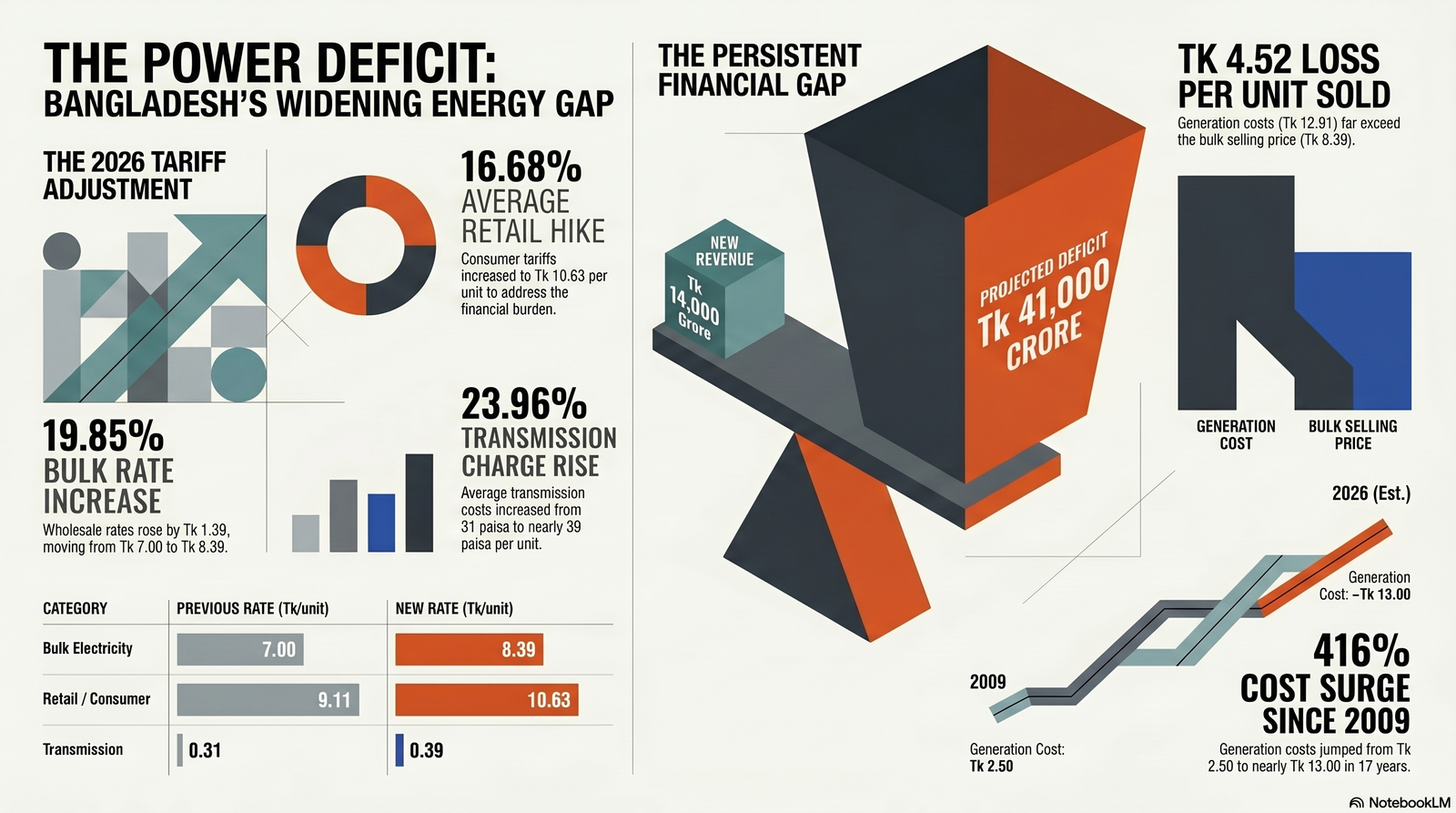
Under the new tariff order, the wholesale electricity rate has been increased by Tk 1.39 per unit, from Tk 7.00 to Tk 8.39 per unit. At the consumer level, the average tariff has risen by Tk 1.52 per unit, increasing from Tk 9.11 to Tk 10.63 per unit. The average transmission charge has also been raised from 31 paisa to nearly 39 paisa per unit.
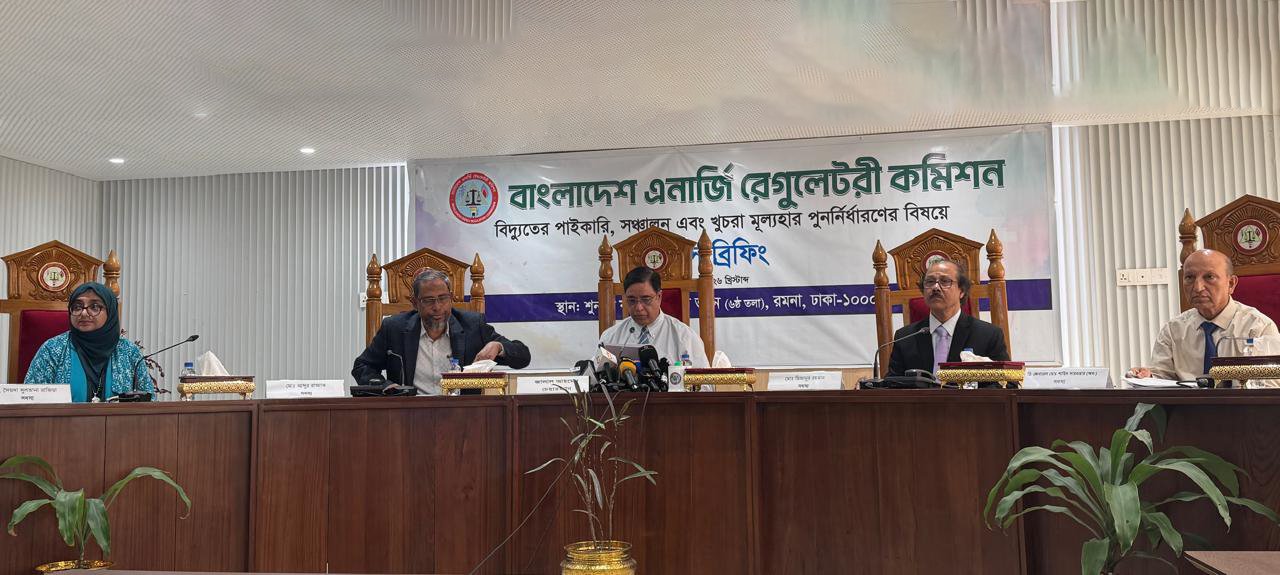
BERC Chairman Jalal Ahmed announced the new rates at a press conference, held 4 working days after the completion of public hearings on the tariff proposals. He said the decision was taken before the start of the new fiscal year to allow the government to address the power sector’s growing financial burden in the national budget.
BPDB Still Faces Massive Financial Gap
Analysis of the tariff order suggests that the Tk 1.39 per unit increase in bulk tariffs could generate approximately Tk 14,000 crore in additional annual revenue for BPDB. However, the utility is still expected to incur a deficit of around Tk 41,000 crore in FY2026-27.
According to BPDB projections, the average cost of electricity generation is expected to reach Tk 12.91 per unit, significantly higher than the revised bulk tariff of Tk 8.39 per unit. As a result, BPDB will continue to lose approximately Tk 4.52 per unit even after the latest price adjustment.
The sharp rise in generation costs highlights the long-term financial challenges facing Bangladesh’s power sector. In 2009, the average generation cost was only Tk 2.50 per unit, compared with nearly Tk 13 per unit today.
Consumer Tariffs Rise Across All Categories
At the retail level, electricity prices have been increased across all consumer categories, with hikes ranging from 15 percent to 19.94 percent.
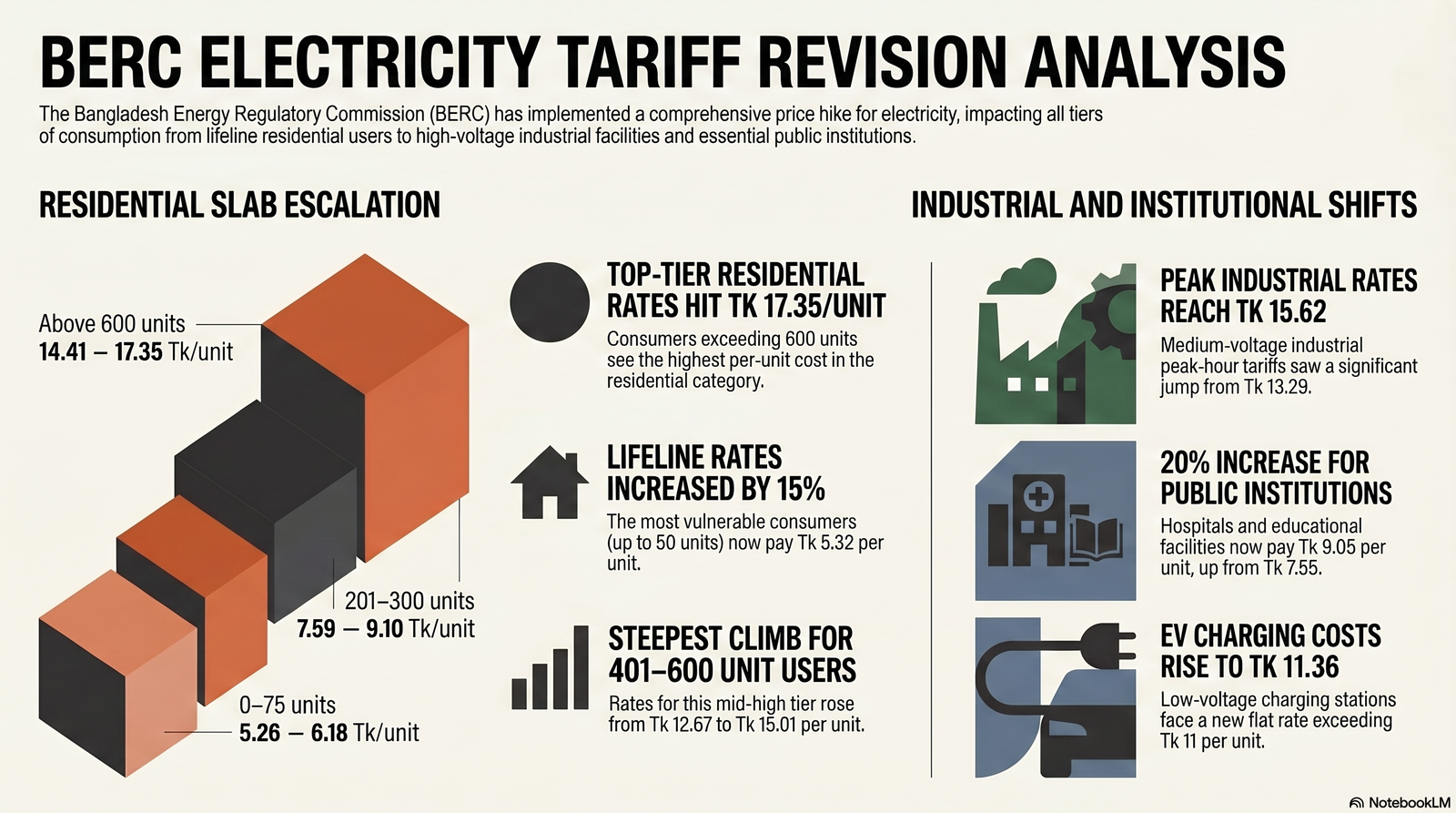
For residential lifeline consumers, the tariff has been raised from Tk 4.63 to Tk 5.32 per unit, meaning households consuming up to 50 units per month will pay roughly Tk 35 more, excluding VAT.
The Bangladesh Energy Regulatory Commission (BERC) has raised retail electricity tariffs by an average of 16.68 percent, with increases ranging from 15 percent for lifeline consumers to a maximum of 19.94 percent across different customer categories.
Revised Residential Tariffs
BERC has revised all residential tariff slabs for low-voltage consumers:
|
Consumption Slab
|
Previous Rate (Tk/unit)
|
New Rate (Tk/unit)
|
|
Lifeline (up to 50 units)
|
4.63
|
5.32
|
|
0–75 units |
5.26
|
6.18
|
|
76–200 units |
7.20
|
8.50 |
|
201–300 units
|
7.59
|
9.10
|
|
301–400 units
|
8.02
|
9.62
|
|
401–600 units |
12.67
|
15.01
|
|
Above 600 units |
14.61
|
17.35
|
Separate tariff structures have been approved for medium- and high-voltage consumers.
Medium-Voltage Industrial and Commercial Consumers
For medium-voltage (11 kV) consumers with connected loads ranging from 50 kW to 5 MW, the flat tariff has been increased from Tk 10.55 to Tk 12.50 per unit. The off-peak tariff has risen from Tk 9.50 to Tk 11.25, while the peak-hour tariff has increased from Tk 13.29 to Tk 15.62 per unit.
Agricultural Irrigation
For low-voltage agricultural irrigation consumers, the tariff has been raised from Tk 5.25 to Tk 6.04 per unit.
For medium-voltage irrigation consumers (11 kV), the flat rate has increased from Tk 6.42 to Tk 7.38 per unit, the off-peak tariff from Tk 5.77 to Tk 6.64, and the peak tariff from Tk 8.06 to Tk 9.23 per unit.
Electric Vehicle and Battery Charging Tariffs
For low-voltage electric vehicle and battery charging stations, the flat tariff has been increased from Tk 9.59 to Tk 11.36 per unit. The off-peak rate has risen from Tk 8.63 to Tk 10.22, the super off-peak rate from Tk 7.71 to Tk 9.09, and the peak-hour tariff from Tk 12.14 to Tk 14.20 per unit.
For medium-voltage (11 kV) battery charging facilities, the flat tariff has been raised from Tk 9.62 to Tk 11.31 per unit, while the off-peak, super off-peak and peak-hour rates have been set at Tk 10.18, Tk 9.05 and Tk 14.14 per unit, respectively.
Institutional and Other Consumers
The tariff for educational institutions, religious establishments, charitable organizations and hospitals under the low-voltage category has been increased from Tk 7.55 to Tk 9.05 per unit.
BERC has also approved tariff increases for residential consumers, small and large industries, commercial establishments, offices and other consumer categories.
Concerns Over Economic Impact
Responding to questions about the speed of the decision-making process, BERC Chairman Jalal Ahmed said there was no external pressure behind the tariff increase, adding that the order was finalized quickly to align with budget preparations.
He acknowledged that higher electricity prices would increase consumer expenses but said no formal economic impact assessment had been conducted prior to the tariff adjustment.
Consumer rights advocates criticized the decision, arguing that the burden of inefficiencies and financial losses in the power sector should not be passed on to consumers.
AHM Shofiquzzaman, President of the Consumers Association of Bangladesh (CAB), said proposals for addressing the sector’s deficit without imposing additional costs on consumers had been submitted during the hearing process but were not reflected in the final decision.
Energy economist M. Masrur Reaz, Chairman of Policy Exchange Bangladesh, warned that transferring the full cost burden to consumers under current economic conditions could further fuel inflation. He argued that government subsidies would still be required to manage the sector’s financial gap while protecting consumers from excessive price shocks.
The latest tariff adjustment underscores the widening gap between electricity generation costs and retail prices, raising fresh questions about the long-term sustainability of Bangladesh’s power sector financing model.