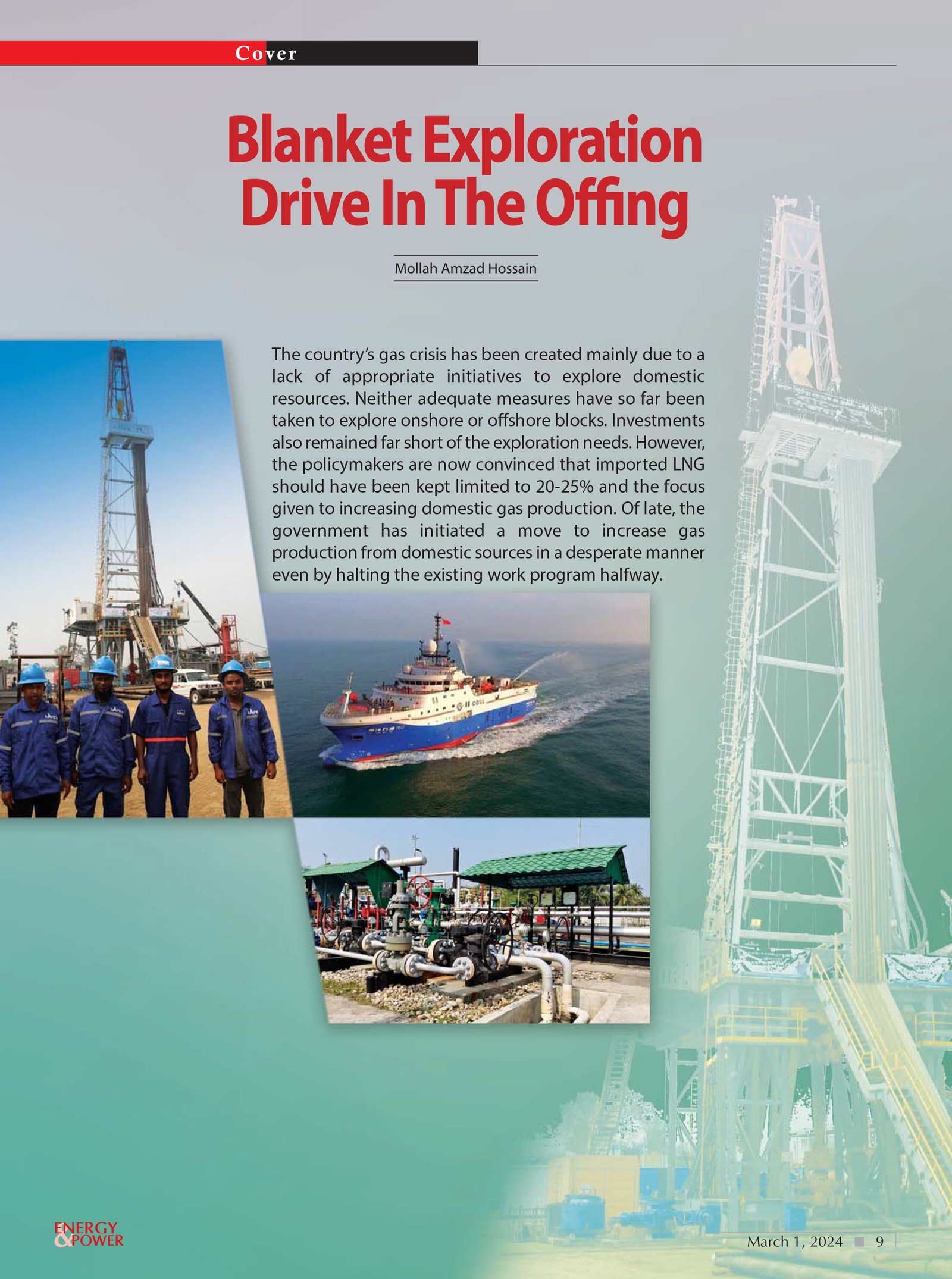
The present gas crisis is considered to be the outcrop of an absence of appropriate initiatives. Experts think preferring imported fuel to own fuel is one of the major mistakes. Earlier differed, the policymakers are now convinced that the supply of Regasified Liquefied Natural Gas (RLNG) should have been kept limited to 20-25% and the focus should have been given to increase domestic gas production. Of late, the Energy Division and Petrobangla started giving priority to increasing production from local sources and, as part of it, an existing program has been suspended halfway to initiate a fresh one to be funded from internal resources. Petrobangla is expecting to finalize the preliminary work program of seismic surveys and development by June this year. Meanwhile, the program for letting out a PSC bidding round for offshore exploration by the first week of March 2024 is now ready. It will be done based on an updated Model Production Sharing Contract (MPSC). The Energy and Mineral Resources Division (EMRD) has also taken policy decisions to attract foreign direct investment in onshore exploration considering the present situation. Accordingly, Petrobangla has started working on updating onshore MPSC while experts’ opinion on the leads it prepared. Experts, who have long been criticizing Petrobangla for its lack of taking exploration initiatives, have welcomed the latest move and cautioned that it would not be possible to execute hydrocarbon exploration by taking a business-as-usual approach like other works of the government. For this, a special strategy must be adopted with special allocations in the budget. However, the EMRD and Petrobangla believe that the implantation success of the plan would come through making some adjustments to the existing policy and guidelines. Necessary funding to implement the plan may come from three sources – government allocations, gas development fund (GDF), and companies’ own money. BAPEX and foreign contractors will work on implementing the initiative.
Present Scenario of Gas Resource
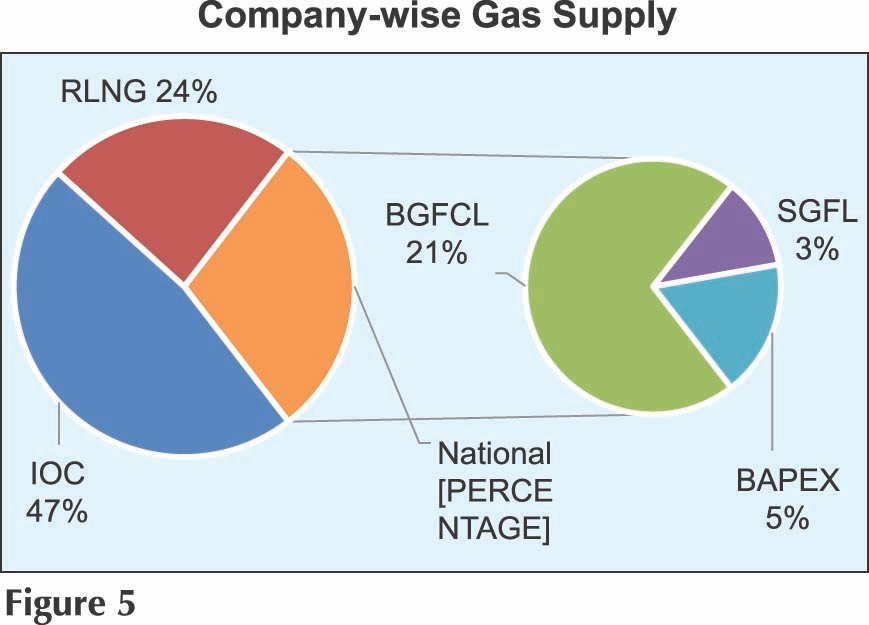
A little over 1.0 Trillion Cubic Feet (TCF) of gas is now being annually used in Bangladesh. Gas in place of 29 discovered gas fields was 38.21 TCF. The recoverable reserve was 29.74 TCF. Till December 2023, the total supply from the reserve has been 20.72 TCF. The remaining recoverable reserve is now 9.02 TCF. The maximum daily production from own fields is 2200 MMCFD. It is a little over 50% of the coincident peak demand. Import of LNG started in 2018 to manage the deficit. The capacity of delivering RLNG of two Floating Storage Regasification Units (FSRUs) now in operation is 1100 MMCFD. It is possible to handle 112 cargoes of LNG utilizing the two FSRUs annually. The government has so far finalized the plan for importing 80 cargoes during January-December 2024. There is a thought of importing 20-24 more cargoes subject to the availability of US dollars. The government would have to spend BDT 400 crore for importing each cargo of LNG under long-term contracts and spot purchases. In 2024, the government would require BDT 32,000 crore or US$3.0 billion for LNG imports.
From the three fields it operates, Chevron Bangladesh alone supplies 55% of the total gas produced locally. However, Petrobangla failed to pay them regularly due to a fund shortage.
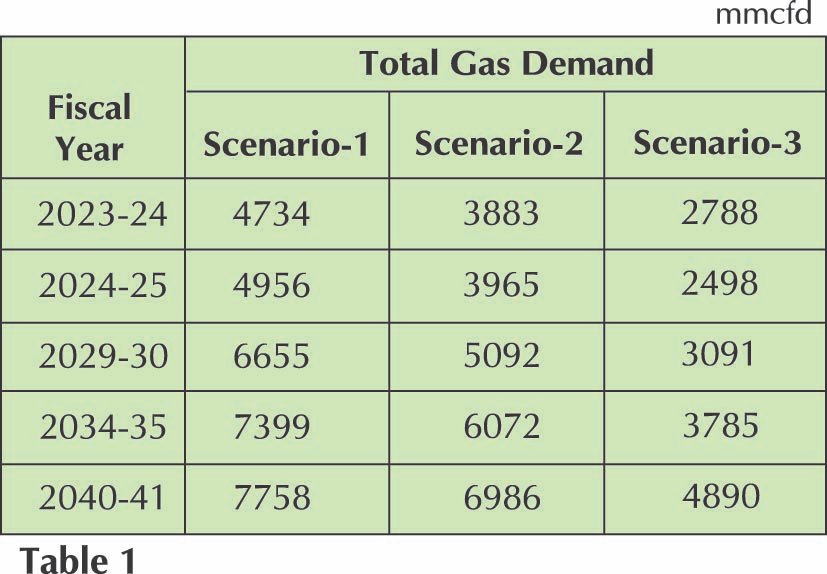
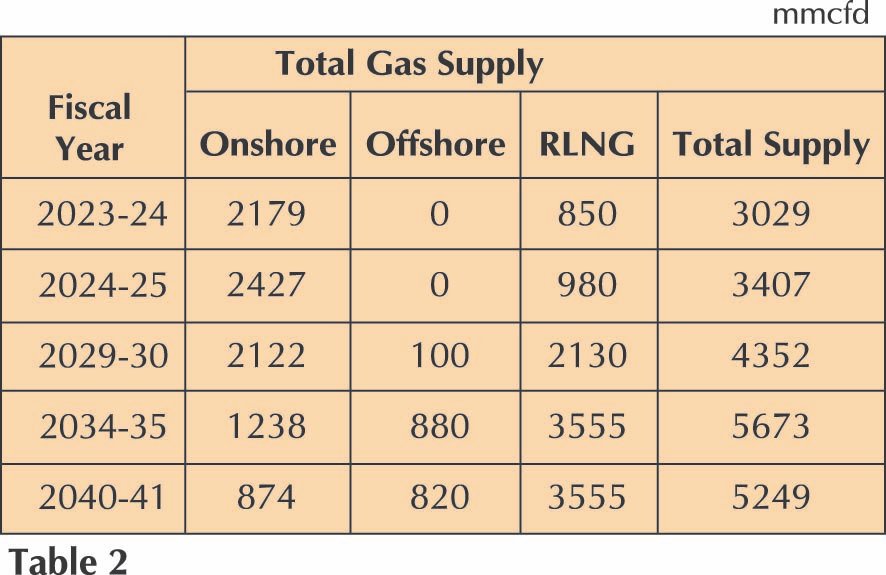
At a recent program, Petrobangla revealed its plan for gas production and supply till 2041. There will also be a gas supply shortage in 2041 even if the highest estimated own production and RLNG supply are considered against the highest demand. (Demand Supply Data are attached in Tables. 1 and 2).
Present Program for Increasing Production
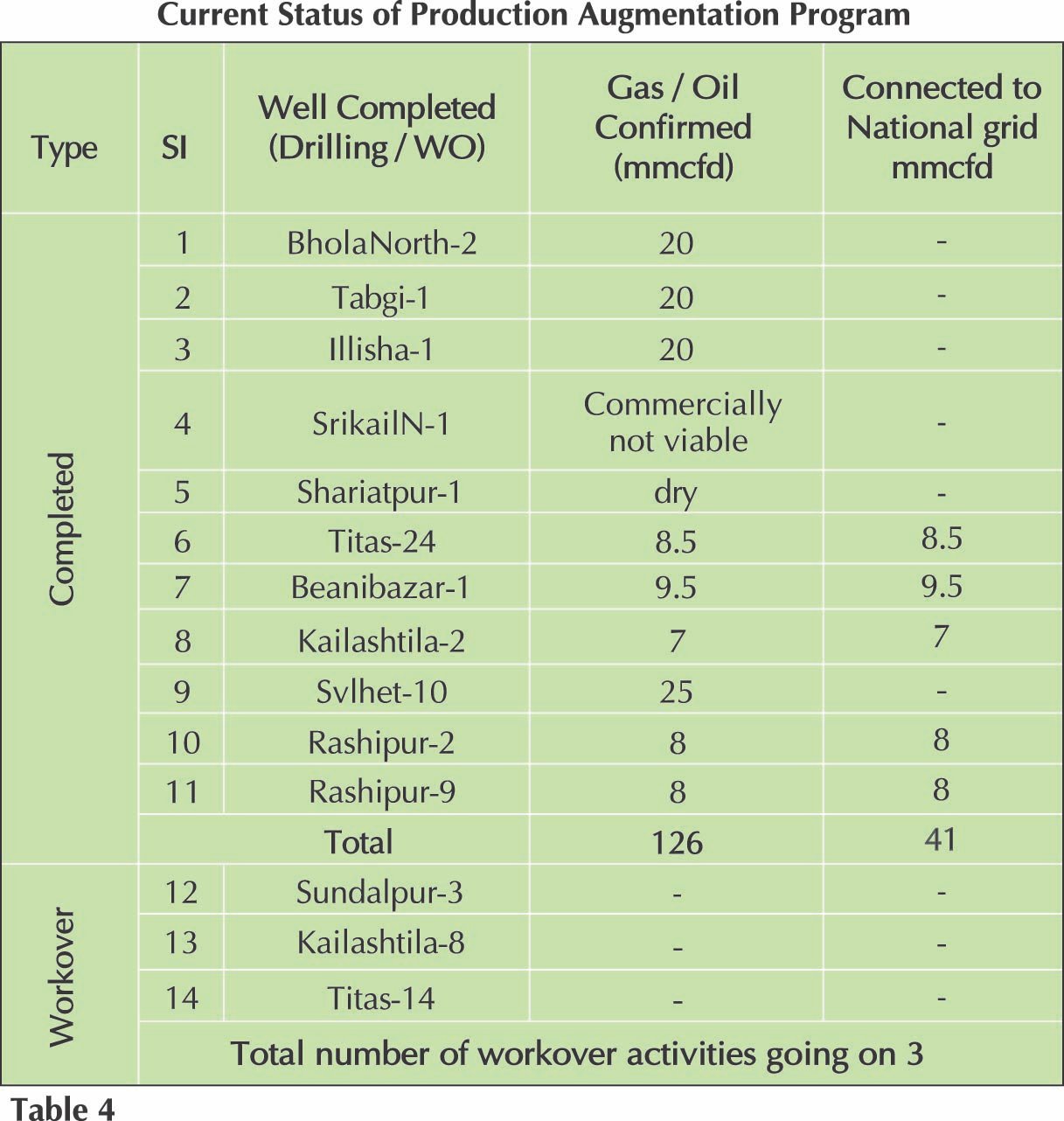
Petrobangla launched a program in 2021 to drill 48 wells, including 17 exploration wells, to increase gas production. The plan was to implement the program through BAPEX and foreign contractors. Only 9 out of 21 wells planned for 2023 could be completed. Some 41 MMCFD new gas could be added to the grid. Four of these are exploration wells. Petrobangla claims it will be able to complete works of 39 wells, including 11 exploration wells, in 2 years by 2025. The total addition of gas including those at Bhola Island will then be 618 MMCFD.
Prof. Dr. Ijaz Hossain, former Dean of BUET, thought that it would not be possible for Petrobangla to complete these works by 2025. Mortuza Ahmad Faruque, former Managing Director of BAPEX, said BAPEX does not have the required drilling crew to operate more than two of their 5 rigs simultaneously. It is not also possible to hire new human resources and make them ready to work within a short period. Dr. Ijaz said it would be a waste of resources to buy a new rig when we cannot operate 5 rigs now due to a lack of competent human resources.
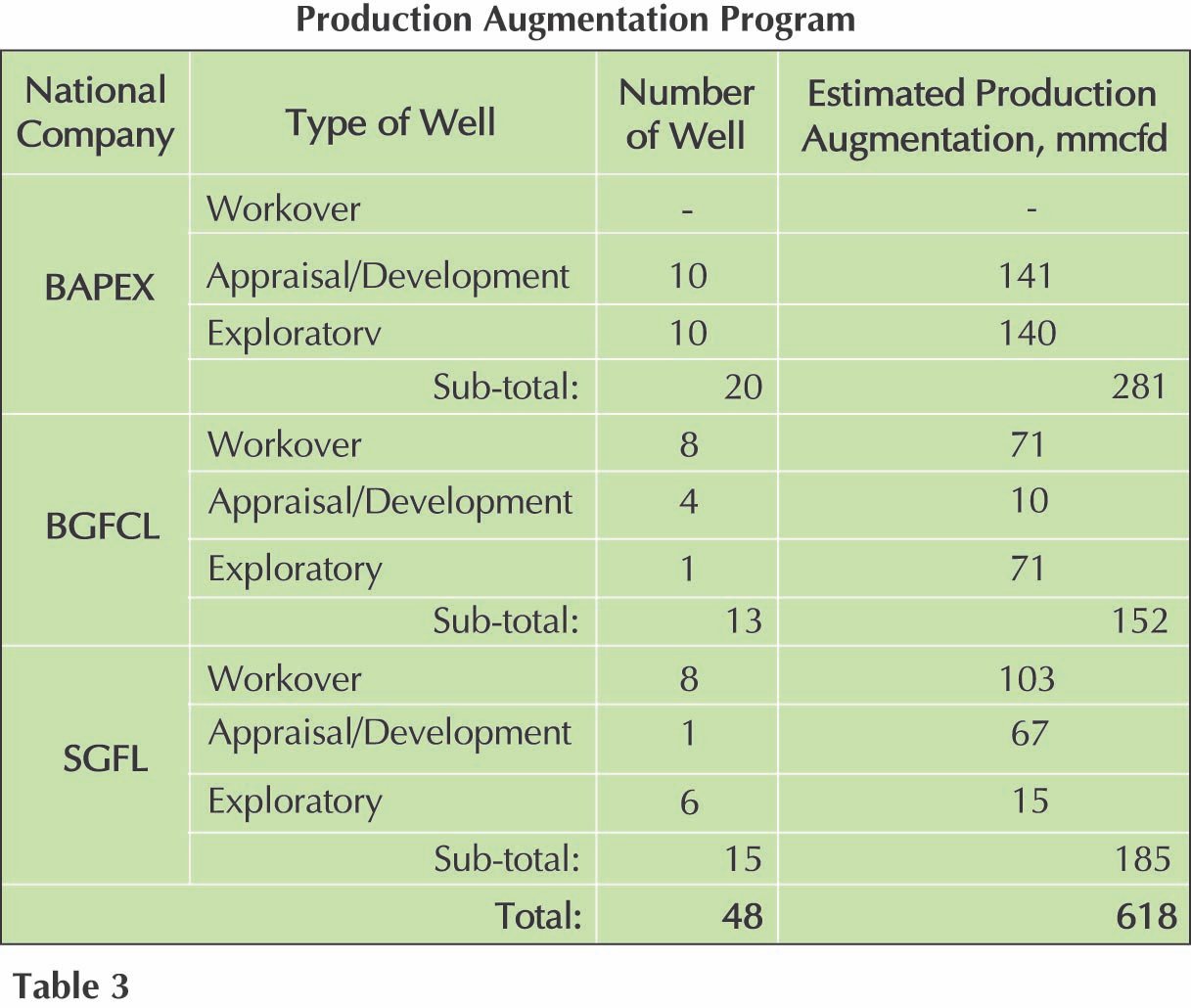
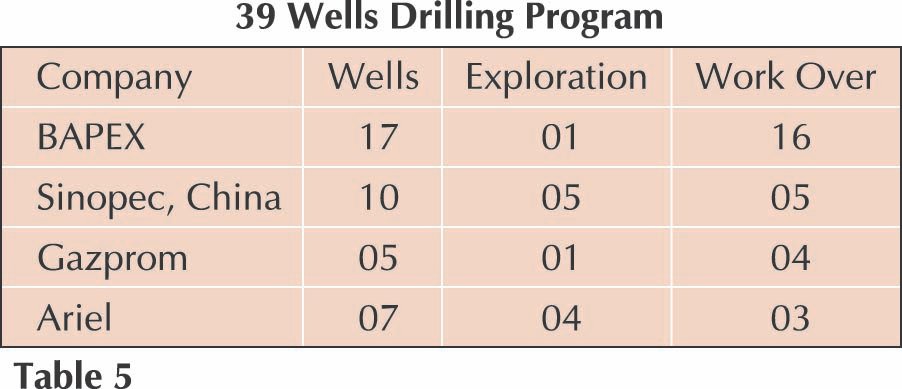
Zanendra Nath Sarker, Chairman of Petrobangla, admitted the lack of human resources and said works are in progress for organizing manpower and making them work. He assured completing works of 39 wells by 2025. Gazprom, Ariel, and Sinopec will accomplish 22 wells, including 10 exploration wells while BAPEX 17, including one exploration well. Taking into consideration keeping each rig in operation, the BAPEX work program till 2025 has been finalized. Approval has been given to all ongoing works to be accomplished in 2024. Some works to be accomplished in 2025 are under the approval process. There is no reason why the target cannot be achieved. (Details of 48 wells drilling program attached in Tables 3, 4, and 5)
Moreover, Chevron with the approval of EMRD is now drilling two wells in the flank of Bibiyana Gas Field. One is already completed, and the work of another one is in progress. It is expected to be completed by the end of this year. State Minister for Power, Energy & Mineral Resources Nasrul Hamid is optimistic about getting up to 1.6 TCF new gas from these initiatives.
Four-Year Plan of Own Initiative
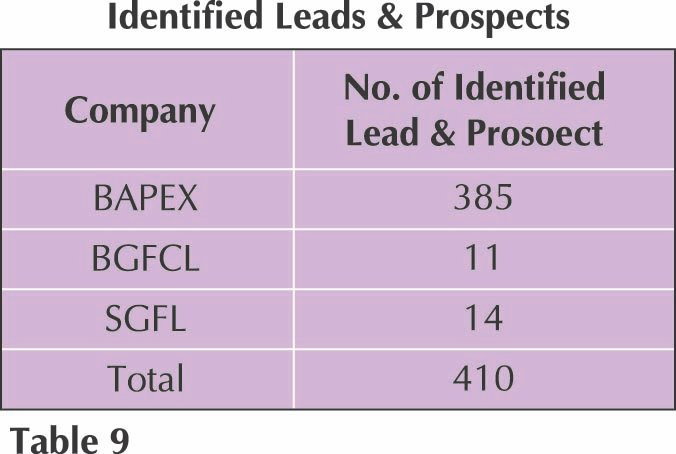
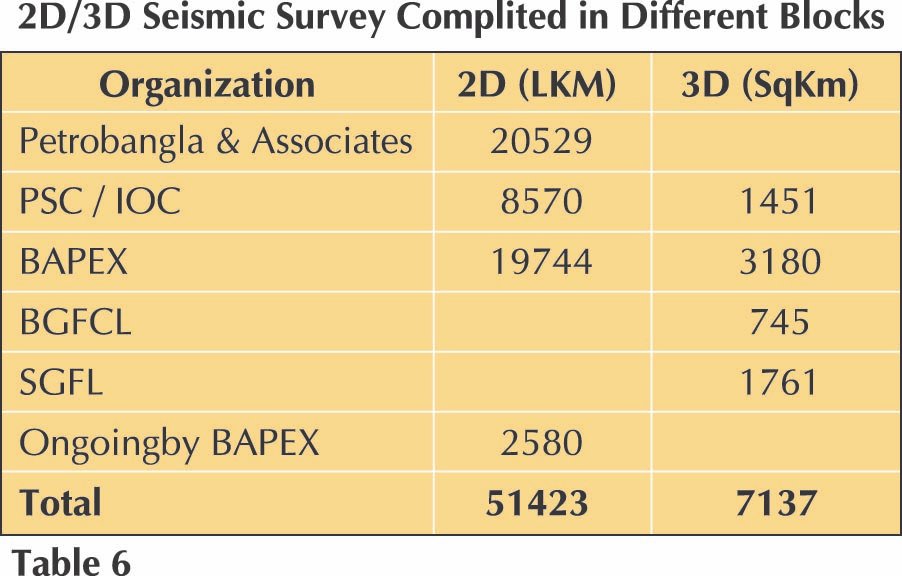
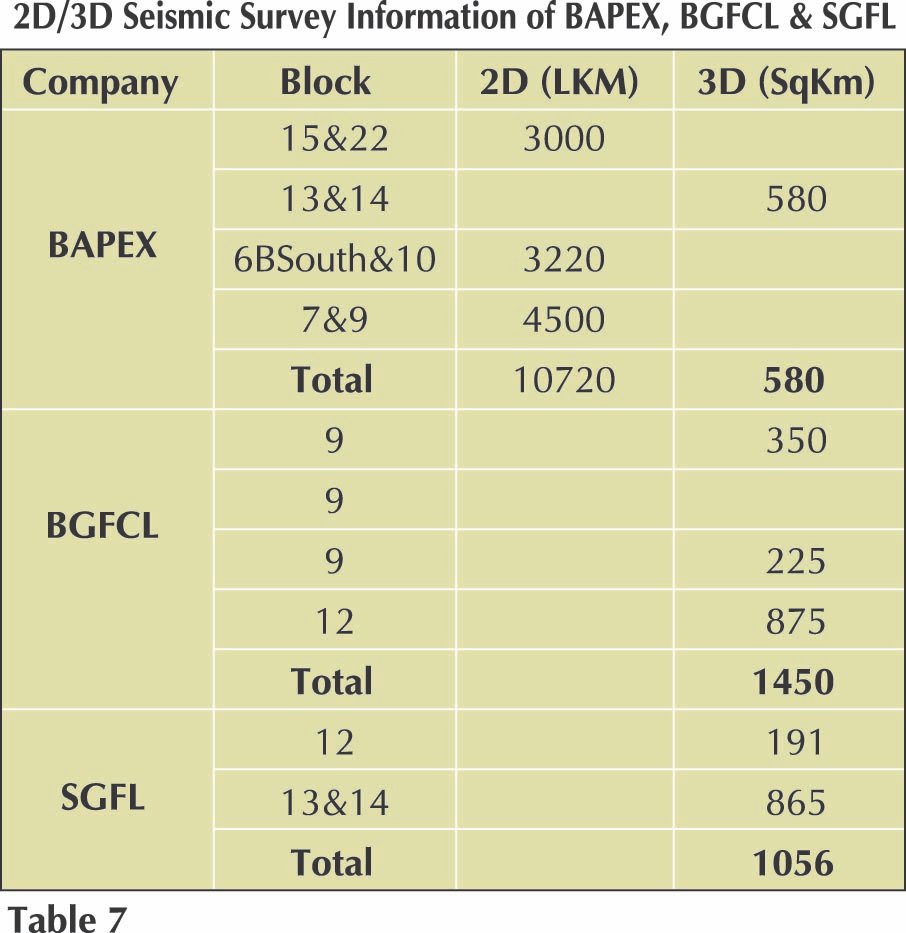
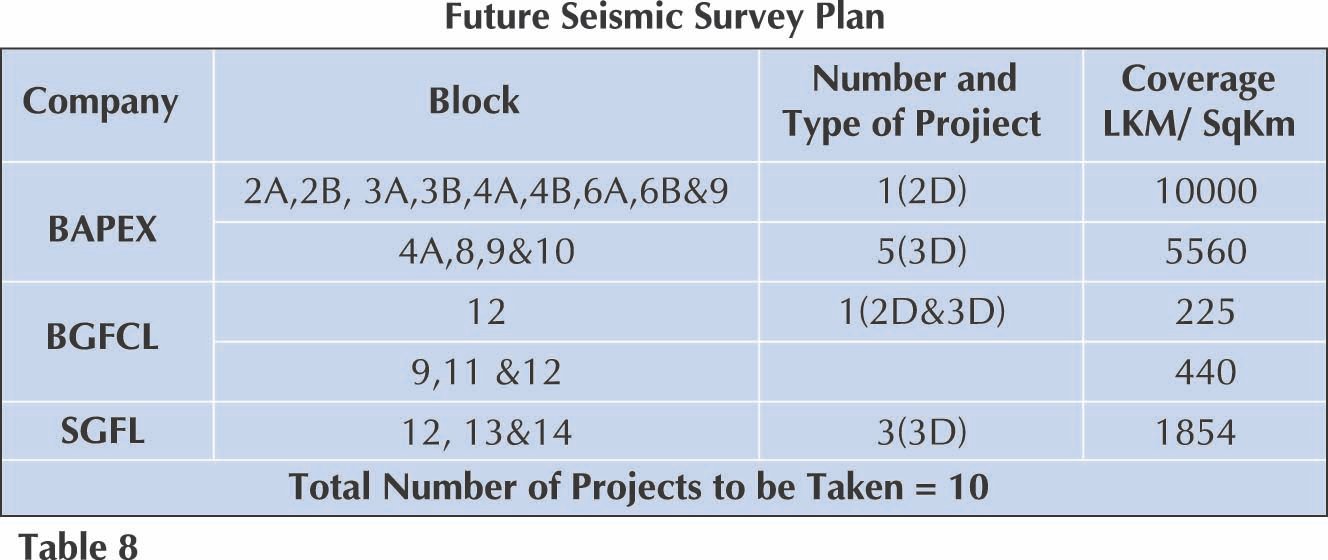
The plan has been finalized taking into consideration all data acquired from 2D and 3D seismic surveys conducted by Petrobangla and the IOCs working under PSC (Table 6). Petrobangla collected 51,423-line kilometer 2D and 7,137 square kilometer 3D seismic survey data in its data bank. Experts of Petrobangla analyzing these data have identified 410 leads and prospects so far (Table 9). Works of 10,720-line KM 2D and 1,056 square KM 3D seismic survey (Table -7) are also in progress. Plans have been made for an additional 1,854 Line KM/Square KM 2D and 3D seismic surveys (Table 8). These are expected to be completed by 2028.
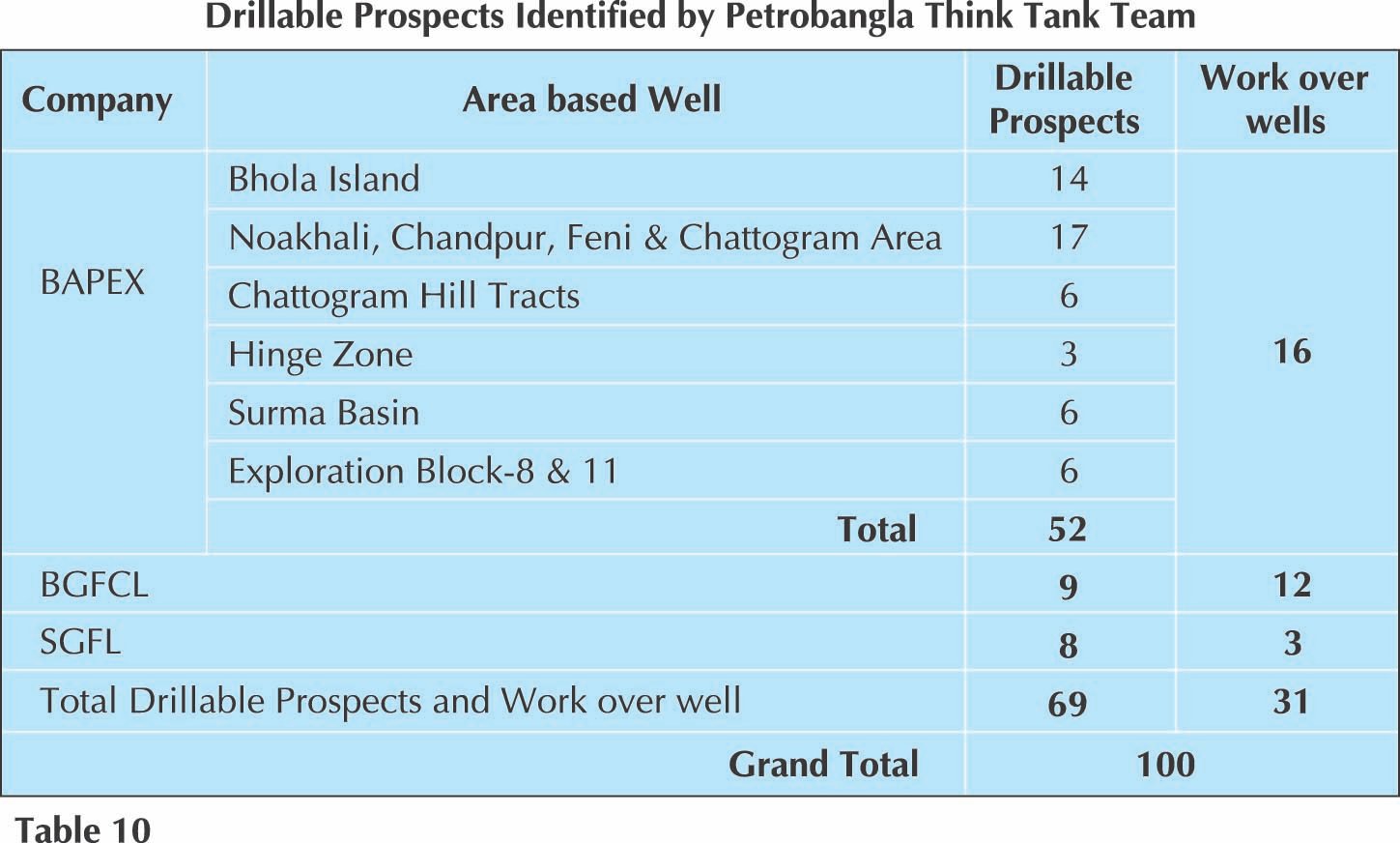
Petrobangla claims that its think tanks, after examining and evaluating 410 leads and prospects initially identified, have recommended planning for 69 exploration wells and 31 workovers (Table 10). Placing this recommendation on board, Petrobangla on 15 February 2024 sought the opinions of experts and former Petrobangla executives. While welcoming this initiative, experts expressed concerns over implementation plans in the business-as-usual process. Md. Nurul Alam, Secretary of EMRD at the meeting acknowledged that there is no option to increase supply from domestic sources of gas to ensure sustainable energy security. That is the EMRD plan. But he reminded that all rules and procedures of the government require to be accomplished in making expenditures, and suggested minimizing program approval time. Addressing the gathering as chief guest, Mr. Nasrul Hamid said that supplying quality power and energy on an uninterruptible basis to all at affordable cost is the political priority of the government. There is no option to increase the supply of gas from domestic sources to achieve it. Import of LNG on a limited scale will also continue side by side. Engaging foreign and local companies in the exploration and development of petroleum resources is the priority of the present government, the state minister reiterated.
Asked whether it is possible to drill 100 wells by 2028, Mr. Zanendra Nath replied in the positive, however pointing out that there is no scope for doing it under a special project. BAPEX on a stand-alone basis cannot also accomplish it. That is why we are finalizing the plan for 100 wells inclusive of 69 exploration wells considering BAPEX and foreign drilling contractors working side by side. It will be completed by June 2024. Alongside BAPEX, Gazprom, Ariel, and Sinopec are in our consideration now. This may change with time and circumstances. No special allocations and separate projects are being planned for these. Rather with some alterations and amendments, these works will be accomplished following existing rules and procedures for project approval and financing. The finance will come from government allocation, proceeds of GDF, and companies’ sources. But, to reduce time and cost, the provision of a third-party feasibility study requires reviewing. Petrobangla's request through letters to the Planning Commission in this regard remains pending. A third-party feasibility study requires 6 months and BDT 75 lakhs. If our proposal for feasibility study gets the nod, it is possible to do it expeditiously within 15 days with the assistance of local experts, spending BDT 5-10 lakhs.
One senior official of BAPEX, on condition of anonymity, told the EP that the leads and locations of wells are determined through the evaluation of 2D and 3D seismic data. This should be accepted as a feasibility study. That will save both time and money. One official of the EMRD told the EP that they were discussing with the Ministry of Planning to resolve this issue.
RLNG Supply Plan for Meeting Gas Supply Deficit
Two FSRUs now in operation have a total capacity of delivering 1100 MMCFD RLNG to the gas grid. 56 cargoes are available annually under long-term contracts with Qatar and Oman. Two new contracts have been concluded with Qatar and Oman for getting additional LNG supply from 2026. Contracts have also been concluded with Excelerate Energy. Another contract will soon be concluded with Summit Energy. All these supplies will be available from 2026. Petrobangla has also enlisted 22 companies. These companies supply LNG from the spot market. The matter of importing 100 MMCFD RLNG through a pipeline from H Energy India is at the final stage of approval. Dipon Gas in a joint venture with an Indian company is working to import 550 MMCFD RLNG through pipeline from India under private sector LNG import policy.
Summit Group has concluded a contract with Petrobangla for processing 500 MMCFD LNG through a new FSRU to be set up at Maheshkhali. This is expected to come into operation by 2026. The contract for 500-1000 MMCFD RLNG supply from a deep-water LNG infrastructure off the coast of Payra of Excelerate Energy is at the final stage of approval. Through a different contract, it is interested in constructing a gas transmission pipeline to Khulna. These projects may come into operation by 2027. The works of 1000 MMCFD capacity Land Based LNG Terminal (LBT) at Matarbari may start in 2024. It may come into operation in 2031.
Petrobangla sources claim that the LNG import infrastructure by 2031 will grow to 3,100-3,600 MMCFD. The sources of supply for this will also be confirmed by then. However, the financial situation at that time will dictate whether Bangladesh can import LNG of that quantity at that time. According to Petrobangla, gas demand will grow to 6,700 MMCFD at that time. It will be possible to supply up to 4,400 MMCFD from own production and imported RLNG.
Gas Resource of Isolated Bhola Island and What Needs to Be Done?
Different figures have been in discussion for a while about gas in place at Bhola island. An international company Schlumberger has recently completed a study for Petrobangla. The reserve is mentioned as 2.06 TCF. Shahbazpur has 1238 BCF, Bhola North 622 BCF, and Ilisha 200 BCF. There is a plan to drill 9 new wells by 2028. Now a company is transporting a very limited quantity of CNG to Dhaka’s industrial areas by converting gas from Bhola, and a few power plants are in operation there. Recently, an initiative has been taken to set up a fertilizer plant there with Japanese investment.
According to Petrobangla’s reserve-to-production ratio, annually 7.5% of Bhola reserves or 400 MMCFD gas can be produced and supplied. But there is no scope for utilizing that gas locally. Petrobangla has carried out a study for connecting the gas with the grid. Five different options emerged. Experts believe that without taking the initiative to connect Bhola gas to the national grid, further investment in drilling there will be mere waste. The Chairman of Petrobangla spoke about the possibilities of converting gas to LNG apart from evacuating gas to the grid through a pipeline.
Will FDI for Offshore Exploration be Available?
The Bay of Bengal has 27 exploration blocks including 15 deep offshore. Indian company ONGC JV is now working on two of these. Petrobangla has taken all required preparations for inviting a fresh bidding round for 25 deep and shallow blocks. It has come to the knowledge of EP that the bidding round will be launched on 7 March 2024. Schlumberger JV has already completed the first phase of multi-client surveys. They will conduct the second phase of the survey next winter. Chevron Bangladesh and PTTEP (Thailand) Limited have already purchased data. ExxonMobil submitted an unsolicited proposal for working in all 15 deep offshore blocks. However, it is uncertain whether they will participate in the open bidding. A team from another company recently held meetings with Petrobangla and EMRD in Dhaka, but they have not purchased any data yet.
Interested bidders will be required to submit offers within 180 days of the announcement of bidding. Petrobangla has plans to complete the evaluation of bids received, conclude negotiations with evaluated bidder(s), and conclude PSCs if possible within 2024. There are talks about conducting roadshows in some countries. But these are not finalized yet.
Eric M Walker, Managing Director and President of Chevron Bangladesh, expressed Chevron’s participation interest in offshore bidding during Nasrul Hamid’s recent visit to Bibiyana Gas Field. Petrobangla is optimistic about getting an encouraging response to its fresh bidding based on the updated MPSC.
Conclusion
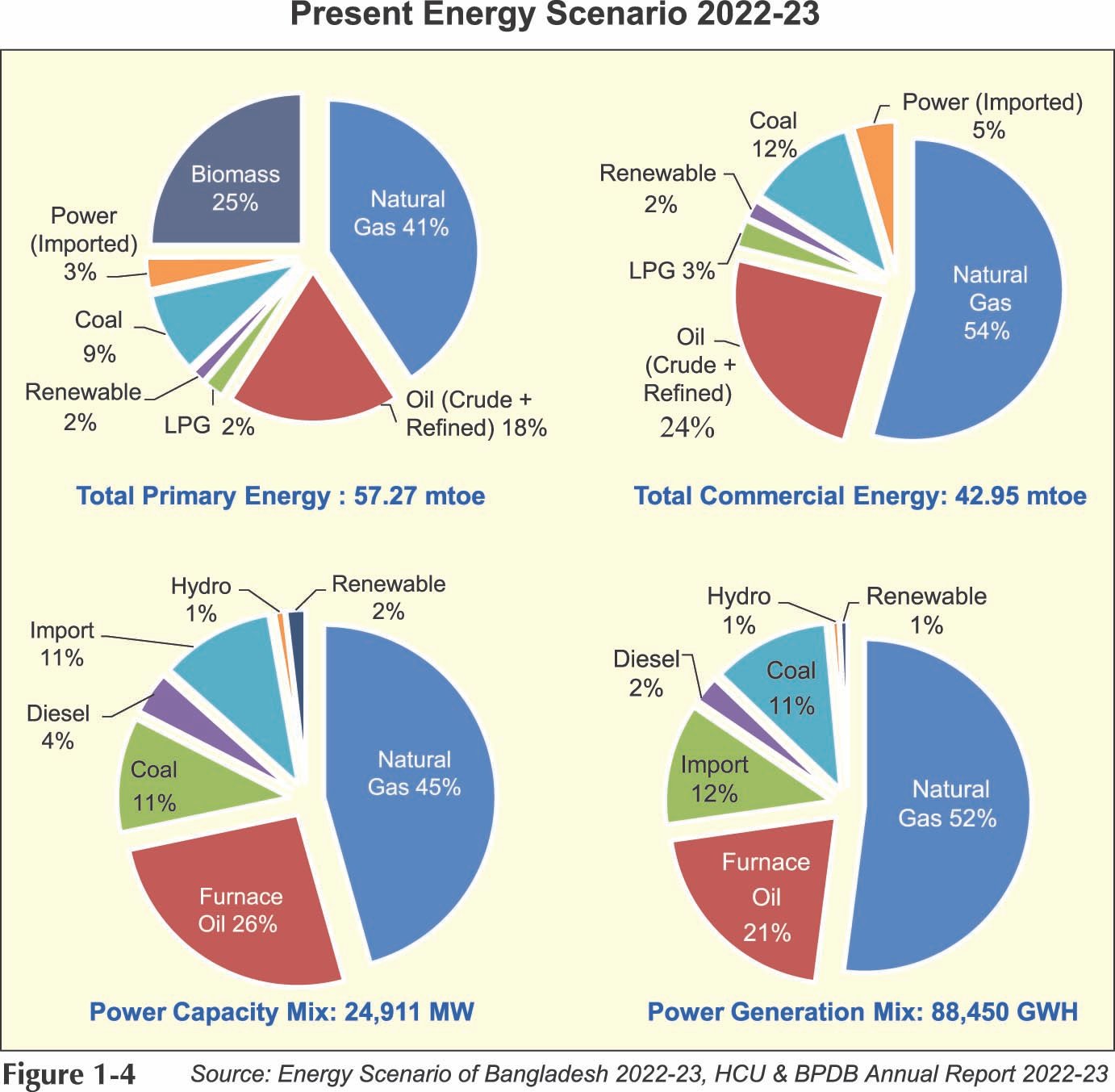
Natural gas is the prime mover of Bangladesh's economy. If we take into account the use of primary fuel in 2023, it was 57.27 million Tonnes of Oil Equivalent (Mtoe) (Fig 1) – 41% of that was natural gas. The total commercial energy used was 42.95 Mtoe (Fig 2) – 54% of that was natural gas. Almost 100% of power generation, 20 years from now, was gas-based. In 2010, the Power System Master Plan suggested a 50% contribution of coal for power generation, reducing gas to power by 25%. The suggestion was a 30% contribution of own coal. Stress on local limited gas resources grew intense for the government not complying with that. Now natural gas contributes about 55% of grid power generation. The gas-based power generation plants now need a 2300 MMCFD gas supply. This is more than the total gas production capacity. BPDB sought at least 1500 MMCFD gas for power generation. But Petrobangla cannot supply more than 1200 MMCFD. On the other hand, it is not possible now to meet 60% of the gas demand by the industries. Production is badly affected by gas supply shortages. Required investments are not coming despite setting up several special economic zones. Trade body leaders are saying that the investors lack confidence in reliable power and energy supply. Industries may lose competitiveness if they are required to operate absorbing the high price of imported LNG.
The reality is expedited exploration campaign may increase production but reliance on imported LNG will continue to increase. The gas deficit will continue to exist if the business-as-usual norms and procedures are followed. It is expected that the required gas supply to industries can be ensured following a 25% gas supply reduction for power generation by 2041 following IEPMP 2023 recommendations. To ensure that all coal-based power plants must operate at full capacity. Replacing imported coal with own coal foreign currency can be saved. That can be used for LNG import. Adding another 2400 MW of nuclear power that should be brought into operation by 2041. 40% generation from clean sources needs to be ensured by 2041. 9,000-10,000 MW through cross-border trading should be available from hydro. Using Gas based power plants as peak load fuel for other base load plants must be arranged by 2041. Industries requiring 24/7 fuel supply use 17% of natural gas for captive generation. Gas supply to captive power plants must be completely stopped by ensuring quality power supply on an uninterruptible basis to industries. Without this quality, gas supply to industries using it in the process cannot be ensured.
Finally, an intensive hydrocarbon exploration campaign onshore and offshore must be done in the next 15 years to ensure a sustainable supply of domestic gas. Industries must get priority in gas allocation. By setting exploration datelines, Bangladesh must get out of exclusive reliance on gas. Natural gas will eventually be exhausted at a time when the Bangladesh economy will by then become resilient and is expected to be able to rely on RLNG or other alternate fuels.
Cover As PDF/userfiles/21_18_Cover.pdf