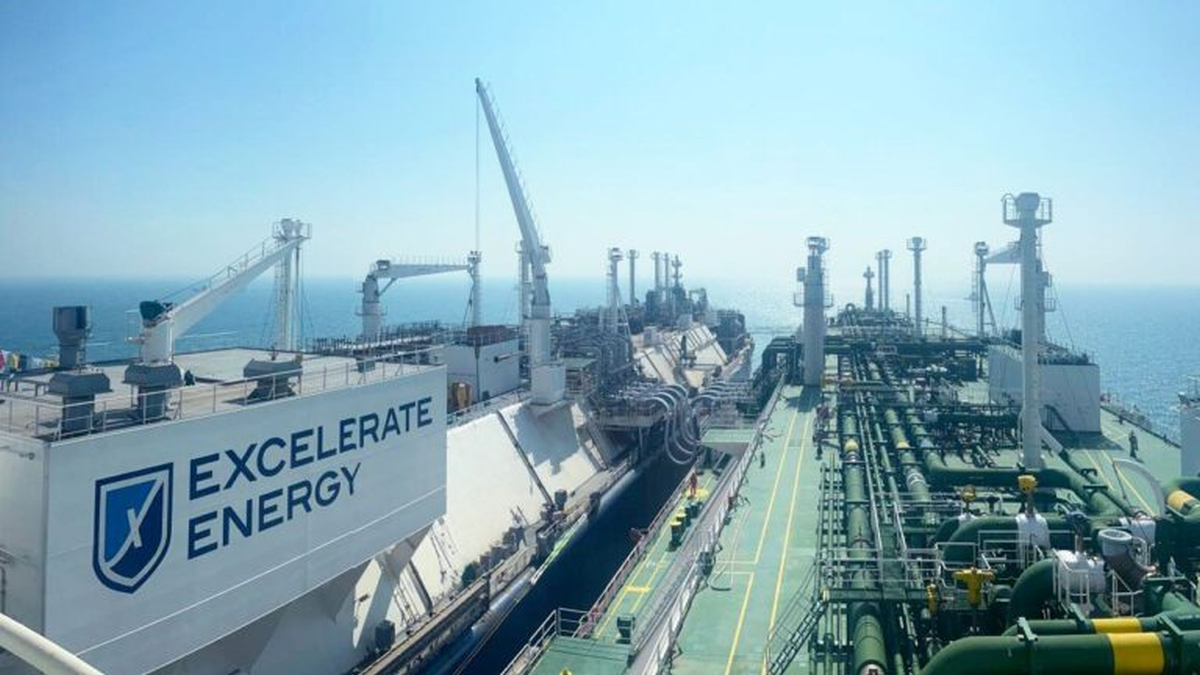
Bangladesh’s prolonged gas crisis has entered a more critical phase after the shutdown of one of its two floating LNG terminals exposed the country’s growing dependence on imported liquefied natural gas (LNG) and the lack of adequate import infrastructure.
For nearly five years, the country’s gas deficit has continued to widen as production from domestic gas fields declines by around 150 million cubic feet per day (MMCFD) annually. Meanwhile, Bangladesh’s LNG regasification capacity has remained capped at about 1,100 MMCFD, with no new import infrastructure added despite rapidly increasing demand.
Although expanding LNG imports has become the only viable short-term option to offset declining domestic production, progress in developing new import facilities has been slow. The government has recently granted in-principle approval to begin negotiations for the country’s third Floating Storage and Regasification Unit (FSRU), but construction and commissioning will still take several years.
The vulnerability of the existing system became evident after a fire and technical failure forced the shutdown of Excelerate Energy’s FSRU at Moheshkhali on July 21, cutting gas supply to the national grid by about 450 MMCFD.
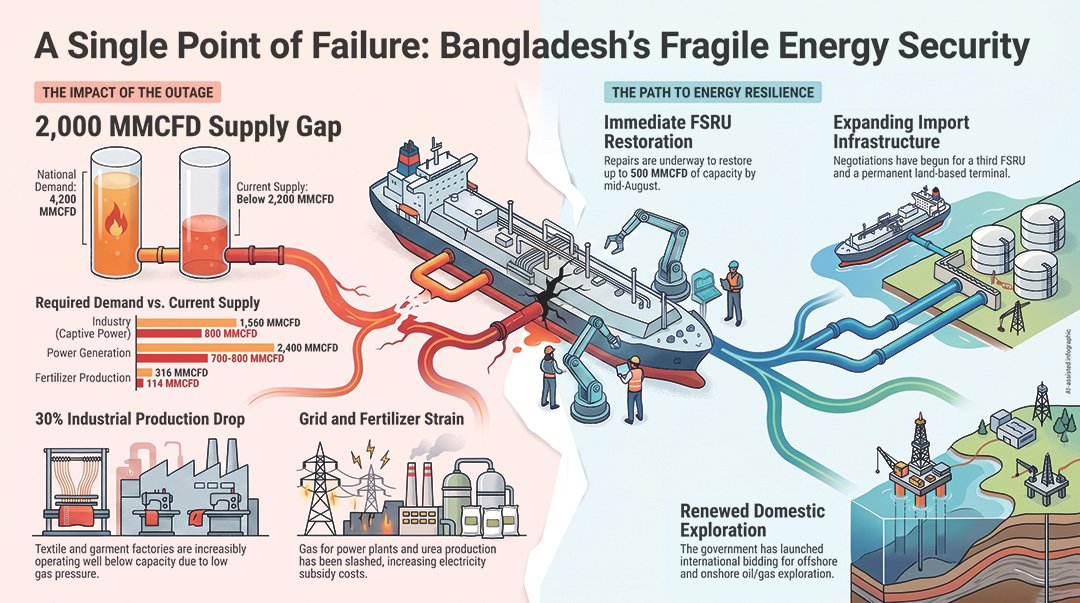
As a result, total gas supply has fallen to below 2,200 MMCFD, against an estimated national demand of around 4,200 MMCFD, leaving a supply gap of nearly 1,800-2,000 MMCFD. The shortage has deepened across all major consuming sectors.
Gas allocation to industries has fallen to nearly half of demand, while supplies to gas-fired power plants have been reduced by another 150-200 MMCFD. The outage of a single LNG terminal has demonstrated how vulnerable Bangladesh’s energy system has become as dependence on imported LNG continues to increase.
Industry Bears the Biggest Blow
The manufacturing sector, particularly the textile and ready-made garment (RMG) industry, has been hit hardest.
According to Petrobangla, industries account for nearly 39 percent of national gas demand, requiring around 1,560 MMCFD for captive power generation and industrial processes. Under normal conditions, industries receive around 950 MMCFD, but current supply has fallen to nearly 800 MMCFD.
Textile mills, spinning, weaving, knitting, dyeing and washing factories are operating well below capacity as inadequate gas pressure prevents boilers from functioning efficiently. Industrialists estimate that production capacity has declined by 25-30 percent, forcing many export-oriented factories to shift production to late-night hours while raising concerns over timely delivery of export orders.
BGMEA President Mahmud Hasan Khan said the gas crisis has persisted for almost five years despite repeated tariff increases.
“The government raised industrial gas prices from Tk16 to Tk40 per cubic meter with the promise of ensuring adequate supply. However, the supply situation has not improved. Production continues to suffer, and if this continues, many garment factories will become financially unviable and eventually shut down,” he said.
BTMA President Shawkat Aziz Russell told Energy & Power that many textile mills have already ceased operations, with inadequate gas supply being one of the principal reasons.
“There is no alternative to urgent government intervention if the textile industry is to survive,” he said.
Recognizing the seriousness of the situation, leaders of the Bangladesh Garment Manufacturers and Exporters Association (BGMEA) and the Bangladesh Textile Mills Association (BTMA) recently met Prime Minister Tarique Rahman, warning that continued gas shortages could severely undermine Bangladesh’s largest export sector.
The Prime Minister assured industry leaders that the government would take immediate measures to minimize disruptions to industrial production and instructed the relevant ministries and agencies to expedite actions to restore stable gas supplies.
Urban Residents Face Severe Hardship
The crisis has also become a daily struggle for millions of urban households.
Residents in Dhaka, Narayanganj, Gazipur and Chattogram report receiving little or no cooking gas for extended periods. In many neighbourhoods, gas pressure remains too low to cook throughout most of the day, with some households receiving supply for only one or two hours.
Many families have been forced to switch to electric cookers, LPG cylinders or purchase prepared meals, significantly increasing household expenses. Complaints from residents unable to cook have flooded social media, while working families have been among the worst affected.
Long Queues at CNG Stations
The transport sector has also experienced major disruptions.
Long queues stretching several hundred meters have become common at CNG filling stations across the country. Many stations are operating with limited supply hours, while others have temporarily suspended operations altogether.
Although CNG station owners have withdrawn their planned strike after discussions with the government, motorists continue to wait six to eight hours to refuel. The prolonged delays have reduced the number of CNG-powered three-wheelers, ride-sharing vehicles and buses operating in Dhaka, creating additional pressure on the city’s already strained public transport system.
Power Generation and Fertilizer Production Under Pressure
The gas shortage has forced authorities to further reduce supplies to gas-fired power plants and fertilizer factories.
Although the power sector requires around 2,400 MMCFD, Petrobangla normally allocates between 900 and 1,000 MMCFD. Following the FSRU outage, supply has dropped to around 700-800 MMCFD.
Gas allocation to fertilizer factories has also been sharply reduced from the required 316 MMCFD to only about 114 MMCFD, affecting urea production.
To maintain electricity supply, the government has increased reliance on coal-fired and liquid-fuel power plants, a move that significantly raises generation costs and increases subsidy requirements.
Government Accelerates Emergency Response
The government has mobilized international technical experts to restore the damaged FSRU as quickly as possible. Energy officials expect partial operations to resume in the coming weeks, with full restoration depending on the arrival and installation of replacement equipment.
At the same time, authorities are accelerating plans to strengthen Bangladesh’s LNG infrastructure.
The Cabinet Committee on Government Purchase has granted in-principle approval to negotiate with China National Energy Engineering & Construction Co. (CNEE) for the development of the country’s third FSRU at Kutubjom in Moheshkhali. The proposed terminal is expected to add 550-600 MMCFD of regasification capacity.
The government is also moving ahead with plans to develop a land-based LNG terminal at Matarbari, which is expected to provide greater long-term supply security than floating terminals.
A Wake-Up Call for Energy Policy
Energy analysts say the current crisis extends far beyond a temporary technical failure.
It has highlighted Bangladesh’s growing dependence on imported LNG while domestic gas production continues to decline. With only two operational FSRUs, the outage of a single terminal has been sufficient to disrupt industrial production, electricity generation, fertilizer manufacturing, urban life and public transportation nationwide.
The incident underscores the urgent need to accelerate domestic gas exploration, diversify energy sources, expand LNG infrastructure, strengthen transmission pipelines and increase investment in renewable energy. Without a comprehensive long-term strategy, experts warn that similar crises are likely to become more frequent as Bangladesh’s dependence on imported LNG continues to grow.
When will the Damaged FSRU Resume Operations?
Power, Energy and Mineral Resources Minister Iqbal Hassan Mahmud has said that the damaged floating storage and regasification unit (FSRU) is being repaired under the supervision of international specialists, while critical replacement components are being imported from overseas. He expressed optimism that the terminal would gradually resume operations during the first half of August.
State Minister for Power, Energy and Mineral Resources Aninda Islam Amit said the FSRU is expected to restore 280-300 MMCFD of gas supply in the initial phase. Once fully repaired and commissioned, the terminal is expected to return to its full regasification capacity of around 500 MMCFD, significantly easing the ongoing gas shortage.
Government Pursues Multiple Measures
Even as it deals with the immediate crisis, the government has accelerated both short-term and long-term initiatives to strengthen Bangladesh’s energy security.
Alongside expanding LNG import infrastructure, efforts to increase domestic gas production are also continuing. Bangladesh has already launched an international bidding round for offshore oil and gas exploration in the Bay of Bengal, with bid submissions scheduled to close in November.
Energy Minister Iqbal Hassan Mahmud has also indicated that the government is considering inviting international investors to participate in onshore oil and gas exploration to accelerate domestic resource development.
To strengthen LNG import capacity, the Cabinet Committee on Government Economic Affairs recently granted in-principle approval to begin negotiations with China National Energy Engineering & Construction Co. (CNEEC) for the installation of Bangladesh’s third FSRU at Kutubjom in Moheshkhali. The proposed facility is expected to add 550-600 MMCFD of regasification capacity to the national gas grid.
Officials said the government is simultaneously advancing plans for a fourth FSRU and a land-based LNG terminal at Matarbari, Cox’s Bazar, aimed at improving long-term supply security.
As an alternative supply option, the government is also evaluating the feasibility of importing LNG from Malaysia using ISO tank containers, particularly for supplying gas to industrial consumers. A Malaysian delegation recently visited Dhaka and held discussions with Petrobangla and representatives of Bangladesh’s ready-made garment (RMG) industry to explore the proposal.
Bangladesh Seeks Malaysia’s Support
The government is also expanding international energy cooperation to strengthen long-term energy security.
During a recent bilateral meeting, Prime Minister Tarique Rahman requested support from Malaysian Prime Minister Anwar Ibrahim in enhancing Bangladesh’s energy security through increased LNG supplies, investment and broader cooperation in the energy sector.
The two leaders reportedly discussed opportunities for long-term collaboration in LNG trade, energy infrastructure development and strategic investment to help Bangladesh address its growing dependence on imported natural gas.
Is the Crisis Merely Temporary?
Energy experts argue that the current shortage is not simply the result of a technical failure at one LNG terminal. Rather, it exposes the structural weaknesses of Bangladesh’s energy system.
Domestic gas production has been declining steadily for years, while dependence on imported LNG continues to grow. Consequently, the shutdown of a single FSRU has been enough to disrupt gas supplies nationwide, affecting industries, power generation, fertilizer production, urban households and the transport sector.
The situation has also highlighted Bangladesh’s growing exposure to volatile global LNG prices, increasing import costs and the government’s subsidy burden.
Experts believe that installing additional FSRUs alone will not provide a lasting solution. They stress the need for an integrated long-term strategy that includes accelerated domestic gas exploration, expansion of transmission pipeline infrastructure, development of strategic gas storage, greater investment in renewable energy, and diversification of the country’s energy mix.
According to analysts, the current gas crisis should serve as a wake-up call. Without sustained investment and comprehensive reforms to strengthen energy security, Bangladesh could face increasingly frequent and more severe supply disruptions in the years ahead.
Download Special Report As PDF/userfiles/EP_24_04_Special_Report.pdf
Afroza Akther Pervin, Managing Editor, Energy & Power and Editor, RangBerang