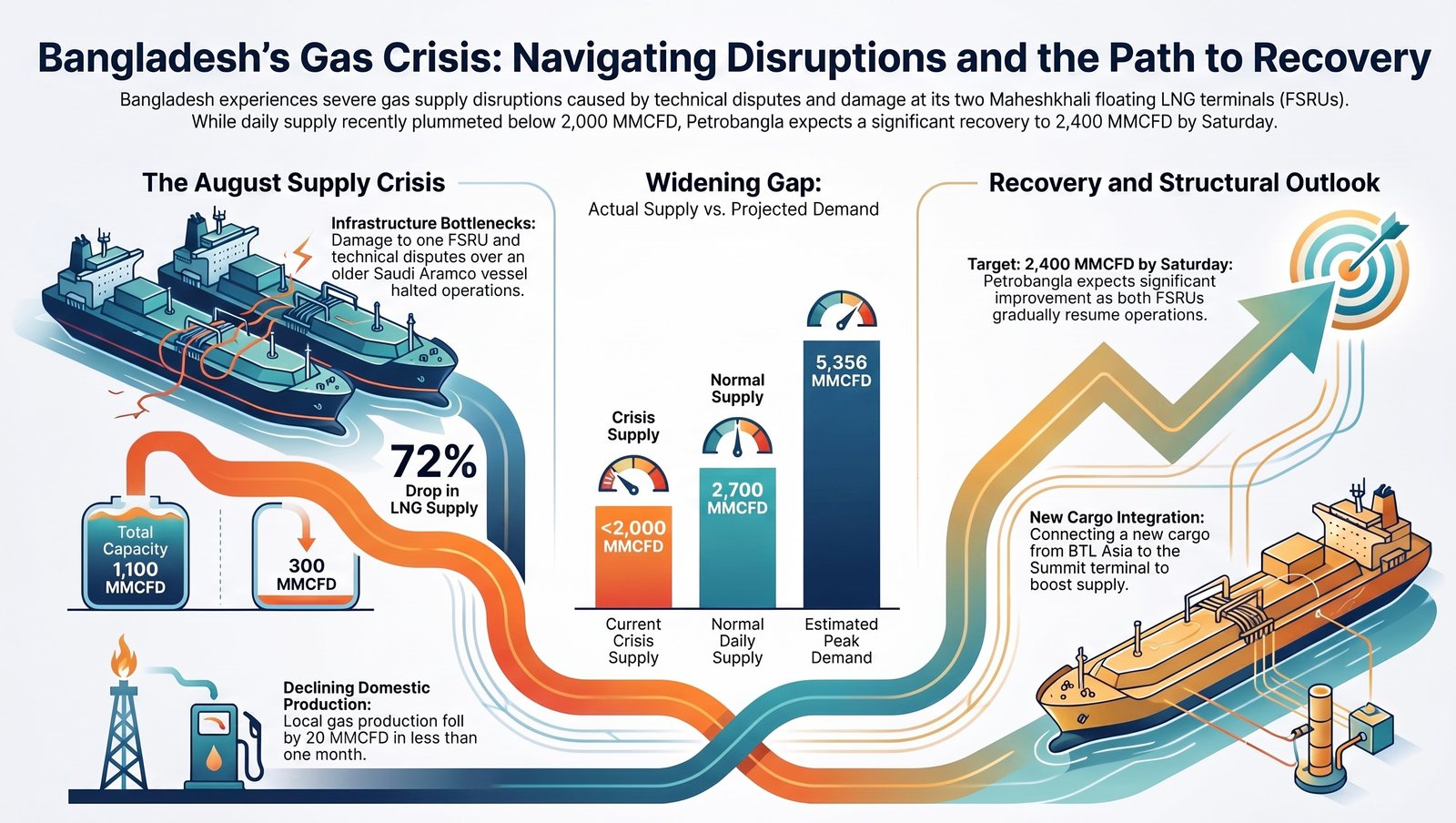
Dhaka, August 14, 2026: Petrobangla expects gas supply across the country to improve significantly by Saturday after severe disruptions over the past two days. Officials said that if supply remains below 2,000 million cubic feet per day (MMCFD), it could rise to around 2,400 MMCFD by Saturday afternoon as both floating storage and regasification units (FSRUs) at Maheshkhali gradually resume operations.
The gas crisis has intensified since an FSRU was damaged in a fire on July 21. The affected terminal partially resumed operations on August 6, providing some relief. However, the situation deteriorated again when supply from the other FSRU was suspended on Thursday, August 13.
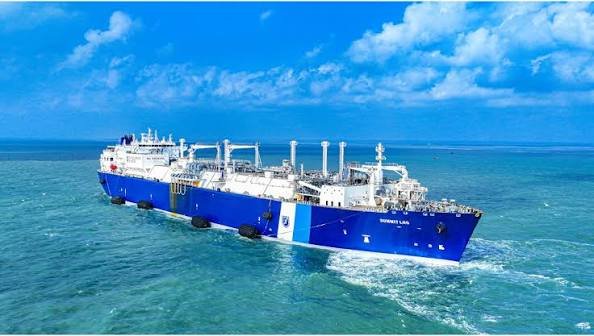
Bangladesh has two FSRUs at Maheshkhali in Cox’s Bazar for importing LNG. One is owned by US-based Excelerate Energy and the other by Summit Group, while both terminals are operated by Excelerate.
The latest disruption is reportedly linked to the unloading of an LNG cargo supplied by Saudi Aramco. Excelerate has reportedly raised concerns over the vessel, Al Hamra, describing it as an older Moss-type LNG carrier, and has not cleared it for connection with Summit’s floating terminal.
The vessel entered Bangladeshi waters around midnight on August 11. Although adverse weather was initially cited as a reason for the delay, energy-sector officials said other vessels have been able to connect with the terminals despite the prevailing weather conditions.
Bangladesh urgently procured the Moss-type LNG cargo from Saudi Aramco through a government-to-government arrangement after a tender for LNG from the international spot market received no response at the end of July.
Officials said the government has been trying to resolve the issue with Excelerate, but efforts have so far failed to secure approval for unloading the cargo. As a result, LNG supply reportedly dropped to around 300 MMCFD, compared with the combined regasification capacity of approximately 1,100 MMCFD of the two FSRUs.
Petrobangla Director (PSC) Engineer Md. Shoaeb said a cargo from BTL Asia had already entered Bangladeshi waters and would be connected to Summit’s terminal.
“We expect gas supply to increase somewhat once the cargo is connected. We hope both FSRUs will be supplying gas by Saturday,” he said.
The supply disruption comes at a time when domestic gas production is also declining while demand continues to rise. According to Petrobangla data, domestic gas production fell from 1,656 MMCFD on July 21 to 1,636 MMCFD on August 12.
Under normal circumstances, Bangladesh supplies around 2,700 MMCFD of gas, against demand estimated at approximately 4,000 MMCFD. However, figures cited in government proposals suggest that actual demand is significantly higher.
A January 2025 proposal BERC by Petrobangla companies to increase gas prices for new industries estimated daily demand among pipeline-connected consumers at 5,356 MMCFD. A subsequent proposal concerning gas prices for fertilizer production put demand at around 5,100 MMCFD.
Energy-sector stakeholders say the widening gap between available supply and actual, committed and prospective demand has become a structural challenge. They believe that without addressing declining domestic production, expanding LNG infrastructure and managing new gas connections alongside short-term supply disruptions, Bangladesh’s gas crisis will remain difficult to resolve.