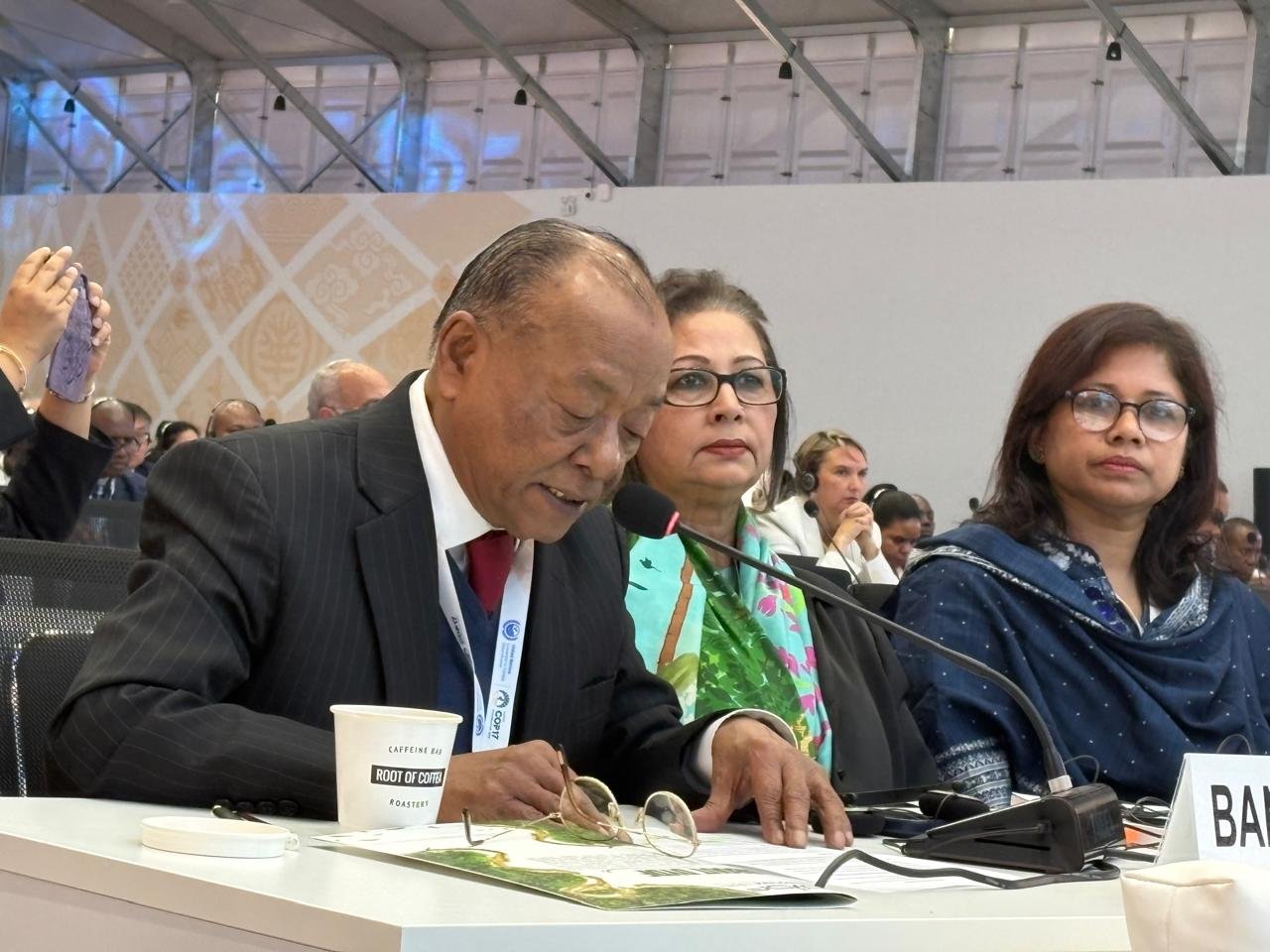
Ulaanbaatar, Mongolia, August 24, 2026: Environment, Forest and Climate Change Minister Abdul Awal Mintoo has said climate resilience and food security cannot be ensured without protecting land.
“Land must be viewed not as an environmental cost, but as an economic and development priority,” he said.
The minister made the remarks while addressing a ministerial dialogue titled “Innovative Financing Mechanisms for Healthy Land and Drought Resilience” during Finance Day at the 17th Conference of the Parties (COP17) of the United Nations Convention to Combat Desertification (UNCCD) in Ulaanbaatar on Monday.
Representing Bangladesh, Mintoo highlighted the country’s efforts to combat land degradation. He said soil fertility, forest resources, waterlogging, hill erosion, coastal salinity and riverbank erosion are being given greater priority in national planning.
He said Bangladesh is transforming its agriculture into a technology-driven and climate-resilient sector while expanding access to agricultural loans and financial support for farmers.
The minister urged multilateral development banks and development finance institutions to introduce guarantees, first-loss capital and blended financing to ensure effective funding for smallholder farmers and land restoration initiatives.
Highlighting Bangladesh’s domestic financing efforts, Mintoo said the country has been financing climate and land resilience projects through the Climate Change Trust Fund since 2009. More than $495 million has so far been allocated through the fund, making it one of the early domestic climate financing mechanisms among developing countries.
According to the minister, the funding has helped develop 12 new stress-tolerant crop varieties and distribute more than 19,400 metric tonnes of drought- and salinity-tolerant seeds among farmers. However, he noted that current demand has already exceeded the fund’s annual allocation.
Mintoo stressed that international financing should complement, rather than replace, national initiatives and help bridge existing financing gaps. He proposed innovative mechanisms such as debt-for-nature and debt-for-climate initiatives, as well as green bonds to finance land restoration.
He said such financing could strengthen managed groundwater recharge in the Barind region, agriculture, afforestation, climate-smart farming and coastal mangrove restoration under the national green mission to plant 250 million saplings.
On regional cooperation, the minister said changes in upstream water flows are increasing salinity and drought risks in deltaic countries like Bangladesh. He called for stronger transboundary water-sharing arrangements among countries sharing river basins, along with joint initiatives for exchanging data on water stress and land degradation.
“Bangladesh is ready to both contribute and receive cooperation,” he said. “We need commitments that are specific, adequately financed and time-bound, so that land financing moves from the margins of decision-making to the centre.”
Mongolian President Khurelsukh Ukhnaa inaugurated the high-level segment of UNCCD COP17. Mongolian Foreign Minister and COP17 President Batmunkh Battsetseg, UN Deputy Secretary-General Amina J. Mohammed, UNCCD Executive Secretary Yasmin Fuad, and ministers and heads of delegations from various countries attended the even