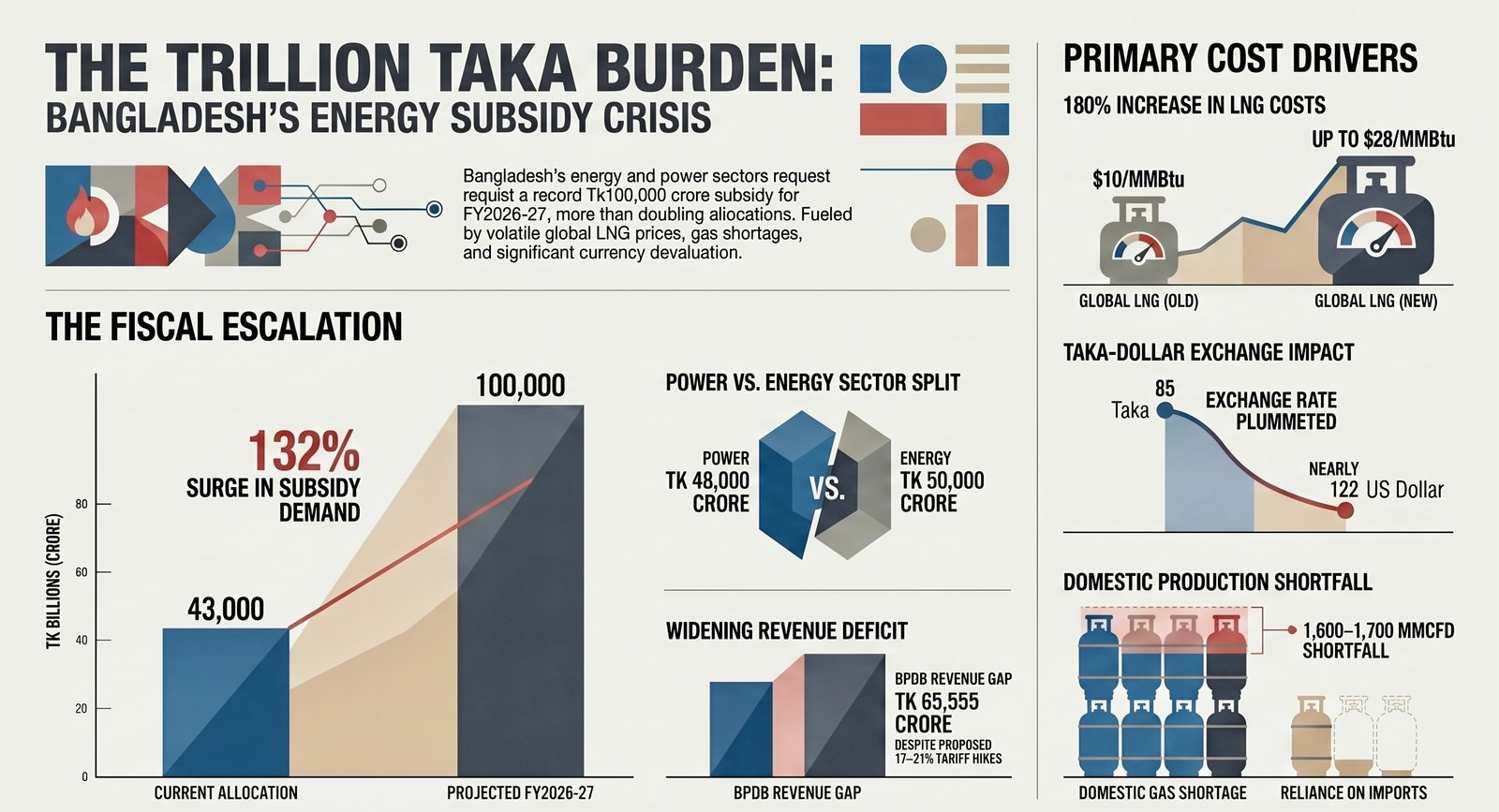
Bangladesh’s Power, Energy and Mineral Resources Ministry has sought nearly Tk100,000 crore in subsidies for the power and energy sectors in the proposed FY2026-27 budget, more than double the allocation of Tk43,000 crore in the current fiscal year, reflecting mounting pressure from rising global fuel costs, LNG imports and growing electricity generation expenses.
The sharp increase in subsidy requirements comes amid heightened uncertainty in global energy markets and a widening gap between production costs and consumer tariffs.
In the current fiscal year (FY2025-26), the government allocated Tk6,000 crore in subsidies for imported liquefied natural gas (LNG). However, the actual requirement is now expected to exceed Tk18,000 crore.
Petrobangla has already received around Tk10,600 crore in subsidies through April and estimates that an additional Tk2,500 crore will be needed in May and nearly Tk5,000 crore in June.
For the first six months of FY2026-27 alone, Petrobangla has proposed Tk27,000 crore in subsidies. Officials estimate the annual requirement could surpass Tk50,000 crore if current market conditions persist.
According to Petrobangla’s projections, the subsidy demand is based on several assumptions, including continued disruptions in global energy supplies, difficulties in LNG procurement, and elevated spot-market prices. If LNG prices remain around $20 per million British thermal units (MMBtu), the subsidy burden could remain exceptionally high.
The ongoing regional conflict involving Iran has significantly disrupted energy markets. At times, Bangladesh has reportedly paid as much as $28 per MMBtu for LNG that previously cost around $10, making budget forecasts increasingly difficult.
With domestic gas production declining and gas shortages ranging between 1,600 and 1,700 million cubic feet per day (MMCFD), the country has little choice but to increase LNG imports to meet growing demand.
The power sector is facing similar challenges. Rising fuel prices have sharply increased electricity generation costs, pushing subsidy requirements far beyond current allocations.
Although Tk37,000 crore was earmarked for power subsidies this fiscal year, the actual shortfall is expected to exceed Tk75,000 crore. The government has already released nearly Tk36,000 crore, while the Bangladesh Power Development Board (BPDB) has sought another Tk10,000 crore for May and June.
For FY2026-27, BPDB has requested Tk48,000 crore in subsidies.
To reduce the subsidy burden, BPDB recently proposed increasing wholesale electricity tariffs by Tk1.20 to Tk1.50 per unit, equivalent to a 17–21 percent rise.
According to BPDB’s submission, the projected cost of electricity generation in FY2026-27 will reach approximately Tk143,108 crore, with the average production cost estimated at Tk12.91 per unit.
At existing wholesale tariff rates, BPDB expects revenue of around Tk77,553 crore, resulting in a deficit of Tk65,555 crore. Even with the proposed tariff increases, the reduction in the deficit would be relatively modest.
BPDB Chairman Engineer Rezaul Karim said the depreciation of the taka against the US dollar has significantly increased costs.
“Most of our payments are made in dollars. The exchange rate has risen from around Tk85 to nearly Tk122 per dollar, creating a substantial financial burden,” he said.
Economists say the government faces a difficult balancing act between fiscal sustainability and protecting consumers from higher energy costs.
M. Masrur Reaz, Chairman of Policy Exchange Bangladesh, said global developments have driven up both fuel prices and supply risks, while domestic gas shortages have forced the country to rely more heavily on expensive LNG imports.
He noted that the power sector is also struggling with significant unpaid liabilities, which must be settled to restore investor confidence and attract fresh investment, particularly in renewable energy.
“Given the current economic situation and inflationary pressures, passing the full cost of energy to consumers is not a realistic option. As a result, increasing subsidies appears unavoidable,” he said.
Finance and Planning Minister Amir Khasru Mahmud Chowdhury told the first session of the National Parliament that the ongoing crisis in the Middle East would require an additional US$3 billion for the energy sector during the current fiscal year.
He said that if the global situation continues, the power and energy sectors are likely to face elevated expenditure in the next fiscal year as well, resulting in sustained financial pressure on the government’s energy budget.
Government spending on power subsidies has risen steadily over recent years, increasing from Tk7,439 crore in FY2019-20 to Tk33,000 crore in FY2023-24.
Energy-sector subsidies have also remained elevated. While LNG import restrictions helped reduce subsidies to Tk8,220 crore in FY2023-24 from Tk21,300 crore a year earlier, the figure rebounded to Tk21,750 crore in the revised budget for FY2024-25 and is now expected to rise sharply again.
With global energy markets remaining volatile and domestic energy demand continuing to grow, policymakers face increasing pressure to balance fiscal constraints, energy security and consumer affordability in the coming fiscal year.