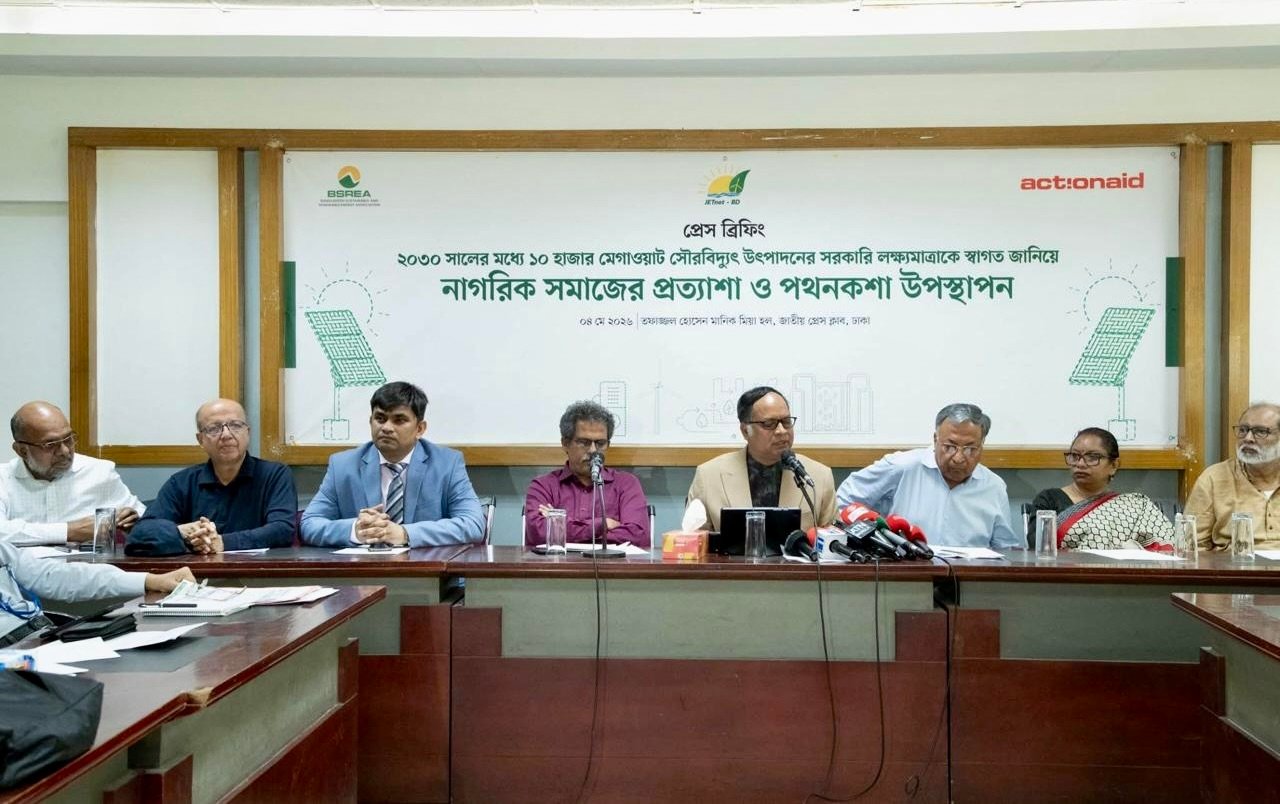
DHAKA, May 4, 2026 — Energy experts and civil society leaders have called on the government to undertake urgent policy reforms—including reducing import duties on solar equipment, streamlining investment procedures, and reallocating fossil-fuel subsidies—to help Bangladesh achieve its target of generating 10,000 megawatts of solar power by 2030.
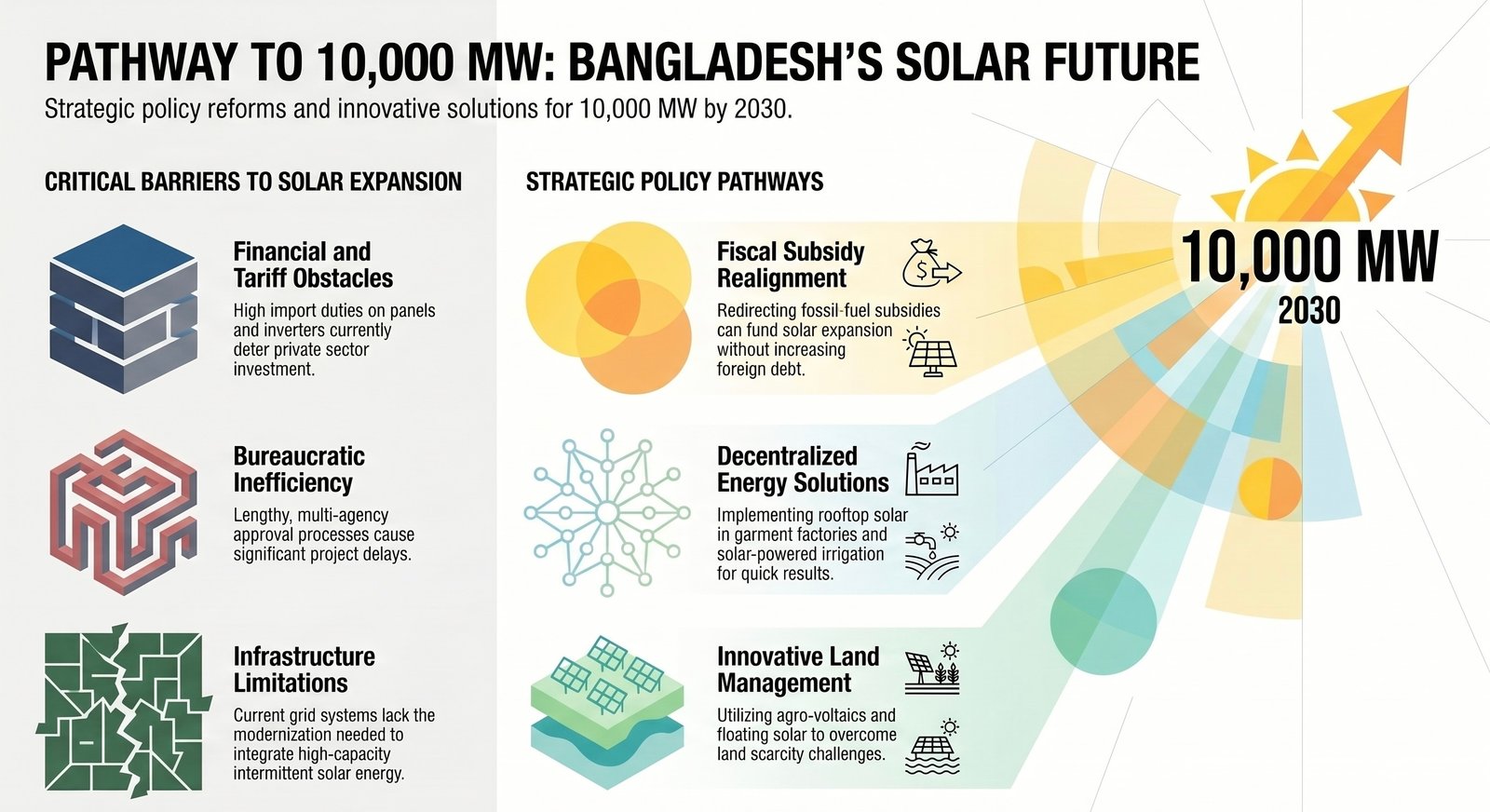
Speaking at a press briefing at the Jatiya Press Club on Monday, participants described the target as ambitious but achievable. However, they warned that bureaucratic delays, high tariffs, and insufficient grid modernization remain major barriers to a timely shift away from imported fossil fuels.
The event was jointly organized by ActionAid Bangladesh, Bangladesh Sustainable and Renewable Energy Association (BSREA) and Just Energy Transition Network Bangladesh.
Energy expert Prof Ijaz Hossain emphasized that integrating 10,000 MW of solar capacity into the national grid could significantly reduce Bangladesh’s reliance on costly LNG and coal imports.
“Solar power is no longer an alternative—it is set to become the backbone of Bangladesh’s energy system,” he said, stressing the importance of Energy Storage Systems to ensure stable supply and utilize excess daytime generation at night.
Shafiqul Alam of the Institute for Energy Economics and Financial Analysis highlighted the untapped potential of rooftop solar installations, particularly across garment factories and large industrial facilities. He noted that stronger net metering policies could incentivize private investment, reduce production costs, and ease pressure on public finances.
Addressing concerns over land scarcity, Dipal Chandra Barua, founder of the Bright Green Energy Foundation, pointed to innovative solutions such as agro-voltaics—where crops are grown beneath solar panels—as well as floating solar and projects in riverine char areas.
Climate finance expert M Zakir Hossain Khan, chief executive of the Change Initiative, said redirecting even a portion of fossil-fuel subsidies could finance solar expansion without relying heavily on foreign loans. He also cautioned against overdependence on large, import-based projects, suggesting that decentralized solutions—such as rooftop and irrigation-based systems—could deliver quick results within months if supported by strong administrative action.
Mustafa Al Mahmud, president of BSREA, identified high import duties on solar panels and inverters as a major deterrent to investment. He also criticized lengthy multi-agency approval processes and called for the introduction of a one-stop, fast-track service for renewable energy projects.
Lipi Rahman emphasized the importance of ensuring that the benefits of solar expansion are distributed equitably. She urged policymakers to include marginalized groups—such as women, smallholder farmers, and micro-entrepreneurs—in the country’s energy transition.
Experts concluded that while the 10,000 MW solar target is technically achievable, it will require a coordinated and streamlined policy framework focused on reducing bureaucratic hurdles, modernizing the grid, promoting decentralized energy systems, and ensuring strong political commitment.