
Bangladesh’s economy is coming under increasing strain from global energy market volatility alongside persistent domestic structural constraints. Rising fuel prices, ongoing dollar shortages, and heavy dependence on imports are placing pressure on industrial production, agriculture, transportation, and everyday livelihoods. These developments raise a fundamental question: is the country experiencing a temporary external shock, or is it gradually becoming locked into a deeper structural “energy trap”?
This question was at the center of a flagship webinar titled “Ajker Agenda: Is the Economy in the Energy Trap?”, organized by the Policy Research Institute of Bangladesh (PPRC). The session brought together policymakers, industry leaders, academics, and civil society representatives to explore both the immediate disruptions and the longer-term structural risks emerging from the current energy crisis.
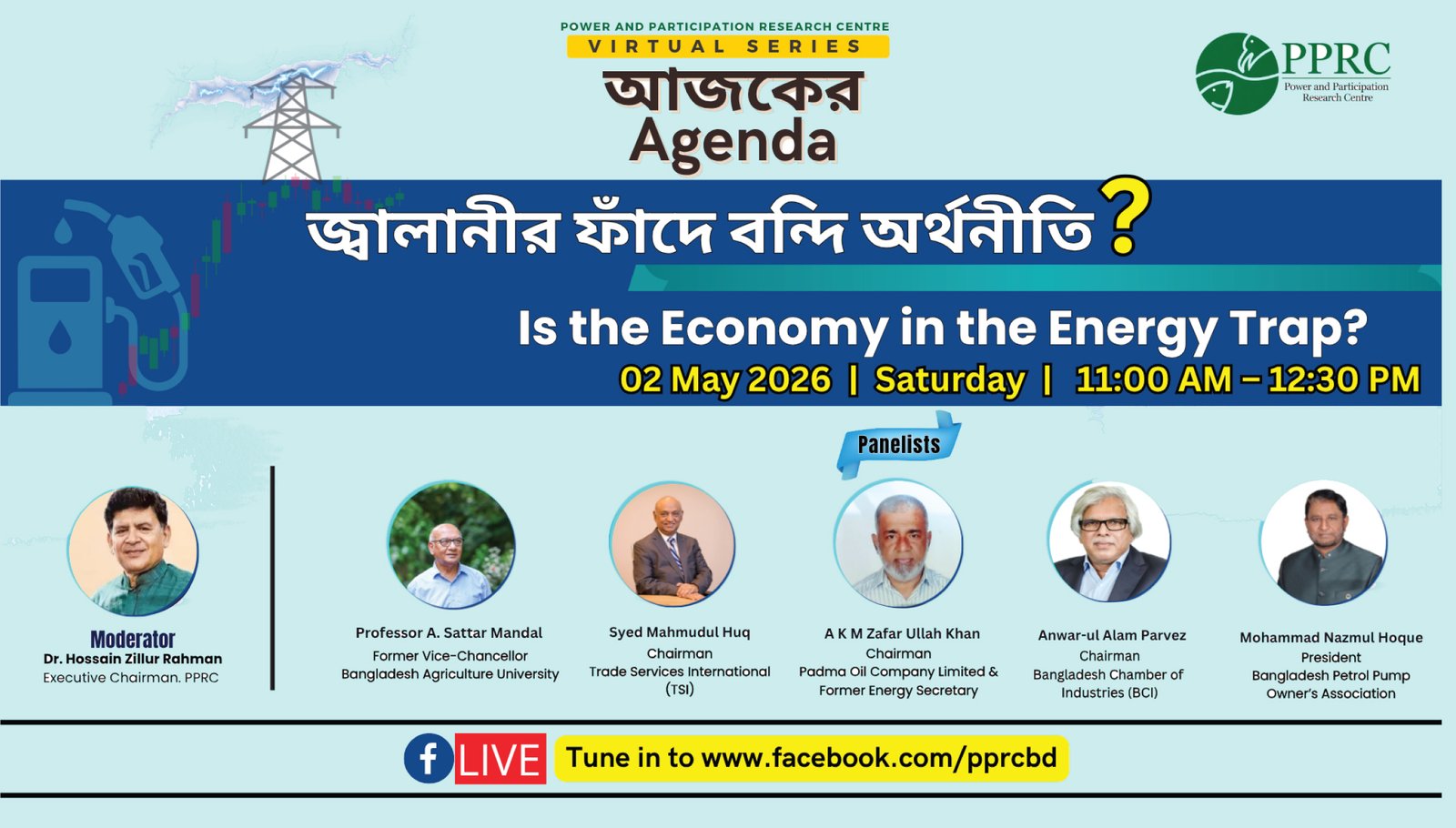
Moderated by PPRC Executive Chairman Dr. Hossain Zillur Rahman, the panel featured Professor A. Sattar Mandal (Former Vice-Chancellor, Bangladesh Agricultural University), Mohammad Nazmul Haque (President, Bangladesh Petrol Pump Owners Association), Anwar-ul Alam Parvez (Chairman, Bangladesh Chamber of Industries), A.K.M. Zafar Ullah Khan (Chairman, Padma Oil Company Limited and Former Energy Secretary), and Syed Mahmudul Huq (Chairman, Trade Services International). The discussion was further enriched by contributions from participants including Mollah Amzad Hossain (Editor, Energy and Power Magazine), Shakiul Millat Morshed (Executive Director, SHISUK), and Khuda Baksh Chowdhury (Former IGP, Bangladesh Police).
From Supply Disruptions to Market Panic
Speakers highlighted how initial supply constraints quickly escalated into widespread market anxiety. Within days, concerns over fuel availability triggered panic buying, leading to a sharp spike in demand. Preventive interventions such as rationing were introduced, but these measures proved insufficient as both consumers and small-scale operators began stockpiling fuel amid uncertainty.
The discussion emphasized that crisis dynamics were not driven by supply limitations alone. Demand-side reactions and gaps in public communication played a significant role in amplifying the situation. Uneven fuel distribution across stations, coupled with intense media coverage of localized shortages, further heightened public perception of crisis.
Structural Weaknesses in Storage and Supply Systems
A.K.M. Zafar Ullah Khan pointed to a critical structural limitation: insufficient storage capacity. He noted that Bangladesh lacks the infrastructure needed to absorb fluctuations in global supply and pricing. While energy prices will inevitably align with international markets, he stressed that ensuring uninterrupted supply must remain the top priority—something current storage limitations make difficult.
Agriculture’s Growing Energy Dependence
Professor A. Sattar Mandal underscored the deepening reliance of Bangladesh’s agricultural sector on fossil fuels. With approximately 4.2 million diesel-powered engines currently in use for irrigation and other farming activities, energy demand in agriculture is both substantial and rising. As mechanization expands and the farming population grows, diesel dependency is expected to increase further—intensifying vulnerability to fuel price shocks.
Macroeconomic Pressure and Import Dependency
Syed Mahmudul Huq highlighted the macroeconomic implications of global energy price volatility. A $5 increase in the international price of oil translates into an additional cost burden of approximately $400–500 million for Bangladesh. Such shocks ripple across the entire economy, affecting fiscal stability, trade balances, and inflation.
He emphasized the need for diversifying supply sources, noting that Bangladesh’s traditional reliance on the Middle East must be broadened to include alternative regions. Strengthening supply security through diversification, he argued, is essential to mitigating external vulnerabilities.
Short-Term Stabilization vs. Long-Term Risks
Panelists observed that while the immediate crisis gradually stabilized through improved demand management and tighter monitoring, underlying risks remain unresolved. Short-term administrative measures—such as restricted business hours—may help contain demand temporarily but can impose unintended costs on micro, cottage, and informal sector activities that depend heavily on evening commerce.
The discussion also pointed to the risks associated with maintaining large fuel inventories in a volatile price environment, particularly in sectors like LPG. This underscores the need for more sophisticated market strategies and risk management frameworks.
Policy Priorities and Strategic Direction
Several actionable priorities emerged from the discussion:
• Expanding storage capacity to improve supply resilience
• Strengthening demand forecasting and crisis preparedness
• Enhancing coordination and communication across institutions
• Diversifying energy sources, including renewables
• Increasing domestic exploration of gas and other resources
Mohammad Nazmul Haque emphasized the importance of accelerating renewable energy adoption alongside expanded gas exploration efforts. Meanwhile, Anwar-ul Alam Parvez called for a multi-tiered policy approach—short, medium, and long term—to ensure energy security. He highlighted the need to maximize existing coal-based generation capacity, maintain regional energy cooperation, and ensure efficient allocation of gas across key sectors such as fertilizer and industry.
Beyond Crisis Management: Toward Energy Transformation
In his concluding remarks, Dr. Hossain Zillur Rahman noted that current responses have largely focused on demand-side controls, often overlooking broader systemic issues. He warned that without strengthening medium-term strategies—particularly in import planning and institutional management—the crisis risks becoming persistent and cyclical.
He also emphasized that Bangladesh’s energy challenge extends beyond oil, encompassing gas, coal, and renewable sources such as solar. Addressing these challenges requires an integrated and diversified energy strategy, supported by stronger institutional capacity and reduced reliance on purely bureaucratic responses.
Importantly, he framed the ongoing crisis as a potential turning point—an opportunity to transform Bangladesh’s energy sector and build a more secure foundation for sustained economic growth.
The webinar concluded with a shared recognition that Bangladesh’s current energy challenges are not merely episodic disruptions but reflect deeper structural vulnerabilities. Addressing these issues will require coordinated policy action, institutional strengthening, and a long-term commitment to diversification, efficiency, and resilience.
Whether the present moment proves to be a temporary shock or a lasting structural trap will depend largely on the country’s ability to translate crisis into reform—and vulnerability into strategic transformation.