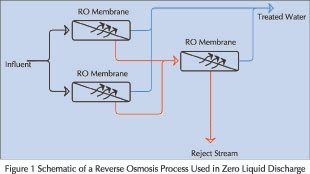
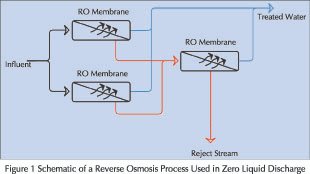
The textile and other industries are being asked by regulatory agencies to think towards implementing zero liquid discharge (ZLD) from their industrial establishments. This is a noble concern with respect to the conservation of our groundwater. The textile industries are clustered around the periphery of our capital city and industrial townships around Dhaka. It has been well publicized that the groundwater table is dropping substantially in this region [1, 2]. The textile processing industry is a water intensive industry; each Kilogram of fabric to be processed requires any were from 30 to 100 liters of water. The present practice is to draw the required water from the underground aquifer. The regulators are currently asking for the industries to treat their generated wastewater and reuse it. For the textile industry which requires soft water for its dyeing calls treating their generated wastewater by using Reverse Osmosis (R.O) as a step in their treatment process to bring down the total dissolved solids to ensure good quality water for their dyeing process. The process of reverse osmosis removes salt from the wastewater so that this water can be reused in the textile processing. In reverse osmosis there are three streams. The first stream is the influent to the system which is the water with high dissolved solids that needs to be treated. The second stream is the treated water stream which is low in total dissolved solids, then there is the third stream which is the reject stream which contains the salt removed from the influent water (refer to Figure 1).
The reject stream is generally ten percent of the influent stream but extremely high in dissolved solids. The concentrations of salt can be as high as 50,000 mg/L and has to be disposed safely. The water regulatory discharge limits of Bangladesh sets the discharge limit of total dissolved solids at 2,100 mg/L, thus the reject stream can have upwards of twenty times the regulatory limit for total dissolved solids. Making the quagmire even worse is the stream also may contain regulated contaminants from the textile dyeing process such as dyes and phenolic compounds. The only way to safely handle the concentrated reject liquid stream is to evaporate the water and safely dispose the residual solids in a hazardous waste landfill. Therein lies the problem. The process of evaporation of the concentrate stream is energy intensive and a country such as Bangladesh has a deficit of energy. To illustrate this point this paper will highlight a case study from a real life textile processing facility which has been mandated by the government to come to zero discharge compliance within a short time.
The Case Study of Existing Textile Manufacturer & Zero Liquid Discharge Compliance
A well established and reputed specialized textile exporter has its textile processingfactory in Gazipu, greater Dhaka in Bangladesh. To keep the identity of the factory of concern anonymous for this study in this paper the factory will be referred to in the text as “Factory X”. To process there fabric and sustain their other operational activities factory X require roughly to date 22, 0000 kW·h of energy per day. To meet the energy demand they generate electricity using natural gas of 8.1 mega watts of electrical power and other 1.0 mega watts of electrical power they buy from the national grid. At present their self power generation capacity is at maximum. The government of Bangladesh is unable to supply them natural gas as such they are limited in their capacity to generate further electric power. Any increase in electric power requirement will have to be met from the national grid. They have asked the government of Bangladesh to increase their electric power supply by 4 mega watt from the national grid but there is a backlog of permission for supply by four years and still pending. This scenario limits their operational ability and places a serious damper on their expansion capacity.
Power requirement for ZLD-Factory X
The current wastewater generation at Factory X is around 6000 m3 per day with an expected anticipated increase to 10,000 m3 per day over the next five years. The government of Bangladesh is requiring that Factory X recycle 90% of their generated wastewater within three years. It also specifies that the rejected process wastewater that cannot be recycled to be treated before discharge to meet all regulatory requirements. It specifies that the concentrate stream to be disposed of by evaporation. In applying reverse osmosis in treating generated wastewater to reuse as process water for dyeing will entail the generation of 1000 m3 of high salt concentration reject stream which need to be evaporated by mechanical evaporation. Based on the complexity of evaporation system the energy required to evaporate varies from 25 kW·h/m3 to 100 kW·h /m3 [3]. To Evaporate 1000 m3 per day the energy requirement could range from 25,000 to 100,000 kW·h/day. What this means that to achieve ZLD goals as required by the government Factory X has to increase their power generation capacity at the minimum from 1.0 to a maximum of 4.0 mega watt of power. There are at present at full power generation capacity with no room for excess power generation and as mentioned in the earlier section the government is unable to provide natural gas so that Factory X can generate the required power or provide from the national grid the required power directly. In all practicality ZLD cannot be achieved due to lack of power.
Let’s Put the Horse before the Cart before Requiring Zero Liquid Discharge (ZLD)
More often than not the regulatory agencies do not fully comprehend the situation at the ground level before they promulgate there regulations. This paper clearly showed with the help of the case study that ZLD cannot be achieved without the supply of natural gas or grid power to the textile processing industries. In the current situation in Bangladesh where energy is scarce the possibility of immediate ZLD from industries is a difficult proposition. The Government of Bangladesh could require recycle of the treated wastewater but give a waiver for reject water discharge till there is sufficient energy available in the Bangladesh energy mix to sustain operation of evaporators. Definitely ZLD but let’s put the horse before the cart before we move on with ZLD.
References
- World Bank. (2014) .The Bangladesh Responsible Sourcing Initiative. A New Model for Green Growth. World Bank. 1818 H Street, N.W. Washington DC 20433, USA.
- Department of Environment. Guide for Assessment of Effluent Treatment Plants. 2008. Department of Environment, Ministry of Environment and Forest. Government of Bangladesh. 3-9-4-10 pp.
- J. Bostjancic and R. Ludlum. (1994). Reducing Wastewater to Dryness: Zero Liquid Discharge Case Studies at New Power Plants.Resources Conservation Company (RCC). P1046EN.doc. www.ge.com/water.
Dr. Nadim Reza Khandaker & Samia Davina Rahman;
Faculty of Civil and Environmental Engineering,
North South University, Bangladesh.
Corresponding Author’s Email: nadim.khandaker@northsouth.edu