In a recent trip to a gas drilling blowout crater in Sylhet gas field, it was disconcerting to see that in a blowout crater approximately 500 m2 in area now filled with water where natural gas is constantly being released unabated. One might add that the release of the gas is with significant pressure and localized in certain areas of the pond clearly visible on the surface of the crater pond (Figure 1 below). To the locals, the crater is known as Utlar Par a verbal explanation of the phenomenon they are observing in the crater of the gas bubbling out just like when water boils in a pot. The local guides put on a show for the tourist where they set the surface gas bubbles on fire (Figure 2 below). The blowout occurred in 1955, when a well was drilled to a depth of 2,377 meters and gas was found, after casing was set, a blowout occurred and a large crater was formed into which the drilling rig sank. The crater is filled with water and existing as a pond which is today still there and known as Utlar Par and vent gas from the subsurface to the atmosphere unabated year round since 1955 [1]. In the new nexus of climate change and global warming and Bangladesh is directly being affected by greenhouse gas emission, it is prudent for the stylet gas field operators to take a second look at how to mitigate the unabated release of natural gas and put it to beneficial use.
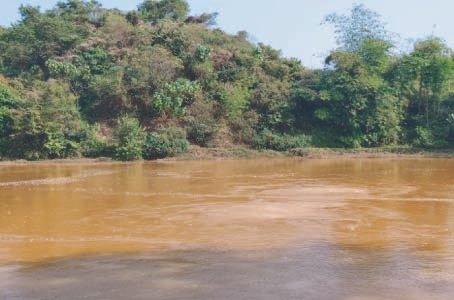
Figure 1: Clearly visible release of gas at Utlar Par Sylhet Gas Field
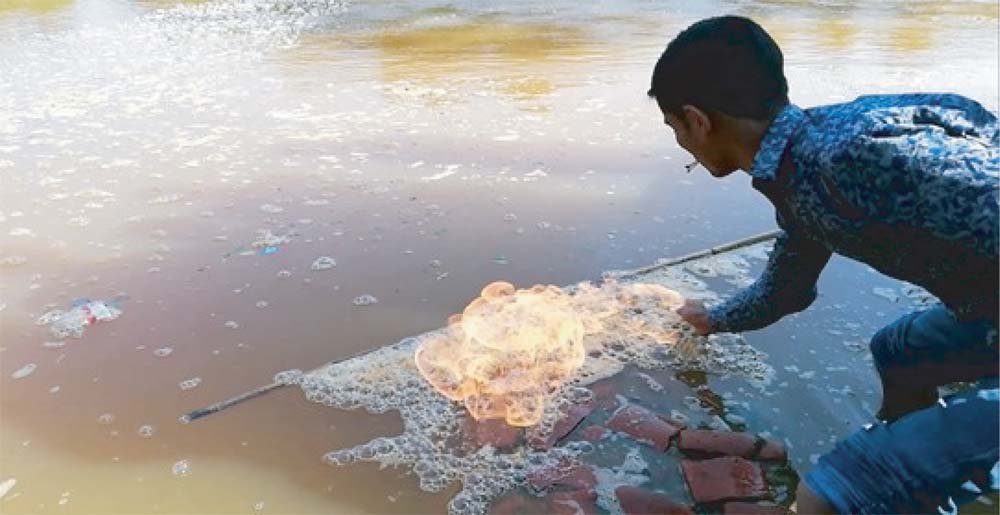
Figure 2: Guides setting fire to the gas bubbles at Utlar Par Sylhet Gas Field
As an applied research project at the location where the gas was bubbling was covered by plastic sheet and the gas collected to show that the gas can be retrieved very easily and put to beneficial use rather than unabated release to the atmosphere. Gas impermeable membrane (geomembrane covers) are commonly used to cover anaerobic lagoon used in wastewater treatment and the biogas generated that bubbles out of the liquid is trapped in a head space between the liquid surface and the membrane and then is drawn of for beneficial use as combustible fuel for boilers or for fuel to power combustion engines to generate electrical power [2]. In the limited applied research as a proof of concept, the escaping gas was trapped using simple gas impermeable locally available plastic sheet and was further ignited to show that it was of sufficient methane content to support combustion.
A 500 m2 pond can easily be covered by geomembrane, the collected gas then can be put to beneficial use. The technology is proven in the biogas industry [2] and what is required is the will to try in a different application. As researchers our research team is willing to work with the Sylhet Gas Field Authorities to explore the viable mitigation option that we have shown to be viable in a limited scale.
Reference:
Md. Ashraful Islam Khan, Fuad Bin Nasir. (2014). A Review Over Major Gas Blowouts In Bangladesh, Their Effects And The Measures To Prevent Them In Future. International Journal of Scientific and Technology Research. Vol. 3:9. Page 109-113.
J. DeGarie, T. Crapper, B.M. Howe, B.F. Burke and P.J. McCarthy. (2000). Floating Geomembrane Covers for Odour control and Biogas Collection and Utilization in Municipal Lagoons. Water Science and Technology Vol.42:10–11 pp 291–298.
Nadim Reza Khandaker, Ph.D.P.Eng.
North South University,
Dhaka Bangladesh and College of Science and Technology,
Royal University of Bhutan