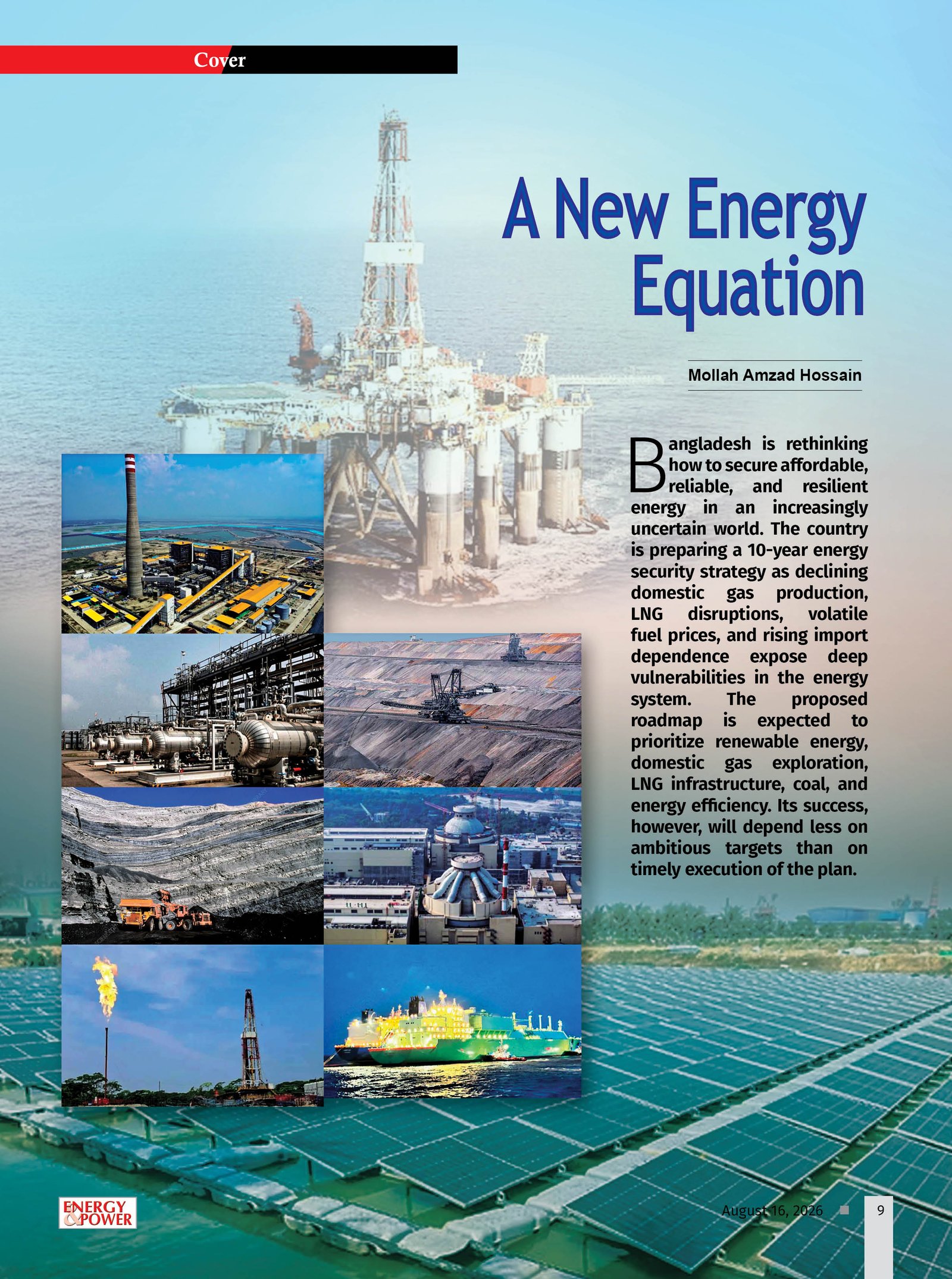
Bangladesh is moving toward a 10-year energy security strategy as prolonged gas shortages, disruptions to LNG supplies, volatile global fuel prices, and rising import dependence expose vulnerabilities in the country’s energy system. The proposed strategy is expected to place greater emphasis on domestic gas and coal resources, renewable energy, energy efficiency and expanded LNG infrastructure.
The urgency has been underscored by the recent energy crisis, which disrupted power generation, industrial production, transportation and household energy supplies. The challenge now is not simply to restore supply, but to build a more diversified, resilient and economically sustainable energy system capable of withstanding future global shocks.
Gas Shortage Hits Industry and Power Generation
Bangladesh’s gas crisis, however, predates the recent geopolitical turmoil. The country has been experiencing persistent gas shortages for around five years, while domestic production has continued to decline.
Domestic gas production has now fallen below 1,700 MMCFD. Under relatively normal conditions, Bangladesh could receive around 1,000 MMCFD of LNG, against estimated demand of around 4,000 MMCFD, leaving a deficit of approximately 1,300 MMCFD.
As a result, industries were already receiving around 30% less gas than their requirements.
Over the past month, however, LNG supply has fallen to around 600 MMCFD, pushing the industrial gas shortfall to roughly 50% of demand.
Gas supplied to gas-fired power plants has also fallen to around one-third of their requirements. As a result, only around 30–40% of Bangladesh’s 12,472MW gas-fired power generation capacity can reportedly be operated.
Although coal-fired power plants are being operated at high utilization levels, the shortage has increased dependence on furnace oil-based generation. However, large unpaid bills owed to the private power sector have also limited the government’s ability to fully utilize this generation capacity.
Fertilizer, Transport and Households under Pressure
The gas supply situation has also severely affected the fertilizer sector. Gas allocation to fertilizer plants has been reduced to a minimum, with only two fertilizer factories currently operating.
The resulting decline in domestic fertilizer production is increasing import dependence, while reports of seasonal fertilizer shortages have already emerged.
The transport sector has also faced CNG supply constraints for nearly a month. The situation is even more difficult for households dependent on piped gas for cooking, forcing consumers to use alternative fuels despite continuing to pay for piped gas services.
A major concern is that Petrobangla and the Energy and Mineral Resources Division have yet to provide a clear timeframe for restoring LNG supplies to previous levels.
The summer peak electricity demand is expected to continue until September. Even if LNG supplies recover soon, there is still uncertainty over how much load-shedding can be reduced.
Government Moves Toward a Long-Term Strategy
Amid the crisis, Prime Minister Tarique Rahman has been consulting leaders of various industrial organizations on possible solutions to the country’s energy and power shortages and seeking their recommendations.
Under his direction, a renewable energy development strategy has also been finalized with a target of adding 10,450MW of renewable energy capacity by 2030.
According to the strategy, Bangladesh’s total electricity demand is projected to reach around 135,000 GWh annually by 2030, of which approximately 27,000 GWh, or 20%, would come from renewable sources.
The Prime Minister has also called for the formulation of a 10-year energy security plan following his visit to the Matarbari coal-fired power plant.
Relevant government agencies have already started working on the plan. Once the draft is finalized, it is expected to be placed before Parliament for approval. The plan will reportedly provide a framework for short-, medium- and long-term actions in the energy sector.
Renewable Energy Expansion
Since taking office, the BNP-led government has placed strong emphasis on rapidly increasing renewable energy capacity. The government initially announced plans to add around 10,000MW of renewable generation capacity by 2030, which has subsequently been reflected in the broader strategy targeting 10,450MW.
As an initial measure, the FY2026–27 budget introduced duty-free import facilities for solar panels, batteries and related equipment.
However, questions were raised over the initial scope of the tax benefits, prompting the National Board of Revenue (NBR) to introduce amendments.
Industry stakeholders nevertheless allege that renewable energy entrepreneurs are still not receiving the benefits announced in the budget. They reportedly continue to face a 2% advance income tax and 15% VAT on certain imports.
Solar panels and associated equipment for industrial installations had previously enjoyed duty-free import facilities, but businesses now reportedly face additional duties and VAT.
Energy Minister Iqbal Hassan Mahmood has told business representatives that the government is prepared to resolve the issue if specific cases are brought to its attention.
Energy Security Requires a Shift in Strategy
The ongoing crisis has exposed Bangladesh’s vulnerability to excessive dependence on imported primary energy. LNG, coal and petroleum imports are increasingly vulnerable to geopolitical disruptions, volatile international prices and supply-chain problems.
The proposed 10-year energy security plan is therefore expected to focus on diversifying the energy mix, increasing domestic gas and coal production, accelerating renewable energy deployment, improving energy efficiency and strengthening fuel import infrastructure.
Reducing import dependence will ultimately require greater use of Bangladesh’s own energy resources alongside renewable energy and nuclear power, while ensuring that environmental and economic considerations are incorporated into investment decisions.
For Bangladesh, the immediate challenge is to restore reliable gas and electricity supplies. The longer-term challenge is to build an energy system that is more diversified, domestically anchored, financially sustainable and resilient to international shocks.
Renewable Energy, Domestic Gas and LNG Infrastructure Key to Bangladesh’s 10-Year Energy Strategy
Bangladesh is preparing a 10-year energy plan that is expected to prioritize renewable energy, efficient use of energy, domestic gas exploration and expansion of LNG import infrastructure to strengthen energy security and reduce dependence on imported fuels.
The plan is expected to incorporate a strategy to accelerate renewable energy development, with a target of significantly expanding clean power generation by 2030.
Bangladesh Engineer Shafiqul Alam, Lead Energy Analyst at the Institute for Energy Economics and Financial Analysis (IEEFA), said the renewable energy target is ambitious but achievable.
“However, SREDA’s institutional capacity must be strengthened, and the policy incentives already announced must be made accessible to private investors,” he said.
Dr. Masrur Reaz, Chairman of Policy Exchange Bangladesh, stressed that restoring investor confidence is essential for developing the renewable energy sector. He said the government should review the 37 Letters of Intent (LoIs) cancelled during the interim government’s tenure.
He noted that although the Energy Minister had promised to review the cancellations, no such review had been carried out over the past six months.
Monirul Islam, acting Managing Director of Infrastructure Development Company Limited (IDCOL), said residential rooftop solar combined with battery storage could significantly reduce pressure on the national grid.
“We have already started working on this. A pilot project for 3–5 kWp rooftop solar systems with storage is expected to begin soon,” he said.
Industry experts believe the expansion of solar power could reduce pressure on grid electricity, lower fuel import requirements and make a significant contribution to Bangladesh’s energy transition. Renewable energy development and energy efficiency are therefore expected to become major pillars of the 10-year strategy.
Focus on Domestic Gas
Bangladesh’s industrial and commercial sectors remain heavily dependent on natural gas. Petrobangla estimates peak gas demand at around 4,000 MMCFD, although sector experts question the accuracy of this figure.
An analysis of gas demand submitted by Petrobangla companies during tariff adjustment proposals suggests that connected demand may be as high as 5,300 MMCFD.
Domestic gas production currently stands at slightly above 1,600 MMCFD and is declining by around 150 MMCFD annually. More concerning is the country’s heavy dependence on the Bibiyana gas field, which accounts for about 45% of current domestic gas supply and is experiencing declining production.
Analysts attribute the current gas shortage partly to inadequate exploration over the past 15 years.
A drilling program involving 50 wells plus another 100 wells has been underway since 2022, with 29 wells completed so far. Although the program has increased production capacity by around 274 MMCFD, only about 140 MMCFD has been added to the national grid. Experts say this has not been sufficient to offset the decline in existing fields.
There is also no guarantee that domestic production will reach 2,000 MMCFD even after the full drilling program is completed.
Petrobangla sources said development work at the Chhatak gas field has been stalled because of a dispute related to the Niko case. Authorities are considering drilling an exploratory well and conducting a 3D seismic survey.
Former BAPEX Managing Director Murtaza Ahmed Faruque said Petrobangla should drill three to four exploration wells at Chhatak within the next six months, arguing that the field has strong prospects for early gas production.
Meanwhile, offshore bidding has already been invited, while preparations are underway to finalize onshore production-sharing contracts (PSCs) and invite bids within a short period. Domestic exploration is expected to receive priority under the 10-year plan.
The government is also considering connecting gas from Bhola to the national grid through a pipeline. Although no final decision has yet been taken, the project is expected to receive priority under the long-term energy strategy, as Bhola is increasingly being viewed as a potential alternative to Bibiyana.
Bhola currently has 10 development wells, with five more under development and another five included in future plans.
LNG Infrastructure Expansion
Energy sector stakeholders believe Bangladesh will need to increase LNG import infrastructure capacity to at least 2,500 MMCFD by 2030 and 3,500 MMCFD by 2035. Current capacity is around 1,100 MMCFD.
Negotiations are underway with Chinese company CNEE to establish another floating storage and regasification unit (FSRU). The negotiations are expected to conclude in August, with a possible agreement in September. Construction and installation would then require at least two years.
Energy Minister Iqbal Hassan Mahmood has said the government is considering three additional FSRUs beyond the existing two, along with a land-based LNG terminal at Matarbari. A pipeline from Maheshkhali to Dhaka is also under consideration and could be incorporated into the long-term plan.
Government officials say expanding LNG import infrastructure is essential to ensuring a reliable energy supply.
According to Petrobangla sources, the process of appointing a consultant for the proposed land-based LNG terminal is nearing completion. However, the terminal is unlikely to become operational before 2032.
Officials believe that, if the government moves quickly, a fourth and fifth FSRU could potentially be added by 2030.
Bangladesh currently has long-term LNG supply agreements with five companies from three countries, while efforts are underway to diversify suppliers and increase the number of long-term contracts.
Energy Shortages Could Constrain Industrial Growth
Energy sector analysts warn that gas shortages could continue to worsen until new exploration projects and LNG infrastructure become operational. This could put existing industries under increasing pressure while discouraging new industrial investment.
Moynul Islam, President of the Bangladesh Ceramic Manufacturers and Exporters Association and Chairman of Monno Ceramic, said the previous government’s decision to cancel Summit Group’s FSRU agreement was a mistake. Had the agreement remained in place, the terminal could have started supplying gas by now, he argued.
Economist Dr. Masrur Reaz also called for the government to reconsider the canceled Summit FSRU agreement as part of efforts to resolve the energy crisis quickly. He also urged the authorities to revive negotiations on RLNG imports and another FSRU project that had previously been canceled.
Without accelerating these initiatives, he warned, the government’s target of resolving the energy crisis within two years may not be achievable.
The emerging 10-year energy strategy is therefore expected to combine renewable energy expansion, domestic gas exploration, LNG infrastructure development and energy efficiency. Experts say timely implementation, institutional reform and stronger investor confidence will be critical to ensuring that the strategy translates into greater energy security and sustained industrial growth.
Bangladesh Weighs Domestic Coal as Key to Future Energy Security
Bangladesh is reassessing the role of domestic coal in its long-term energy security strategy as rising import dependence, gas shortages and growing electricity demand put increasing pressure on the country’s energy sector.
The country currently has around 7,312MW of coal-fired power generation capacity. Except for the 525MW Barapukuria power plant, which uses domestic coal, the other coal-fired plants depend on imported coal. The government has spent around US$1.4 billion on coal imports for these plants.
Although Barapukuria uses locally produced coal, its production costs remain high because of inefficient mining practices. The mine was originally planned to produce 64 million tonnes of coal over 64 years, but only around 15 million tonnes have been extracted so far. Given the mine’s current condition, experts estimate that no more than another four million tonnes may be recoverable.
Bangladesh has five identified coalfields with substantial reserves. These include Jamalganj, Phulbari, Khalaspir, Dighipara and Barapukuria. The estimated reserves are around 7.8 billion tonnes, with Jamalganj alone accounting for approximately 5.45 billion tonnes.
Among the major undeveloped coalfields, Phulbari has remained at the center of debate. A detailed feasibility study and Scheme of Development have already been submitted to the government, but the proposal has remained undecided for nearly two decades. The field has the potential to produce around 15 million tonnes of coal annually, which could meet a significant portion of the coal requirement for power generation in Bangladesh.
Professor M Tamim, Vice-Chancellor of Independent University, Bangladesh, said there was no fundamental economic or technological barrier to developing domestic coal resources. “I see no obstacle to extracting coal from an economic assessment perspective. The technology is available. What is needed is a political decision,” he said.
He suggested that the Phulbari development proposal could be independently evaluated before a final decision is taken. Alongside renewable energy, he said Bangladesh would need to consider coal and nuclear power to meet future electricity demand.
Mining engineer Dr. Mushfiqur Rahman, speaking to Energy & Power, said developing a coal mine would be difficult for the private sector to undertake alone under the current circumstances.
“The government needs to become a partner. After completing the overall planning, land acquisition and project development would have to proceed simultaneously, which would be extremely difficult for the private sector to undertake independently,” he said.
Finance and Planning Minister Amir Khosru Mahmud Chowdhury recently indicated that the government was considering open-pit coal mining at Phulbari, saying there was no alternative.
Government sources said domestic coal production and utilization are being considered as important components of the proposed 10-year energy security plan. Once the plan is approved by Parliament, work on developing domestic coal resources could begin, with Phulbari likely to receive priority. The development potential of Barapukuria, Khalaspir and Dighipara would also be reviewed.
The Energy Division is reportedly preparing a 10-year framework covering the country’s primary energy supply, including domestic coal and gas, exploration and utilization, expansion of LNG import infrastructure, renewable energy, financing requirements and private-sector investment.
The plan is expected to provide the basis for a detailed roadmap and implementation strategy.
Professor Shamsul Alam, energy adviser to the Consumers Association of Bangladesh (CAB), said the energy sector was in critical condition and required a clear long-term policy direction.
He said the government should develop a 10-year strategy to transform the energy sector into an efficient and service-oriented sector capable of ensuring national energy security.
Professor Tamim also called for electricity and gas demand to be determined through sector-specific assessments rather than simply as a ratio of GDP. He said the government should clearly define priorities for gas use and avoid developing additional grid-connected gas-fired power plants except for peaking capacity.
He recommended prioritizing utility-scale solar projects where government land and grid evacuation facilities are available, while allowing rooftop solar expansion to be driven primarily by the private sector.
He said Bangladesh would need to finalize a balanced future energy mix in which renewable energy is complemented by coal and nuclear power to ensure reliable electricity supply while reducing carbon emissions. Experts also stressed the importance of energy efficiency and conservation to reduce future demand.
Conclusion
A comprehensive 10-year energy plan, they said, should assess domestic gas and coal resources, exploration potential, import requirements and renewable energy development, followed by a clear implementation mechanism.
Bangladesh has previously responded to energy challenges through major policy and investment initiatives, including offshore oil and gas exploration, private-sector participation in power generation, private investment in LPG distribution and the expansion of solar home systems in rural areas.
The current crisis, however, is more complex because of the country’s high dependence on imported energy.
Download Cover As PDF/userfiles/EP_24_05_Cover.pdf