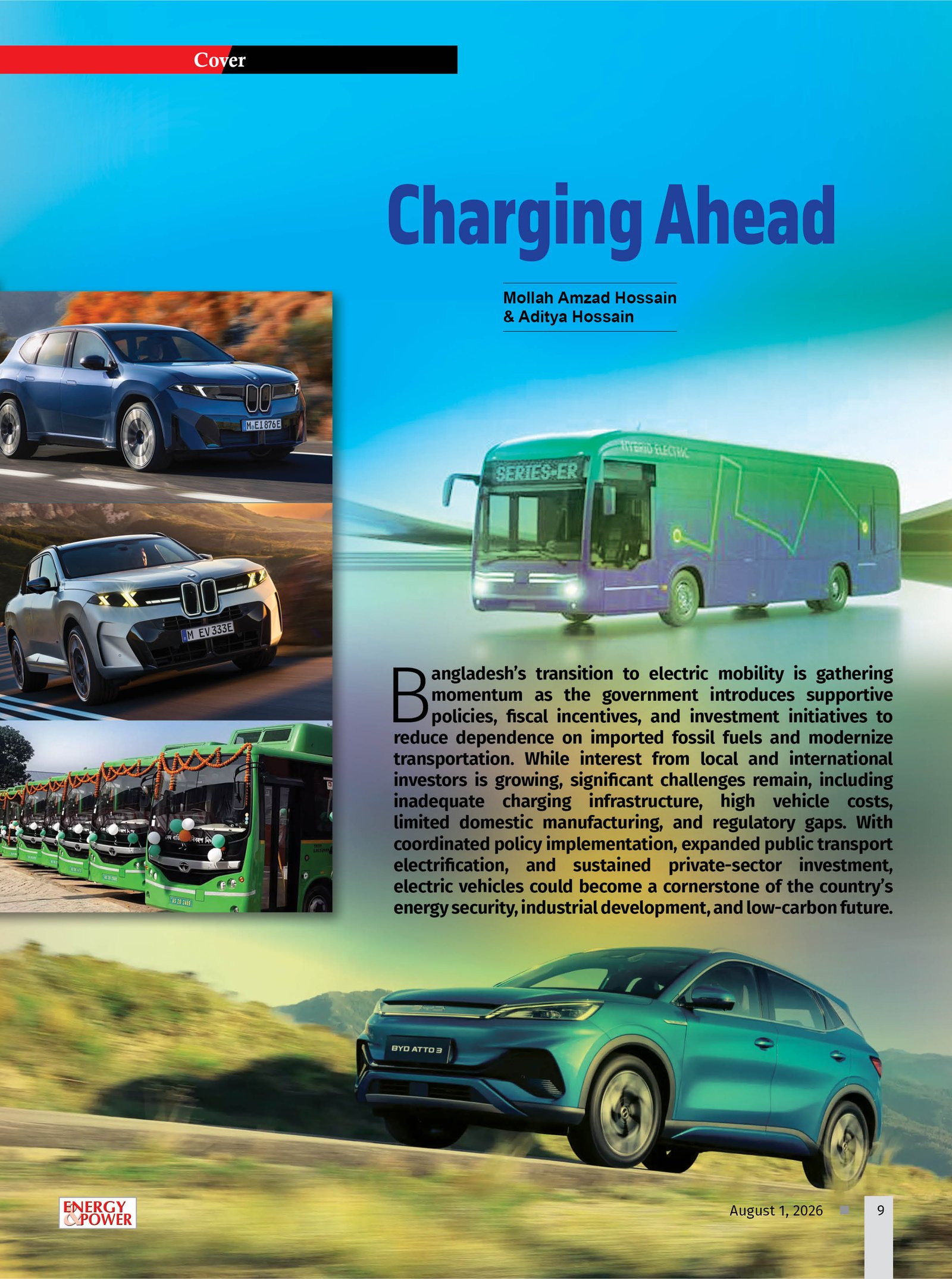
Bangladesh's transition to electric mobility has moved beyond environmental ambition to become a strategic economic imperative. As the country grapples with rising fuel import costs, persistent energy insecurity, and growing urban pollution, electric vehicles (EVs) are emerging as a viable pathway toward cleaner transportation, lower operating costs, and reduced dependence on imported fossil fuels.
Yet the road ahead is far from straightforward. While the government has unveiled ambitious targets, generous fiscal incentives, and plans to electrify public transport, Bangladesh must still overcome major obstacles—including limited charging infrastructure, high vehicle costs, weak domestic manufacturing capacity, and an underdeveloped regulatory framework. Whether the country can build a sustainable EV ecosystem over the next decade will depend not only on policy commitments but also on coordinated investment, technological innovation, and long-term planning.
.jpg)
Although the country's EV market remains in its infancy, experts believe that strong government initiatives, growing private-sector investment, and increasing interest from international development partners could transform Bangladesh into a significant EV market over the next decade.
A Transport System Dependent on Imported Fuels
Bangladesh's transport sector relies heavily on imported fossil fuels. Of the approximately six million tonnes of petroleum products consumed annually—including diesel, octane, and petrol—around 70 percent is used by the transport sector.
In addition to petroleum fuels, compressed natural gas (CNG) and liquefied petroleum gas (LPG) are widely used for vehicles. However, persistent natural gas shortages have placed CNG-powered vehicles under increasing pressure. Drivers often spend hours waiting to refuel, reducing productivity and increasing operating costs.
Meanwhile, rising international oil prices have significantly increased transportation costs. Although domestic diesel prices have been adjusted upward, the government continues to provide substantial subsidies to shield consumers from the full impact of higher global energy prices.
Bangladesh has also witnessed the rapid and largely unregulated expansion of lead-acid battery-powered electric rickshaws. Because many operate without official registration, reliable statistics on their actual numbers remain unavailable.
Experts warn that the improper use and disposal of lead-acid batteries pose serious risks to soil and water quality. The absence of regulated charging facilities has also resulted in widespread electricity losses and unsafe power connections. Moreover, the rapid growth of unregulated battery-powered rickshaws has contributed to traffic congestion and road safety concerns, particularly in Dhaka.
Experts therefore argue that these three-wheelers should be incorporated into the formal EV framework through mandatory registration, standardized safety regulations, and the gradual replacement of environmentally hazardous lead-acid batteries with cleaner and more sustainable technologies.
Government Policy Priorities
Promoting green transportation has become one of the government's key policy priorities. It aims to ensure that 30 percent of all vehicles on Bangladesh's roads are electric by 2030.
As part of the government's election commitments, Prime Minister Tarique Rahman has emphasized the development of a modern, environmentally friendly, and carbon-neutral transport system.
Under his directive, the government has initiated the procurement of electric buses for the Bangladesh Road Transport Corporation (BRTC), along with electric minibuses dedicated to improving safe transportation for women.
The government has also decided to gradually electrify its own vehicle fleet.
Recently, the Finance Division approved a Tk 4 billion loan for BRTC to procure 100 electric buses. In addition, all ministries, government departments, autonomous organizations, and state-owned enterprises have been instructed to purchase only fully electric vehicles for new acquisitions under both development and operating budgets.
Another initiative is underway to procure 100 electric minibuses through BRTC to provide safer transportation for women.
Fiscal Incentives and Investment Promotion
To encourage investment in the EV industry, the government has introduced a series of fiscal incentives designed to attract both domestic and foreign investors.
These include:
* Duty and tax exemptions on the import of electric buses and trucks through 2030.
* Elimination of taxes on EV charging equipment, reducing the rate from 39.75 percent to zero.
* A 10-year corporate income tax holiday for companies establishing EV charging stations.
* Policy support to encourage local assembly and manufacturing instead of importing fully built vehicles.
Bangladesh Bank has also expanded its green finance program to support environmentally friendly technologies and renewable energy projects, creating opportunities to finance EV manufacturing and related industries.
Potential for Electric Public Transport
The greatest transformation from EV adoption is expected in Bangladesh's public transportation system.
BRTC currently operates a fleet of more than 1,000 buses and plans to gradually replace conventional buses with electric models. Significant opportunities also exist for electric buses in city corporations, metro rail feeder services, and intercity transportation.
Experts believe that introducing route-based electric bus services in Dhaka and other major cities could substantially reduce fuel consumption while significantly improving urban air quality.
Since Bangladesh's public transport system is largely operated by private companies, experts recommend developing a clear national roadmap that establishes timelines for the gradual transition from fossil fuel-powered buses to electric fleets.
They also stress the need for nationwide charging infrastructure and easier access to low-interest financing for private operators investing in electric mobility.
The Private Passenger Vehicle Market
Electric vehicles still account for only a small share of Bangladesh's private car market. Although overall car ownership remains relatively low compared with many countries, several barriers continue to discourage consumers from switching from gasoline- or CNG-powered vehicles.
The principal challenges include:
* High purchase prices
* Limited charging infrastructure
* Inadequate after-sales service
* Concerns about battery life
* An underdeveloped resale market
Nevertheless, alongside established global manufacturers, Chinese brands such as BYD, MG, Changan, Geely, Neta, and Dongfeng are steadily expanding their presence in Bangladesh. Industry observers expect EV prices to become more affordable once local assembly begins.
Experts argue that imported EVs remain beyond the reach of most Bangladeshi consumers. Expanding domestic assembly and manufacturing would reduce costs while strengthening the country's industrial base.
Access to affordable financing also remains a major obstacle. They therefore recommend government-backed financing programs and lower-interest loans to accelerate EV adoption.
Lower Operating Costs, Higher Efficiency
A recent seminar organized by the Dhaka Chamber of Commerce and Industry (DCCI) highlighted the significant economic advantages of electric vehicles over conventional internal combustion engine vehicles.
According to presentations at the seminar, operating an EV costs only Tk 2.80-3.80 per kilometer, compared with Tk 11-14 per kilometer for petrol-, diesel-, or CNG-powered vehicles.
Maintenance costs are also estimated to be 30-50 percent lower because EVs have fewer moving mechanical parts and no internal combustion engine.
In addition, EVs achieve energy efficiency of 75-90 percent, substantially outperforming conventional vehicles and making them a more economical and environmentally sustainable transportation option over the long term.
EV Investment Landscape
According to the Bangladesh Economic Zones Authority (BEZA), Bangladesh Auto Industries Ltd. has become the country's first EV manufacturer. The company has invested nearly Tk 10 billion in an EV manufacturing facility on a 100-acre site at the National Special Economic Zone in Chattogram. Managing Director Mir Masud said an additional Tk 5-6 billion in investments is planned.
Nasir Group plans to invest Tk 5 billion in EV manufacturing and charging infrastructure, while Akij Group has announced a similar investment. Runner Group, which currently imports and markets BYD vehicles, is also moving into domestic manufacturing. According to Managing Director Amid Sakif Khan, Runner plans to invest Tk 3.5-4.0 billion in an EV manufacturing facility, in addition to the Tk 2 billion already invested at its Bhaluka factory.
RANCON Group has announced plans to invest Tk 2.0-2.5 billion in EV manufacturing and charging infrastructure. Walton and PRAN-RFL Group are each planning investments of around Tk 2 billion, primarily in electric scooter production.
According to the Bangladesh Investment Development Authority (BIDA), investment proposals worth approximately Tk 2.45 billion have been received from 14 local and foreign companies covering EV assembly, lithium-ion battery manufacturing, spare parts production, and IoT-enabled charging networks.
Market Outlook
Several international brands—including BYD, BMW, Mercedes-Benz, and Audi—are now selling EVs in Bangladesh. Combined annual sales are estimated at 200-300 vehicles.
According to Faisal Ahmed, Head of Sales at Mercedes-Benz Bangladesh, a conventional vehicle typically requires Tk 15,000-20,000 per month in fuel expenses, whereas an EV covering the same distance incurs electricity costs of only Tk 2,000-3,000. Electric buses offer similar operating cost advantages.
Although the latest national budget reduced taxes on standard EVs, it increased duties on luxury EVs while lowering import duties on plug-in hybrid vehicles.
Industry representatives say the lack of charging facilities remains the biggest obstacle. Importers have therefore begun financing a limited number of private charging stations, but large-scale public investment will be essential for widespread EV adoption.
According to the Bangladesh Road Transport Authority (BRTA), 830 EVs had been registered by June this year. Registrations increased from just four vehicles in 2021 to 478 during the first half of 2026 alone, indicating that the market is beginning to gain momentum.
Charging Infrastructure Remains the Biggest Challenge
Experts agree that a reliable nationwide charging network is the single most important prerequisite for large-scale EV adoption.
Although a handful of private companies have established charging stations, Bangladesh will require an extensive network of fast chargers along highways, in major cities, shopping centers, residential areas, and government facilities.
Experts also recommend that electricity distribution companies develop smart grids, introduce time-of-use electricity tariffs, and integrate renewable energy into EV charging systems.
Solar-powered charging stations equipped with battery storage could further reduce pressure on the national grid while creating new green jobs.
Role of Development Partners
International development partners are actively supporting Bangladesh's transition toward electric mobility.
Organizations including the World Bank, Asian Development Bank (ADB), Japan International Cooperation Agency (JICA), GIZ, UNDP, UNEP, and the International Finance Corporation (IFC) are providing policy support, technical assistance, and climate finance for sustainable transportation initiatives.
Bangladesh could also benefit from international climate funds to finance low-carbon transport and EV infrastructure in the years ahead.
Expert Perspectives
Dr. Khondaker Golam Moazzem, Research Director at the Centre for Policy Dialogue (CPD), argues that importing EVs alone will not be sufficient. Bangladesh must simultaneously develop domestic manufacturing, charging infrastructure, battery management systems, and financing mechanisms. Without consistent long-term policies, he says, the industry cannot achieve sustainable growth.
Dr. Rashed Al Mahmud Titumir, Adviser to the Prime Minister on Finance and Planning, recently emphasized that the energy transition is not merely an environmental necessity but also an economic strategy. He called for greater investment in domestic manufacturing of batteries, solar technologies, and related components.
Engr. Shafiqul Alam, Lead Energy Analyst for Bangladesh at the Institute for Energy Economics and Financial Analysis (IEEFA), believes the incentives announced in the current budget will accelerate sectoral growth. According to him, the measures support not only EV imports and charging stations but also domestic assembly, helping reduce dependence on diesel and CNG. He also suggested that the government's goal of making 30 percent of all vehicles electric by 2030 should be even more ambitious.
Global Momentum
The global EV market continues to expand rapidly. According to the International Energy Agency (IEA), nearly one in every four new cars sold worldwide in 2025 was electric.
China remains the world's largest EV market, while Europe and the United States continue investing heavily in charging infrastructure and battery manufacturing.
Countries including China, Norway, the Netherlands, Sweden, and the United Kingdom have announced plans to phase out new gasoline and diesel vehicle sales. At the same time, falling battery costs and technological advances continue to make EVs more affordable worldwide.
Key Challenges Ahead
To ensure sustainable growth of Bangladesh's EV industry, experts recommend prioritizing:
* Finalization of the National Electric Vehicle Policy.
* Development of a nationwide fast-charging network.
* Promotion of local manufacturing of batteries, motors, and charging equipment.
* Building a skilled workforce for EV maintenance and servicing.
* Establishing a comprehensive battery recycling system.
* Integrating EV charging with renewable energy.
Conclusion
The expansion of electric vehicles in Bangladesh is no longer simply an environmental initiative. It has become a strategic pillar of the country's energy security, import substitution, industrialization, employment generation, and climate ambitions.
Recent policy reforms, tax incentives, and government plans to electrify public transportation have sent encouraging signals to investors. Yet the long-term success of Bangladesh's EV transition will ultimately depend on coherent policies, robust charging infrastructure, sustained private-sector investment, stronger domestic manufacturing, and growing consumer confidence.
If these challenges are addressed through coordinated action, Bangladesh has the opportunity to emerge as one of South Asia's leading examples of sustainable, low-carbon transportation over the coming decade.
Download Cover As PDF/userfiles/EP_24_04_Cover.pdf