If one asks me about one of the burning issues the interim government has to deal with, I will mention the dwindling energy supply situation. Restoring law and order situations, combatting corruption, and controlling soaring prices of essentials are also essential while preparing the nation for a free, fair, and participatory general election. However, working towards sustainable and reliable energy security for comforting economic development is equally important.
The energy security of Bangladesh is now in a deep crisis. The system cannot manage the generation and supply of 15,000 MW of electricity consistently despite possessing 31,175 MW grid and non-grid capacity. The sustainable supply of primary energy is the major issue. The maximum gas and LNG supply possible is 3,000-3,100 MMCFD against coincident peak demand of 4,200 MMCFD. 1,100 MMCFD gas deficit limits gas-based power generation and fertilizer production while making the operation of gas-using industries extremely difficult. With dollar scarcity, buying coal, LNG, and liquid fuel has also become difficult. Petrobangla, BPDB, and BPC owe billions of dollars to the fuel and electricity suppliers. The most worrying situation is that Bibiyana Gas Field, which supplies 50% of the total gas is depleting. BAPEX is having some success in discovering new resources. But the addition of the new reserve is too small for the evening feeling comfortable. The new government has canceled the contract with Summit for setting up 500 MMCFD capacity 3rd FSRU for supplying RLNG. Engagement of new investors or operators of FSRU selected through competitive bidding may take a year at least. Hence there is no chance of any increase in LNG supply before 2028. The government has also canceled contracts with GAZPROM, SINOPEC, and ARIEL for drilling wells. There is every doubt that the Petrobangla and EMRD plan of drilling 100 wells by 2028 will be possible. The interim government has inherited a trouble-prone energy sector. It will not stay in state power for an indefinite period. But it can lay out a roadmap for the recovery of the power and energy sector. It can take some pragmatic actions that the political government hesitated in the past. The government may decide to mine domestic coal and use it for power and energy generation, evacuate Bhola gas to the national gas grid, and increase the contribution of solar and renewable energy to the energy mix. The government can also carry out essential reforms in the power and energy sector management.
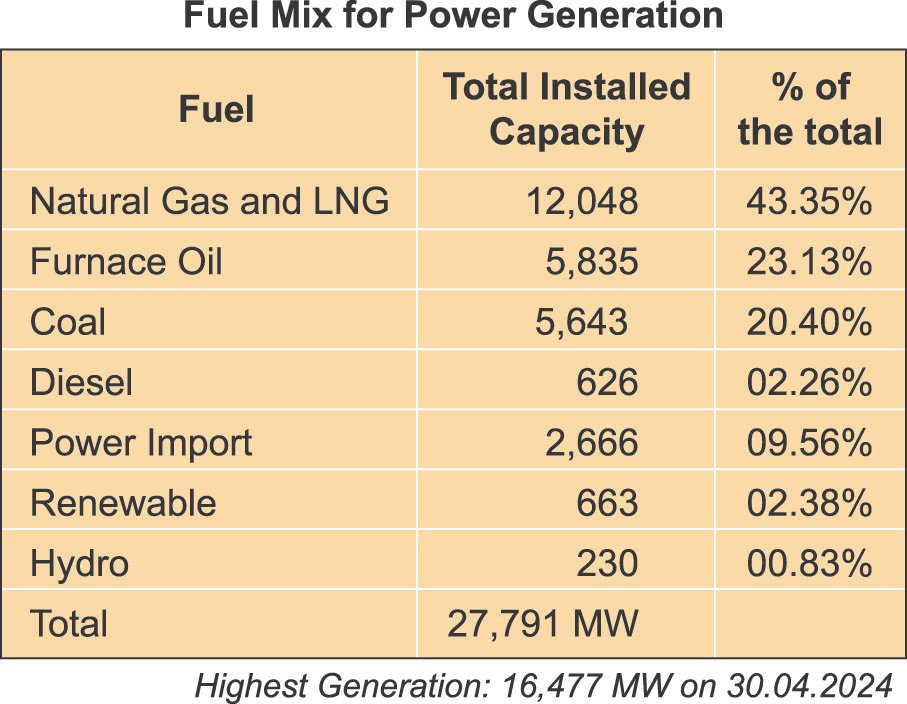
From the above, it appears that ensuring the supply of fuel is a major challenge for Bangladesh. Despite many challenges, natural gas and imported LNG still dominate the fuel mix. This is followed by dirty polluting High Sulfur Furnace Oil that was introduced as a short-term contingency measure. Power imports from neighboring India have also increased significantly following the commissioning of power from Adani. Own gas production is alarmingly depleting and LNG import has price and infrastructure challenges. The government has to get rid of polluting liquid fuel-based generation. Another pressing challenge is exploiting domestic primary fuel resources coal and natural gas.
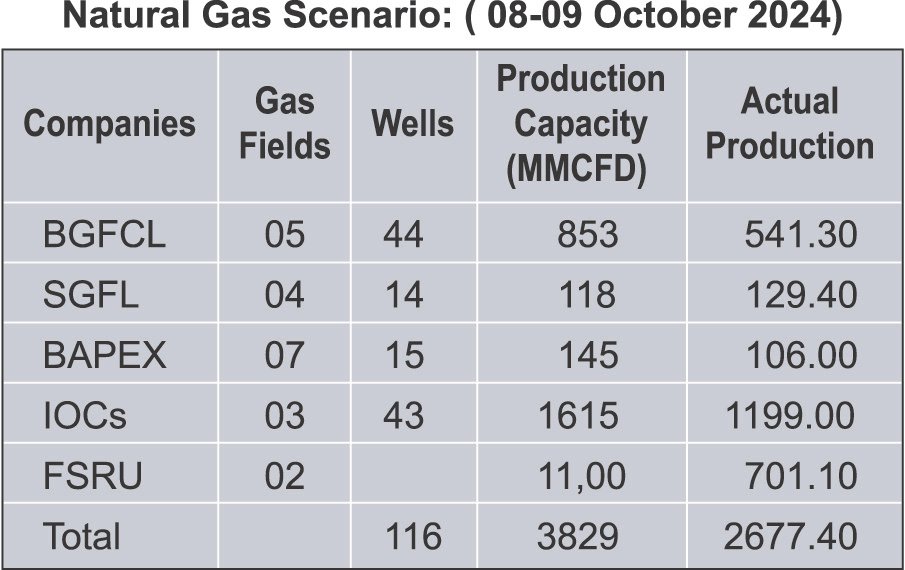
Petrobangla must review the capacity of the producing wells and make necessary amendments to their daily report. At times of gas crisis, the information let out in the public domain must be accurate. Gas production is fast depleting. The real concern is production from IOC-operated fields, especially prolific Bibiyana. At this crisis time gas from gas fields at Bhola remains stranded.
Contingency Measures
The interim government will not stay in the state power for an indefinite period. It must address the present energy crisis by taking some contingency actions. Petrobangla and EMRD after wasting valuable time in the wilderness have started executing some plans for increasing gas production. A project for drilling 48 wells by 2025 is in progress. A plan is at the final stage for drilling another 100 wells by 2028. BAPEX will manage the program using its capacity and engaging drilling contractors or forming JV with foreign companies. But judging from historical records, the target appears highly optimistic. However, while facilitating the Petrobangla/EMRD program in all possible ways, the interim government must take the following initiatives on a priority basis.
Evacuation of Bhola Gas to the National Grid
It is ridiculous that while the country is suffering from a diabolic fuel supply crisis at least 1.5 Tcf discovered gas resources are lying stranded at Bhola island for dilemma over the construction of a gas transmission pipeline, linking Bhola Gas Fields to the national grid in Khulna. IOC UNOCAL in the late 1990s proposed an integrated project named the Western Region Integrated Project (WRIP). The project in its scope included the development of Bhola Gas Fields, and the construction of a gas transmission pipeline from Shahbajpur, Bhola to Digholia Khulna via Barishal. The project also included gas-based power plant construction at Bhola, Barishal, and Khulna. Draft PSC, GPSA, PPA, GTA, and IA were negotiated and developed. Pipeline ROW was extensively surveyed, and route maps were prepared. WRIP was abandoned at a mature stage for political reasons. At that stage, US geologists and engineers were confident about enough gas availability in the region to support the investment. Two decades have elapsed. BAPEX and Gazprom have discovered additional gas resources on the island. The gas supply chain is suffering from a huge crisis. Even then Petrobangla and EMRD are hesitating about evacuation of gas from Bhola. True the pipeline needs crossing some mighty tidal rivers. But there are proven off-the-shelf technologies, there are competent international pipeline contractors. The government must make decisions as soon as possible. Gas from Bhola can be evacuated to the national grid in 3 - 3.5 Years. This project must get top-priority national attention.
Mining Own Coal
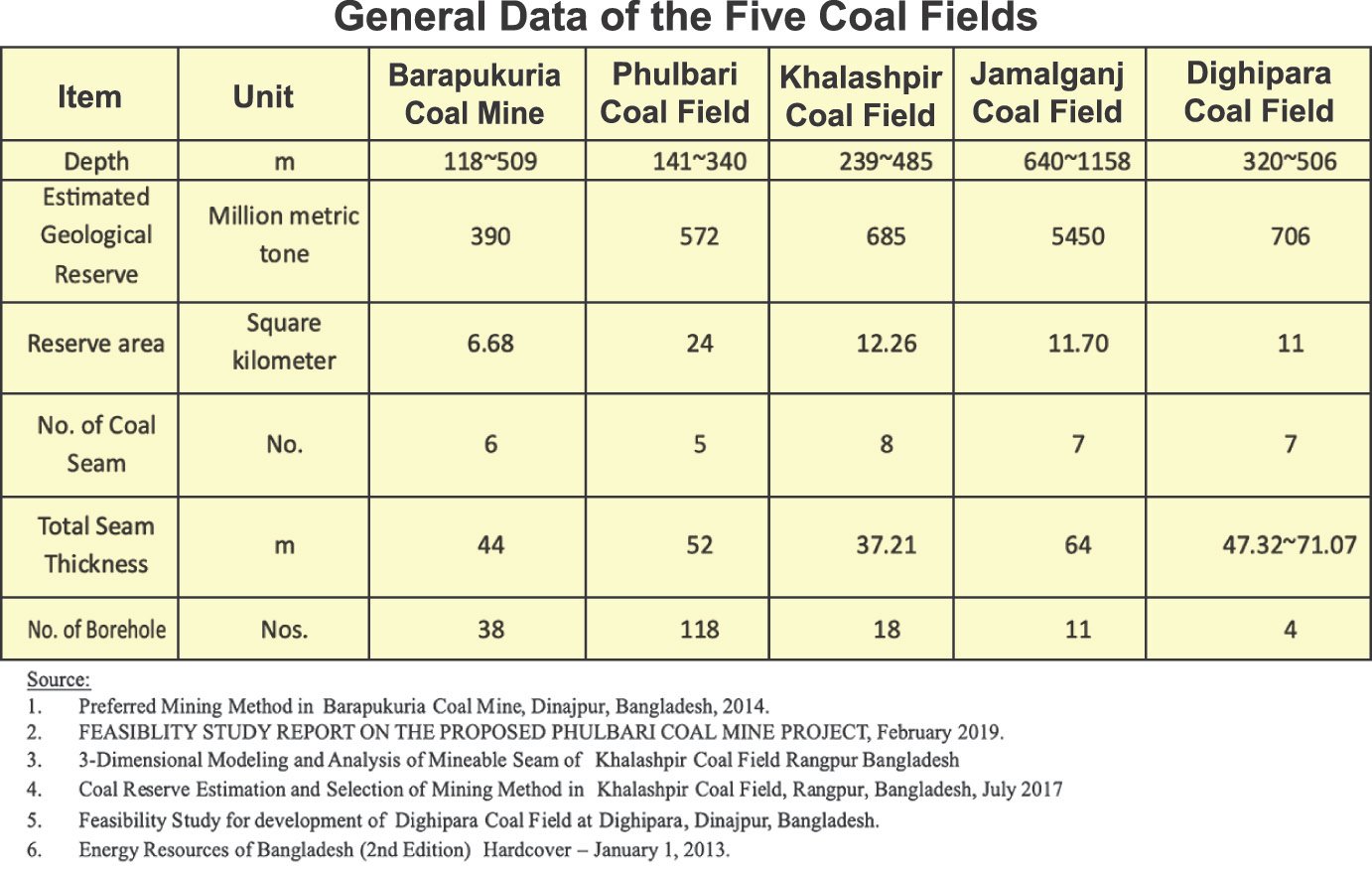
Successive governments since 2005 failed to make the required political decision for mining own discovered superior quality high-heating-value, low-ash, and low-Sulphur coal lying at mineable depth. True the coal resource is located in highly fertile farming land of Dinajpur and Rangpur regions. There exist challenges in the aquifer and mine water management, mine-affected community relocation, and rehabilitation. However, there are technologies and proven measures for the restoration of mine land and management of water. Accredited mining consultants have carried out extensive studies. In a similar situation, mining has been successfully carried out in Germany, India, Poland, and other countries. Yes, mining will create a carbon footprint. But Bangladesh has very little carbon footprint and now has no obligations to restrict carbon emissions. Exploiting about 4 billion tonnes of discovered coal resources by applying state-of-the-art modern technology for addressing and minimizing environmental and social impacts can facilitate the generation of 10,000 MW of coal-fired power generation for 30-40 years. The associated CSR implemented by the mining companies can vastly improve the living standard of the region. The government must give fresh attention to mining. The SOD (Schemes of Development) and mining proposals can be technically audited by competent experts and decide on mining. Phulbari and Barapukuria can be ideal candidates for launching mining operations by applying appropriate methods. In 3 years, the first coal can come to the surface, and in 4 years, the first coal-based power can be made available to the grid if works start simultaneously. Even the present mine-mouth power plants can get an assured supply of coal. Fuel from no other sources is cheaper and easily available than our coal.
.jpg)
Increasing Contribution of Solar and RE
The Chief Adviser of the interim government has set a “three-zero” vision that includes zero emissions. Ultimately, Bangladesh along with the rest of the world will move towards zero emissions. It is also a reality that nations will not be able to achieve net zero by 2050. Bangladesh has a vision for achieving a 40% contribution from clean energy by 2041. The present contribution is only a little less than 3%. There are plans for increasing generations from solar, wind, and other sources. But, at the same time, there are issues affecting renewable energy growth. Some of these are fiscal, some physical. At present, the mindset of major consumers is not very positive towards RE. High import duties and taxes on imported solar equipment panels, inverters, and batteries made solar costlier than other competitive sources of power generation. Land and evacuation facilities are also issues. The previous government’s strategy of awarding contracts to entrepreneurs under a special act was not right. The government should think about providing similar incentives given to entrepreneurs of IPPs of traditional fuel and selecting entrepreneurs under competitive bidding would enable the government to achieve at least 20% contribution from solar by 2030 and 30% by 2041. The government must acquire and develop land and provide land under the lease agreement. At the same time, the government should invest in evacuating the power. There should be provisions for storage for solar projects. The government must prioritize offshore wind resource development. We must realize that Bangladesh has a limit to RE generation and contribution.
Implementation of Austerity Measures in the Use of Power and Energy
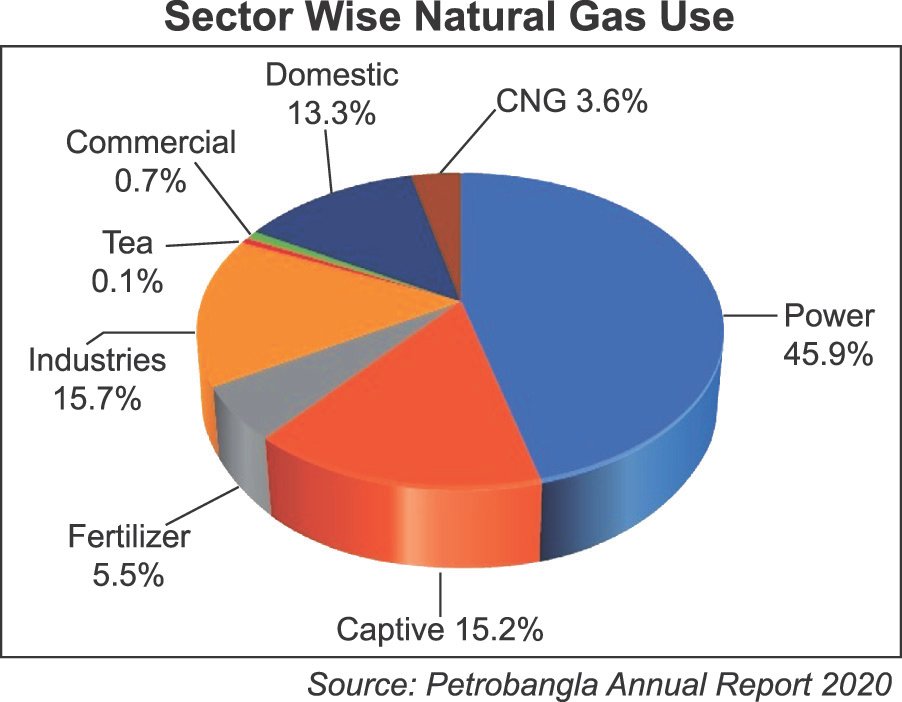
At this time of severe gas and electricity crisis, the government must plan and execute appropriate austerity measures in the use of energy. The first measure must be optimizing the use of fuel – natural gas. Gas must be used in value-added operations only where there are no other alternatives. Gas for industrial use and fertilizer production must be given the highest priority. Coal, renewables, and power import facilities are there for power generation. Hence gas allocation to power must be restricted to highly efficient combined cycle power plants with limited supply to some simple cycle power plants for contingency operation. Gas for domestic and commercial use and CNG may gradually be phased out and replaced with LPG and Autogas.
As can be seen from the above, about 29% of the present gas supply is required for captive power generation and domestic cooking. Industrial users may be encouraged to use grid power. But that will require a reliable supply of quality power and price incentives. The time has come to review gas use for domestic cooking. Gas distribution companies are struggling to manage unauthorized gas use, theft, and pilferages. Gas distribution networks have become unsafe for thousands of leakages originating from illegal tapping.
On the power side, the government may formulate a policy for formally launching electric vehicles. Millions of three-wheelers, rickshaw pullers, and even bicycles use batteries charged illegally from the power grid. The formal launching of electric vehicles creating incentives and setting up country-wide charging stations will increase power demand and help the power sector earn revenues. Charging stations may set up small solar power facilities.
Reforms of Power and Energy Sector Management
The interim government has suspended the operation of the Speedy Power and Energy Supply Special Act 2010 and canceled a few projects negotiated under that act. The amendment of the BERC act authorizing MPEMR to determine power tariffs and energy prices has been rescinded. There have been changes in the senior positions of power and energy at the ministry level, corporations, and companies. The government talked about withdrawing bureaucrats from company levels and reorganizing the board of directors with experienced competent professionals. But these have not been done yet. We observe some impatience in energy companies debating over disparities. The government must address these. The energy and power sector is a highly technically-intensive sector where absolute bureaucratic control has made things messy. Professionals must be posted in proper places and given enough freedom to contribute.
The interim government must take some contingency actions and carry out essential reforms as soon as possible. Energy is the key to smooth economic development.
Download Cover Article As PDF/userfiles/EP_22_9_Cover Article.pdf