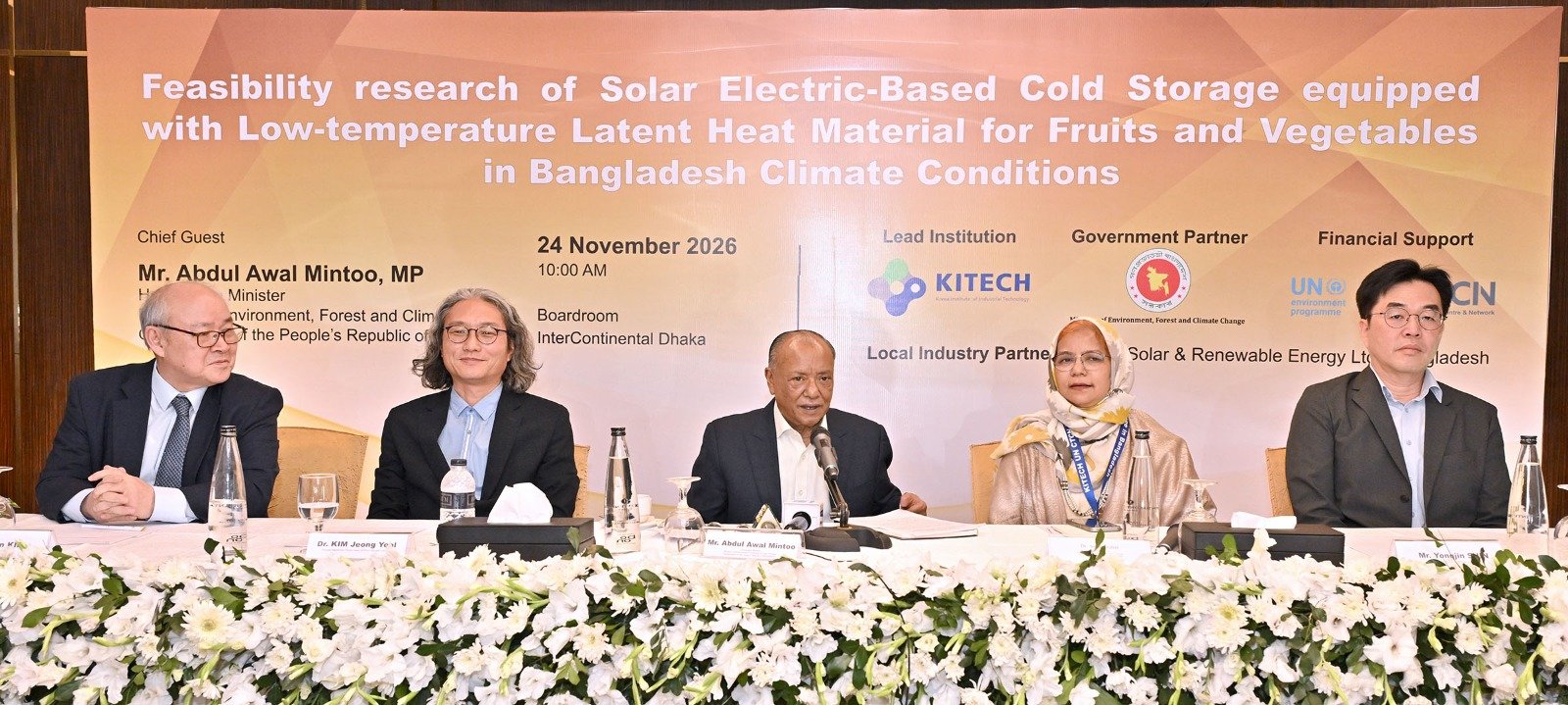
DHAKA, November 24, 2026 — Environment, Forest and Climate Change Minister Abdul Awal Mintoo has stressed expanding solar-powered cold storage facilities to reduce post-harvest losses, preserve the quality of fruits and vegetables and increase farmers’ incomes.
He said connecting cold storage facilities with temperature-controlled transportation would enable farmers to deliver a larger share of their produce to markets in good condition, creating opportunities to earn more.
The minister made the remarks as chief guest at the closing ceremony of a project assessing the feasibility of solar-powered cold storage for preserving fruits and vegetables under Bangladesh’s climatic conditions. The event was held at Hotel InterContinental in Dhaka on Tuesday.
Mintoo said agriculture plays a vital role in the country’s economy, food security and rural livelihoods. However, high temperatures, inadequate cold storage facilities and irregular electricity supplies often cause agricultural produce to spoil before reaching markets, adding to the challenges posed by climate change.
Referring to a pilot facility installed at an agricultural farm in Rajshahi, he said the system had been designed to suit Bangladesh’s climate, farming practices and electricity supply conditions. The demonstration would help assess how solar power and thermal energy storage could make rural cold storage more reliable.
The feasibility study and experience from the Rajshahi pilot could support an integrated cold-chain system combining rapid pre-cooling, refrigerated storage, temperature-controlled transportation and digital temperature monitoring, the minister said. Such an approach could strengthen local technical capacity and support a climate-resilient, low-carbon agricultural system.
The pilot facility uses low-temperature Latent Heat Material (LHM) to maintain stable temperatures inside the storage chamber. The technology stores cooling energy and helps maintain the required temperature when solar generation is unavailable or reduced.
The project was led by the Korea Institute of Industrial Technology (KITECH), in cooperation with the Ministry of Environment, Forest and Climate Change, with financial support from the United Nations Environment Programme (UNEP) and the UN Climate Technology Center and Network (CTCN). Technical training was also provided under the initiative.
Mintoo thanked UNEP, CTCN, KITECH, local partners, farmers and experts involved in the project. He expressed hope that technical cooperation with South Korea and CTCN would continue to expand the technology to other agriculture-intensive regions.
Additional Secretary of the Ministry Dr Nurun Nahar, KITECH Principal Researcher and Project Leader Dr Kim Jong Yeol, EST Company Ltd Director Youngjin Shin of South Korea, and expert Dr Inhan Kim also spoke at the event.