Climate experts warn of a widening gap between global climate commitments and action, urging governments to accelerate fossil fuel phase-out, expand renewable energy and strengthen international cooperation.
The world must drastically accelerate greenhouse gas emission reductions to limit global warming and return to the 1.5°C threshold by the end of the century, according to the United Nations Environment Program (UNEP).
The Emissions Gap Report 2026: The Point of Return, released on Wednesday, warns that temporarily exceeding the 1.5°C limit above pre-industrial levels has become unavoidable. However, the report stresses that the magnitude and duration of this overshoot can still be limited through immediate and sustained climate action.
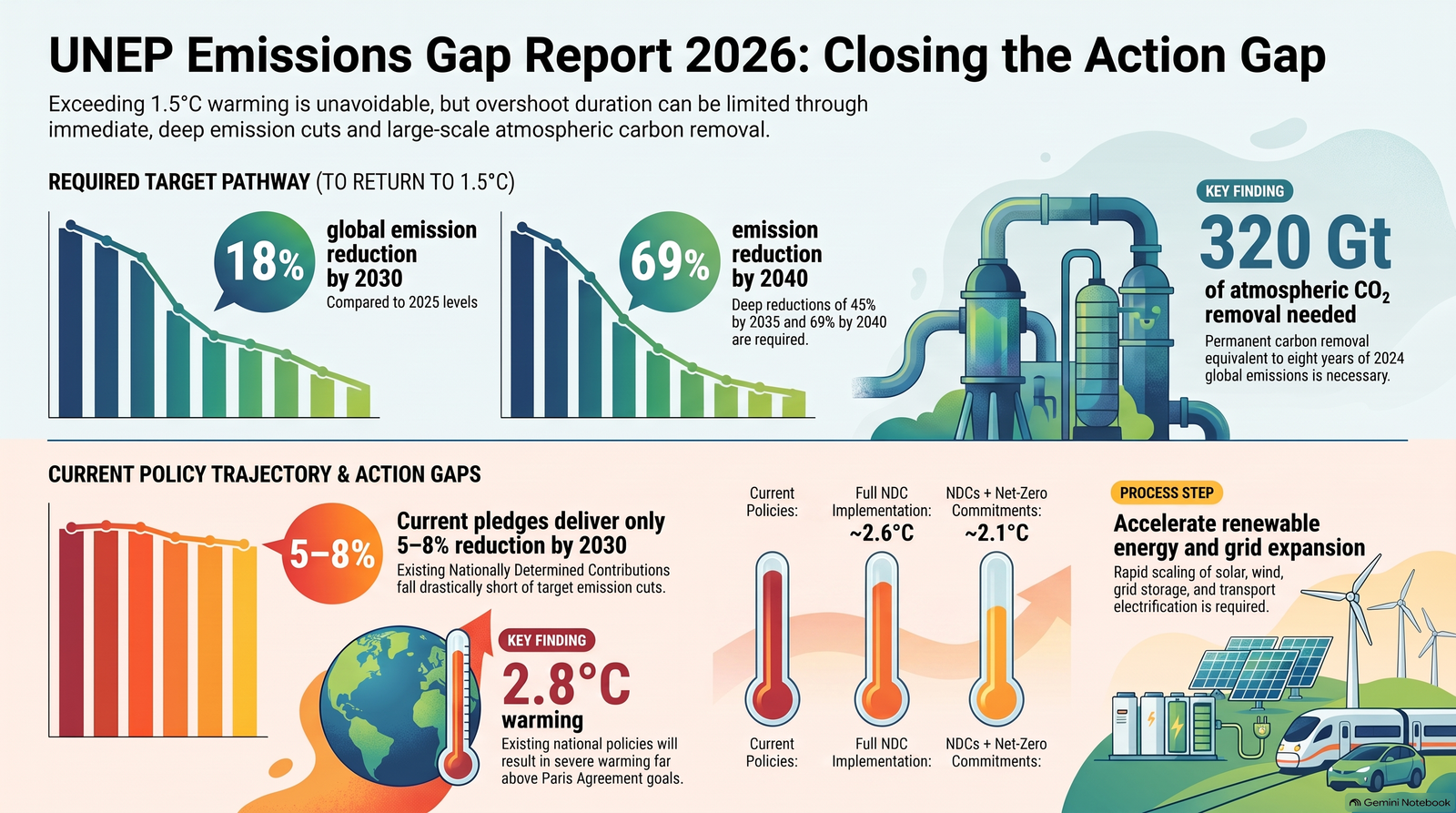
To achieve the lowest possible overshoot scenario, global greenhouse gas emissions must fall by 18% by 2030, 45% by 2035 and 69% by 2040, compared with 2025 levels. This would limit peak warming to approximately 1.7–1.8°C around the middle of the century before temperatures return to or below 1.5°C by 2100, with a roughly 50% probability.
The findings highlight a widening gap between the ambition required to meet the Paris Agreement’s temperature goal and the climate commitments currently made by governments.
Current Climate Pledges Fall Far Short
The report estimates that full implementation of countries’ Nationally Determined Contributions (NDCs) would reduce global emissions by only 5–8% by 2030 and 11–15% by 2035, relative to 2025 levels.
Under current policies, global temperatures could rise by approximately 2.8°C during this century. Even if countries fully implement their existing climate pledges and continue similar efforts, warming would likely reach 2.6°C. The most optimistic scenario, combining NDCs with additional net-zero commitments, limits warming to approximately 2.1°C.
These projections are worse than those in the previous year’s report, partly because of the United States’ withdrawal from the Paris Agreement and revised estimates of historical emissions. New climate commitments submitted since the previous assessment have made little difference to the overall outlook.
The report also cautions that global greenhouse gas emissions have continued to grow over the past decade, although emissions in 2025 remained broadly similar to those in 2024. This does not yet establish that global emissions have peaked.
UN Chief Calls for Urgent Action
UN Secretary-General António Guterres described the findings as a warning that the world must act decisively to prevent a prolonged period of dangerous warming.
“Overshoot is not surrender,” Guterres said in a message accompanying the report, stressing that the world could still limit peak temperatures and return to below 1.5°C by the end of the century.
He called for an 18% reduction in global emissions by 2030 and a 45% reduction by 2035, compared with 2025 levels.
The UN chief’s message reinforces the need for governments to move beyond long-term climate promises and implement immediate measures to reduce emissions across energy, transport, industry, buildings and land use.
UNEP Executive Director Inger Andersen also urged countries to intensify their efforts, warning that every additional fraction of a degree of warming increases the risks of deadly floods, heatwaves, wildfires and other climate impacts.
She said successful climate policies and technological advances had demonstrated that emissions could be reduced rapidly, but governments needed to scale up these measures through stronger and sustained action.
Climate Experts Demand Faster Fossil Fuel Phase-Out
The report has prompted renewed calls from climate experts and advocacy organizations for governments to accelerate the transition away from fossil fuels.
Bill Hare, chief executive of Climate Analytics, said governments needed to introduce policies that reduced fossil fuel consumption as quickly as possible.
He argued that the technologies and policy options required to cut emissions were already available, but political inaction—particularly among major fossil fuel-producing countries—continued to undermine progress.
Hare singled out major producers, including the United States and Saudi Arabia, urging them to align their policies with the scientific evidence on climate change. Climate Analytics warned that continued inaction would intensify climate impacts and increase the risk of irreversible damage to natural systems.
Mohamed Adow, director of Power Shift Africa, also criticized governments for failing to match technological progress with political leadership.
He pointed to the rapid expansion of solar and wind power as evidence that viable alternatives to fossil fuels were increasingly available, arguing that governments needed to accelerate the transition rather than prolong dependence on carbon-intensive energy sources.
Climate scientists have also emphasized that the challenge is no longer a lack of scientific evidence but the failure to translate that evidence into sufficiently ambitious policies.
Johan Rockström, director of the Potsdam Institute for Climate Impact Research, warned that current national commitments would leave emissions substantially above the levels needed to limit warming. He said disagreements over the timing of future scientific assessments must not become an excuse for delaying climate action.
Renewable Energy Offers Hope
Despite the alarming projections, UNEP identifies significant opportunities to close the emissions gap.
Since the adoption of the Paris Agreement in 2015, global renewable electricity capacity has expanded much faster than anticipated. Solar photovoltaic deployment has grown particularly rapidly, while the growth of coal and oil supplies has been slower than projected a decade ago.
The report highlights 63 structural changes, including renewable energy investment and carbon pricing policies, that have contributed to meaningful emissions reductions across countries and economic sectors.
UNEP argues that successful policies should be replicated and expanded internationally. Priority measures include accelerating renewable energy deployment, electrifying transport and heating, improving energy efficiency, expanding electricity grids and storage, reducing methane emissions and halting deforestation.
Governments must also establish credible pathways for transitioning away from fossil fuels while protecting workers and communities affected by the shift.
However, the transition requires more than expanding renewable generation. Investment in transmission networks, electricity storage and system flexibility will be essential to accommodate growing shares of variable wind and solar power.
Reducing methane emissions could also deliver relatively rapid climate benefits because methane is a potent greenhouse gas. At the same time, governments must address emissions from industry, agriculture, buildings and land use to achieve economy-wide reductions.
Carbon Removal Presents a Major Challenge
Returning global warming to 1.5°C after a temporary overshoot would require not only deep emission cuts but also large-scale carbon dioxide removal.
Under its lowest-overshoot scenario, UNEP estimates that approximately 320 gigatonnes of carbon dioxide would need to be removed from the atmosphere and permanently stored over the course of this century. That amount is equivalent to roughly eight years of global CO? emissions at 2024 levels.
Achieving this scale of removal would require substantial investment and technological development. It would also raise questions about feasibility, costs and the availability of reliable long-term storage.
Carbon removal, therefore, cannot be treated as a substitute for immediate emission reductions. Delaying cuts would increase the amount of carbon that must eventually be removed and make the task more difficult.
Implications for COP31 and Vulnerable Countries
The report arrives as governments prepare for COP31 in Antalya, Türkiye, scheduled for November 9–20, 2026. Its findings increase pressure on countries to demonstrate how their climate commitments will translate into measurable emission reductions.
For climate-vulnerable countries such as Bangladesh, the report reinforces the importance of ambitious global mitigation alongside stronger adaptation measures and adequate climate finance.
Limiting warming would reduce, although not eliminate, the growing risks associated with extreme heat, flooding, sea-level rise and other climate-related hazards. Countries with limited financial and technological resources will need international support to strengthen resilience and pursue low-carbon development.
The findings also highlight the importance of international cooperation in delivering emissions reductions while ensuring a just transition for developing economies.
The central message of UNEP’s 2026 report is that the opportunity to avoid a 1.5°C overshoot has been lost, but the long-term temperature goal need not be abandoned. Limiting the overshoot and returning to 1.5°C by 2100 remain possible, although success depends on unprecedented emission reductions, stronger climate policies and sustained global cooperation.
For governments heading towards COP31, the challenge is to turn that possibility into action before further delays make the climate consequences increasingly severe.
UNEP’s Emissions Gap Report 2026: The point of return