DHAKA, October 21, 2026 (EP Analysis) — Bangladesh has introduced a new legal framework to accelerate solar power deployment, facilitate private investment and reduce dependence on imported fossil fuels through the Special Solar Power Installation Ordinance, 2026.
The ordinance was gazetted on October 19, following Cabinet approval of its draft, establishing specific provisions for solar installations of up to 5 megawatts (MW). It covers rooftops, courtyards, unused land, tea gardens, floating solar systems and agrivoltaic projects, while excluding large-scale ground-mounted solar power plants.
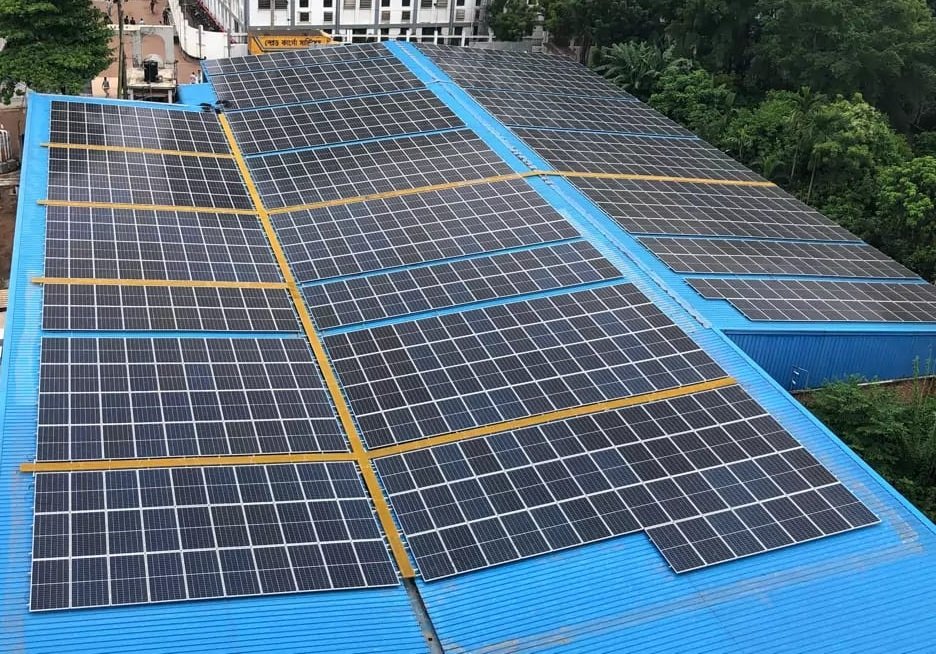
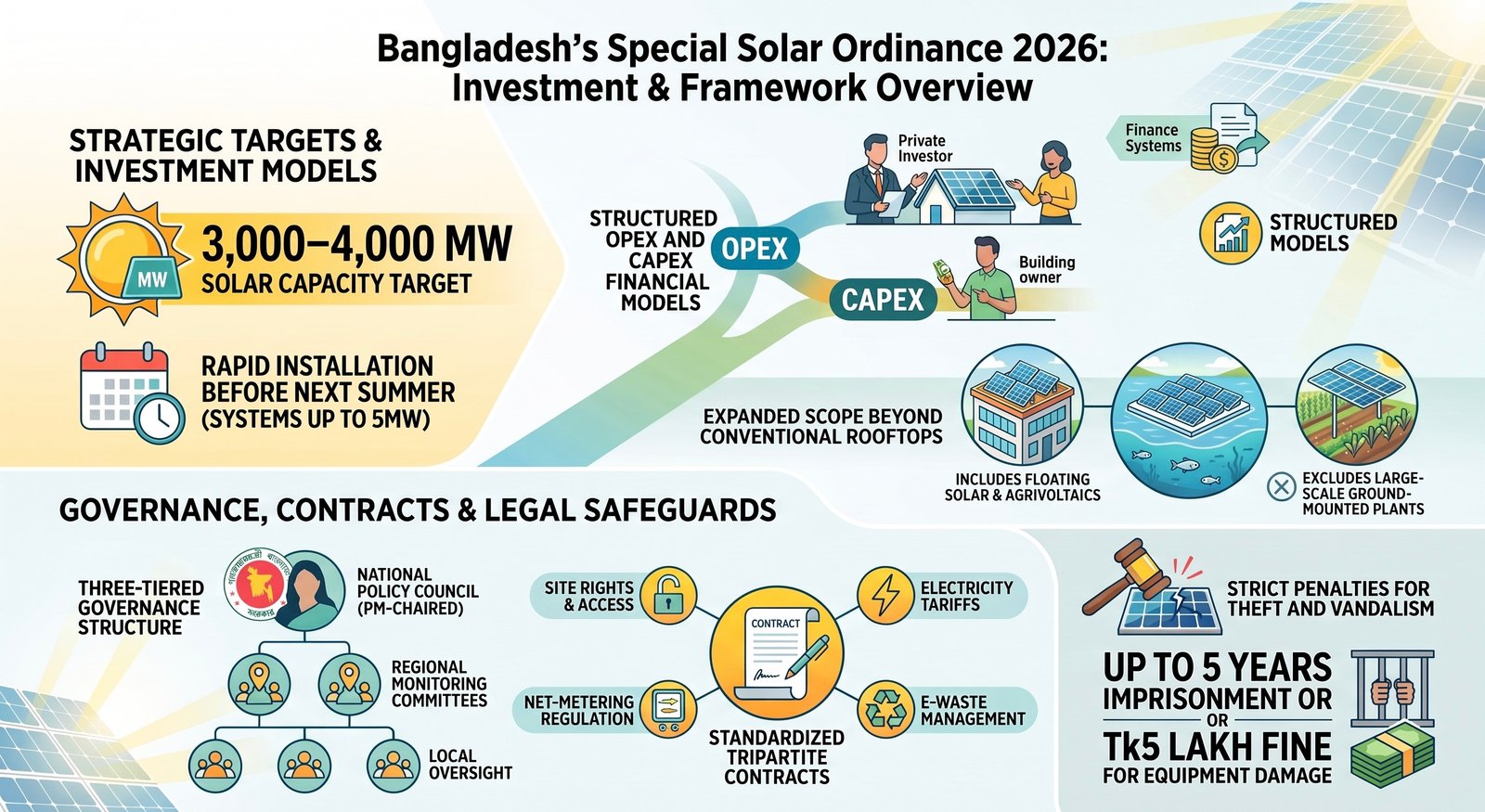
The government aims to install 3,000–4,000MW of rooftop solar capacity before next summer under its National Renewable Energy Development Strategy 2026–2030. The ordinance is intended to address regulatory gaps that have complicated investment decisions, particularly regarding long-term electricity pricing, rooftop rental arrangements and maintenance responsibilities.
New Rules for Private Investment
A key feature of the ordinance is its focus on the operational expenditure (OPEX) model, under which private investors finance, install, operate and maintain solar systems. Building owners receive electricity under contractual arrangements without bearing the full upfront investment cost.
The capital expenditure (CAPEX) model is also permitted for eligible institutions that finance and own their systems.
Previously, the absence of specific provisions governing these arrangements created uncertainty over electricity prices, maintenance obligations and the sharing of electricity or other benefits in exchange for rooftop access. These issues are particularly important for long-term agreements that may extend to 15 years.
The new framework provides for a tripartite agreement among the consumer, service provider and competent authority, using a government-prescribed standard contract. The agreement will cover site-use rights, equipment standards, electricity tariffs, net-metering facilities, electronic waste management and manufacturers’ take-back arrangements for discarded equipment.
The significance is that rooftop solar is being positioned as a structured investment opportunity rather than simply an equipment-installation exercise. Standardized contracts could reduce negotiation costs and uncertainty for investors, building owners and public institutions.
However, the actual investment response will depend on the commercial terms of the contracts, including electricity prices, payment arrangements, equipment performance guarantees and the allocation of risks between the parties.
Beyond Rooftops: Floating Solar and Agrivoltaics
The ordinance extends the scope of eligible solar installations beyond conventional rooftops. Floating solar and agrivoltaic systems could open additional opportunities to expand renewable generation where suitable land is limited or competing uses make conventional solar development difficult.
Agrivoltaics combines solar electricity generation with agricultural activities, while floating solar uses suitable water bodies for panel installation.
For Bangladesh, these options could help diversify solar deployment beyond industrial rooftops and conventional solar parks. Their practical potential, however, will depend on site suitability, engineering requirements, environmental safeguards, grid access and project economics.
The 5MW ceiling also has implications for project structuring. Developers and investors will need to understand how the capacity limit applies to individual installations and whether projects can be aggregated under the relevant rules. The ordinance does not bring large-scale ground-mounted solar projects within its scope.
New Oversight and Accountability Mechanisms
The ordinance establishes a National Policy Council, chaired by the prime minister, to oversee solar expansion and coordinate policy across relevant ministries.
District Technical and Coordination Committees, led by deputy commissioners, will monitor implementation and report to the national council every three months. Upazila-level committees, chaired by upazila nirbahi officers, will supervise field activities and report monthly to the district committees.
These arrangements could help resolve coordination problems involving public institutions, service providers and local authorities. Their effectiveness will depend on clear institutional responsibilities, technical capacity and timely decision-making.
The ordinance also provides for service-provider selection through competitive processes or open tendering, with simplified arrangements for maintaining district-level lists of eligible providers.
For certain CAPEX-model purchases, it permits limited tendering for goods and services worth up to Tk5 crore, with the usual e-government procurement requirement not applying to those purchases under the special arrangement. While these provisions are intended to accelerate implementation, transparent selection and effective monitoring will be essential to maintain competition and public confidence.
Protecting Investments and Equipment
The law introduces penalties for theft, vandalism, unauthorized connections and obstruction of installation, inspection or maintenance activities.
Theft of electricity or solar equipment can attract up to three years’ imprisonment, a fine of Tk50,000, or both. Damage to solar panels or equipment can result in up to five years’ imprisonment or a fine of up to Tk5 lakh. Unauthorized connections and obstruction of relevant personnel can attract up to three years’ imprisonment or a fine of up to Tk5 lakh.
These provisions are intended to protect installations and ensure continuity of operation. The ordinance also assigns the Sustainable and Renewable Energy Development Authority (SREDA) a role in maintaining information on installations and monitoring whether systems remain operational.
The Implementation Test
Despite the new legal framework, reaching 3,000–4,000MW before next summer will be a substantial undertaking. The ordinance can remove regulatory barriers, but it cannot by itself guarantee rapid project delivery.
Implementation will require a pipeline of bankable projects, reliable financing, qualified service providers, timely approvals, suitable rooftops and grid infrastructure capable of accommodating additional solar generation. Standard contracts must also balance investor returns with affordable electricity for consumers.
Grid integration is particularly important. Solar generation varies with weather and daylight, so distribution utilities will need appropriate planning, protection systems, metering and forecasting. Storage may help in selected applications, but its costs and commercial arrangements must be assessed separately.
The ordinance’s provisions on equipment standards, electronic waste and manufacturers’ take-back schemes are also significant. As installations expand, long-term performance, safe disposal and replacement of panels and other equipment will become increasingly important.
Ultimately, the new law creates an opportunity to mobilize private capital and expand solar generation across a wider range of sites. Its success will depend on whether the government can translate the legal provisions into predictable contracts, competitive investment opportunities and functioning projects.
For Bangladesh, the strategic objective extends beyond adding solar capacity. It is to reduce exposure to imported fuel prices, ease pressure on electricity subsidies and strengthen energy security through greater use of domestic renewable resources.