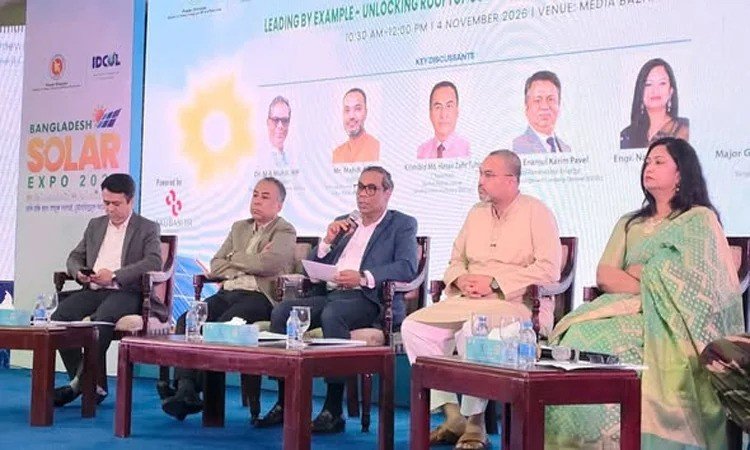
DHAKA, Nov 4, 2026 — The government aims to make the health sector a leading example of solar power adoption, ensuring uninterrupted electricity at healthcare facilities across the country, State Minister for Health and Family Welfare Dr MA Muhit said today. Report BSS
“Uninterrupted electricity supply in the health sector is not merely a general service but an essential necessity directly linked to health security,” he said at a panel discussion on expanding rooftop solar in public buildings at the Bangladesh Solar Expo.
Dr Muhit said Bangladesh has around 15,000 healthcare centers, along with district hospitals, medical colleges and specialized institutions, offering substantial potential for rooftop solar installations. The government plans to reduce reliance on diesel and use clean energy to support operating theatres, emergency services, intensive care units and vaccine cold chains.
Structural and energy audits of health facilities will be completed within six months to one year, he added, urging private investors to participate in hospital solar projects while ensuring equipment quality, security and regular maintenance.
Prime Minister’s Adviser Mahdi Amin said a list of educational institutions suitable for solar installations would be prepared within six months. Solar projects are already at various stages of implementation in more than 30 public universities.
Barind Multipurpose Development Authority Chairman Md Hasan Zafir Tuhin said around 17,000 irrigation pumps in the Barind region would be brought under a solar network within a year, potentially supplying 450–800 megawatts to the national grid during idle periods.
IDCOL Head of Renewable Energy Md Enamul Karim Pavel said government building rooftops could generate around 2,000 MW of solar power.
The discussion was jointly organized by the Power Division and IDCOL and moderated by Bangladesh Rural Electrification Board Chairman Major General Md Mahbubul Haque.