NEW DELHI, Nov 4, 2026 — A new analysis of 21 submissions representing 115 countries to the COP30 Presidency’s proposed fossil fuel transition roadmap has found broad agreement on the need to move away from fossil fuels, but significant differences over implementation, financing and national responsibilities.
The study, Whose Transition? Unpacking the Discourse on Transitioning Away from Fossil Fuels in Climate Negotiations, by the Council on Energy, Environment and Water (CEEW), says transition pathways must reflect countries’ different economic conditions and starting points. More than three-quarters of submissions linked expectations to existing UNFCCC commitments, including nationally determined contributions (NDCs) and net-zero targets.
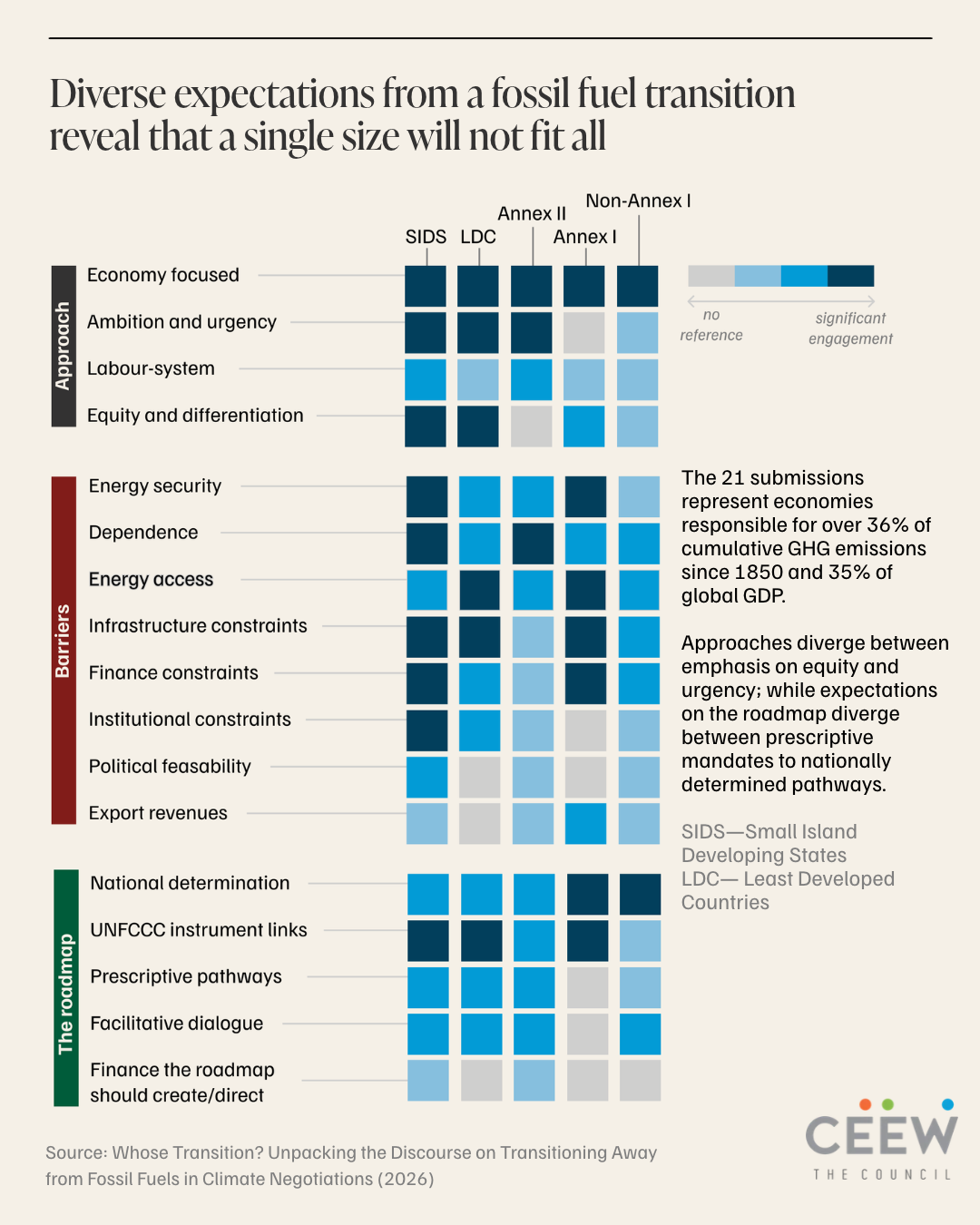
CEEW cautioned that transition involves more than replacing energy sources: it reshapes jobs, public finances and industries. It called for an inclusive, nationally determined approach, arguing that developing countries need finance, technology and fiscal space—not additional mandates.
The analysis said a proposed global electrification target of 35 percent by 2035 should account for national circumstances. India’s electricity share in final energy use is projected to reach around 27 percent by 2035 on current trends, while countries with greater capacity could pursue targets of 40–45 percent to help achieve the global goal.
The study also highlighted an accountability gap. Only seven countries, including India, China and South Africa, are on track to meet their 2030 NDC targets, while the European Union, United Kingdom, Switzerland and Canada are falling behind.
CEEW said developing countries’ estimated climate finance needs of US$455–584 billion annually through 2030 far exceed the new US$300 billion annual collective finance goal. It urged COP31 in Antalya to operationalize the Just Transition Mechanism, strengthen technology cooperation and climate finance, and establish a technical committee to assess the impacts of climate-related trade measures on developing countries.
The study stressed that a transition roadmap must be inclusive and built through existing UNFCCC processes, with clear responsibilities and finance reaching countries and communities.