
August 25, 2026: The global electric vehicle (EV) solar modules market is projected to expand more than fourfold over the next eight years, driven by growing interest in solar-integrated vehicles, fleet cost savings and advanced energy-management technologies.
According to Polaris Market Research, the market was valued at approximately US$728.71 million in 2026 and is expected to reach US$3.09 billion by 2034, registering a compound annual growth rate (CAGR) of around 19.73%.
The emerging technology is increasingly being viewed not simply as a way to add driving range, but as a means of reducing EV dependence on grid charging. Solar modules integrated into vehicle roofs, hoods and other surfaces can help power auxiliary systems, reduce standby energy consumption and support short-distance driving.
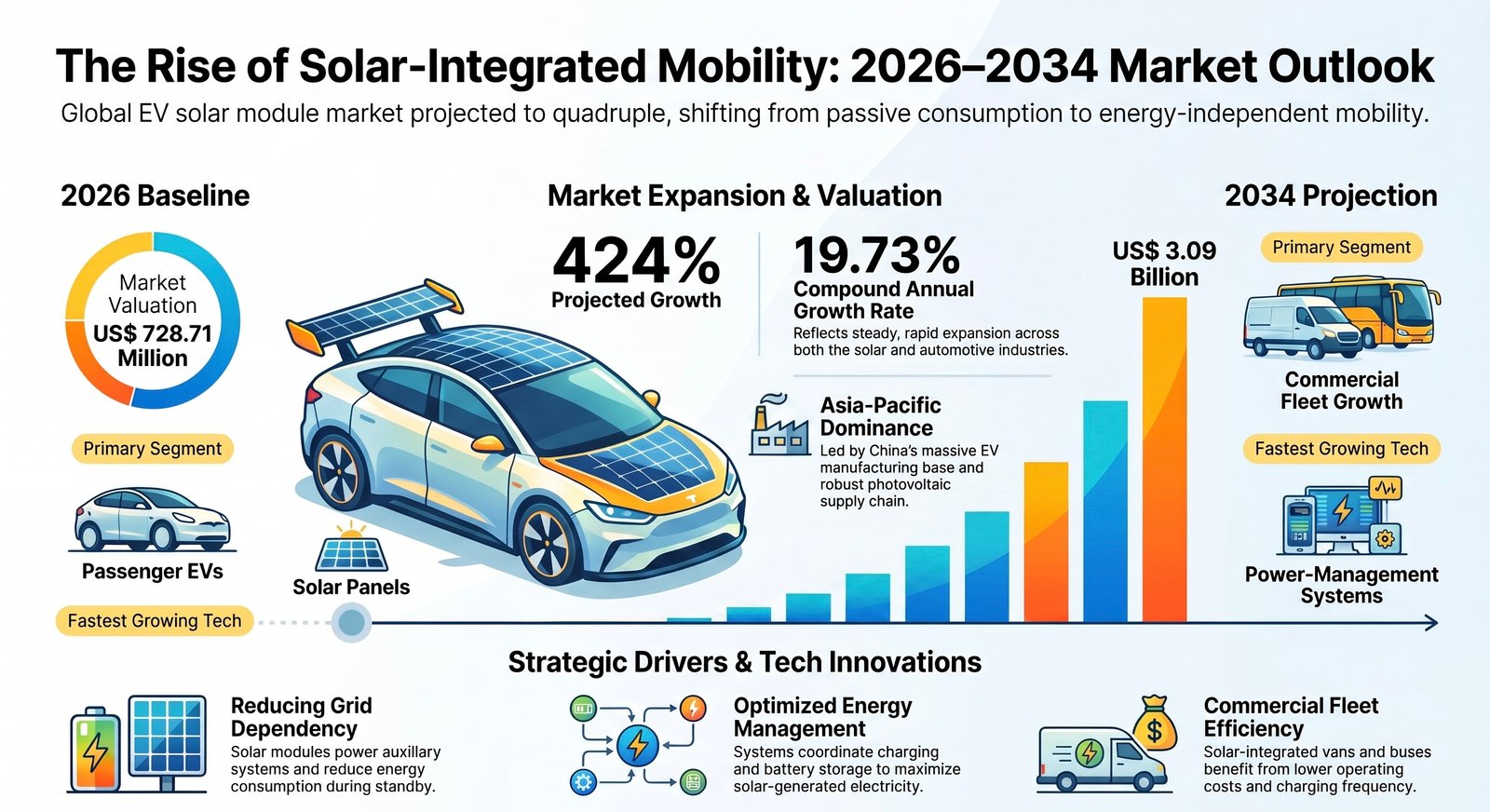
For commercial fleets, even modest solar-assisted charging could reduce charging frequency and operating costs, particularly for high-utilization vans, buses and utility vehicles. Automakers, meanwhile, are exploring integrated solar technology as a potential product differentiator.
The market is also seeing growing interest in vehicle-integrated photovoltaic (VIPV) systems and solar-enabled charging infrastructure. Companies including Nissan, LONGi and NIO are exploring applications that combine solar generation with EV technology.
Solar panels currently account for the largest component segment, while power-management systems are expected to record the fastest growth. Advanced energy-management systems can optimize solar-generated electricity by coordinating charging, battery storage and auxiliary loads.
By vehicle type, passenger EVs currently dominate the market, while commercial electric vehicles are expected to experience faster growth as fleet operators seek to lower energy and charging costs.
Asia-Pacific remains the leading regional market, supported by China’s large EV manufacturing base and strong photovoltaic supply chain. North America is expected to see increasing adoption, while Europe’s regulatory push for domestic clean-technology manufacturing could support vehicle-integrated solar development.
The competitive landscape spans both the solar and automotive industries, with photovoltaic companies such as LONGi, JinkoSolar, Trina Solar, First Solar and Hanwha Solutions operating alongside automakers and EV technology companies.
Future growth is expected to be supported by lightweight thin-film and perovskite solar technologies, which could be better suited to curved vehicle surfaces. However, high integration costs and relatively limited power output compared with EV battery capacity remain key challenges.
The market’s development suggests that solar technology could increasingly transform EVs from passive electricity consumers into mobile energy-generating assets, creating new opportunities for automakers, fleet operators and energy companies.