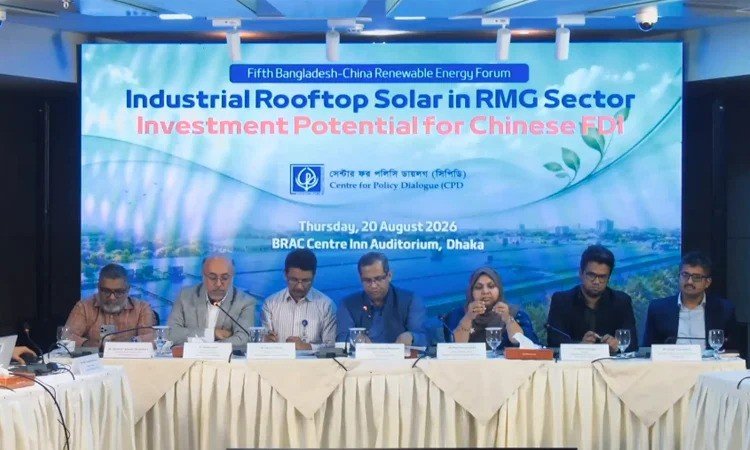
Dhaka, August 20, 2026: The Centre for Policy Dialogue (CPD) has recommended blended green financing, faster regulatory approvals and cluster-based investment models to expand rooftop solar power in Bangladesh’s ready-made garment (RMG) sector and attract Chinese foreign direct investment (FDI) in renewable energy.
The recommendations were presented at the fifth Bangladesh-China Renewable Energy Forum at the BRAC Centre in Dhaka. The event featured a discussion titled “Rooftop Solar in Industries: Prospects for Chinese Investment in the RMG Sector.”
CPD Research Director Dr Khondaker Golam Moazzem moderated the program, where CPD Research Associate Abrar Ahmed Bhuiyan and Program Associate Nur Yana Jannat presented the findings of the study.
The study recommended that Infrastructure Development Company Limited (IDCOL) and other financing institutions introduce blended green financing facilities combining concessional loans at interest rates of 5–7% with Chinese green investment capital. Such financing could extend loan tenures and improve the financial viability of rooftop solar projects.
For the Bangladesh Garment Manufacturers and Exporters Association (BGMEA), the study recommended establishing a dedicated bilateral support desk and quickly implementing incentives for member factories partnering with verified Chinese engineering, procurement and construction (EPC) companies.
The Bangladesh Knitwear Manufacturers and Exporters Association (BKMEA) was advised to develop cluster-based investment models in industrial areas such as Narayanganj, bringing together small and medium-sized knitwear factories to attract investment from Chinese renewable energy service companies under the RESCO model.
The study also urged factory owners to take advantage of early-stage investment opportunities to reduce initial capital expenditure and minimize exposure to future increases in grid electricity prices.
For small and medium-sized factories, it recommended integrated RESCO and Build-Own-Operate-Transfer (BOOT) financing models involving EPC companies and investors.
The study further called for the Sustainable and Renewable Energy Development Authority (SREDA) to make grid-connection approval procedures faster and more predictable.
Industry associations were also encouraged to arrange visits to factories that have already installed rooftop solar systems, particularly Chinese-owned facilities, to raise awareness among manufacturers that have been slow to adopt renewable energy.
According to the study, Bangladesh’s RMG and textile sectors have significant potential for rooftop solar generation. The estimated potential is around 2,815 megawatt-peak (MWp), requiring investment of approximately Tk 12,669 crore.
Of 1,016 potentially suitable establishments, around 879 MWp of rooftop solar capacity could be developed in the short term, the study found.
Financing was identified as one of the key factors determining project viability. Capital costs, electricity prices, interest rates and loan tenures can significantly influence the financial performance of rooftop solar projects.
The study noted that these factors are also crucial for achieving a 1.25 debt service coverage ratio (DSCR) required for bank financing.
It identified several financial and institutional barriers, including high financing costs for small and medium-sized enterprises, delays in SREDA approvals, structural limitations of older factory buildings, import and letter-of-credit costs, payment and foreign-exchange risks, and uncertainty over grid connections.
The study found that renewable energy currently accounts for only around 3% of total electricity consumption among the surveyed RMG factories.
However, it concluded that rooftop solar could meet a significant share of the electricity demand of Bangladesh’s garment factories, helping reduce energy costs, strengthen energy security and support the sector’s transition towards cleaner production.