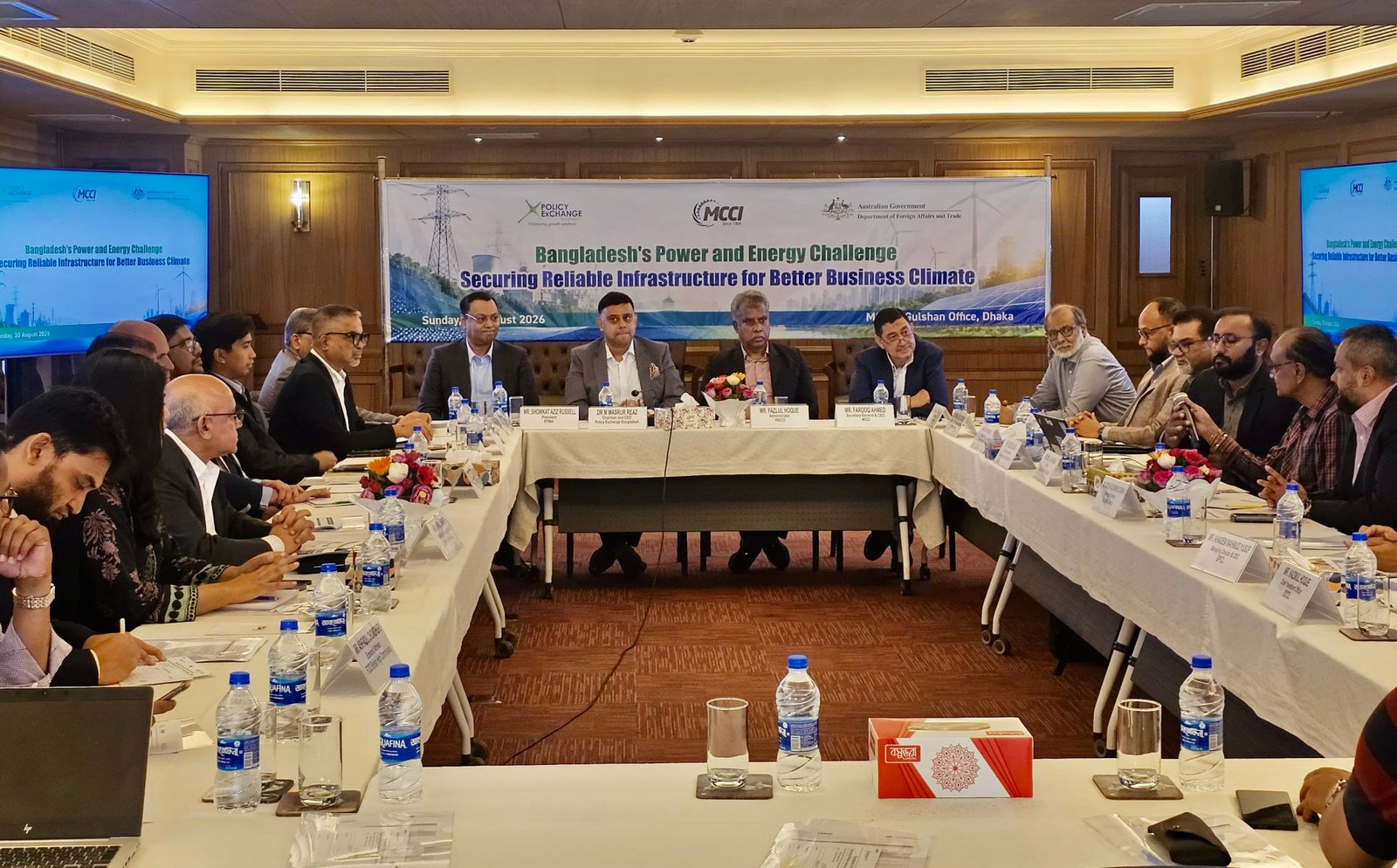
Dhaka, August 30, 2026: Policymakers and business leaders have called for a predictable, affordable and sustainable energy supply to protect the competitiveness of Bangladesh’s industries, warning that prolonged uncertainty over gas and electricity is undermining production, investment and business confidence.
They also stressed the need for a long-term national energy strategy to safeguard existing investments and build confidence for future industrial expansion.
The observations came at a roundtable discussion organized by the Metropolitan Chamber of Commerce and Industry (MCCI) at its conference hall in Gulshan, Dhaka.
The discussion was moderated by Dr M Masrur Reaz, Chairman and CEO of Policy Exchange Bangladesh. FBCCI Administrator Fazlul Hoque attended as the guest of honor, while MCCI Secretary General Faruk Ahmed delivered the welcome address.
The panel included Bangladesh Textile Mills Association (BTMA) President and Amber Group Managing Director Shawkat Aziz Russell; LafargeHolcim Bangladesh CEO Mohammad Iqbal Chowdhury; former BUET professor and energy expert Dr Ijaz Hossain; and Moinul Islam, Chairman of Munno Ceramics and President of the Bangladesh Ceramic Manufacturers and Exporters Association.
Participants called for priority energy allocation to export-oriented industries and major industrial clusters. They also urged the authorities to publish reliable and credible load-shedding schedules in advance so that factories can plan their production accordingly.
Business leaders said unpredictable gas and electricity supplies are making it increasingly difficult for industries to maintain production schedules, meet export commitments and plan new investments.
Shawkat Aziz Russell said the government and industry need to adopt a long-term approach to resolving the gas crisis. Rather than engaging in a “blame game,” the government and private sector should work together to identify practical solutions, he said.
He stressed the need to intensify gas exploration in both onshore and offshore areas to address Bangladesh’s growing gas shortage.
Mohammad Iqbal Chowdhury emphasized the importance of credibility and predictability in the long-term energy outlook to protect existing industrial investments. He called for a clear 10- to 20-year energy strategy to support industrial competitiveness and sustainable economic development.
According to him, investors need greater certainty about the future availability and cost of energy before making long-term investment decisions.
Dr Ijaz Hossain stressed the need for realistic policies on energy pricing and allocation, alongside greater use of renewable energy and improvements in energy efficiency. He also called for a practical and balanced energy mix capable of ensuring reliable supply while keeping energy costs manageable for industries.
Moynul Islam said gas is not merely a source of energy for the ceramic industry but one of the key inputs required for production. He warned that prolonged uncertainty over gas availability is threatening industrial output, employment and investment in the sector.
The discussion also highlighted findings from the Bangladesh Business Climate Index (BBX) 2024-25. According to the index, Bangladesh’s business infrastructure score declined from 71.1 in FY2023-24 to 68.8 in FY2024-25.
The survey found that 74.2 percent of businesses experienced power outages occasionally. The pharmaceutical and chemical industries, along with electronics and light engineering, were also identified as sectors facing significant impacts from recurring power interruptions.
Participants said prolonged gas shortages, inadequate gas pressure, restrictions on energy supplies and rising energy costs are adversely affecting industrial production, business operations and investment planning.
They stressed that ensuring reliable energy supply should be treated as a strategic economic priority rather than simply an infrastructure or utility issue.
A predictable and sustainable energy system, they said, is essential for protecting existing investments, maintaining export competitiveness and creating the conditions necessary for sustained industrial growth.