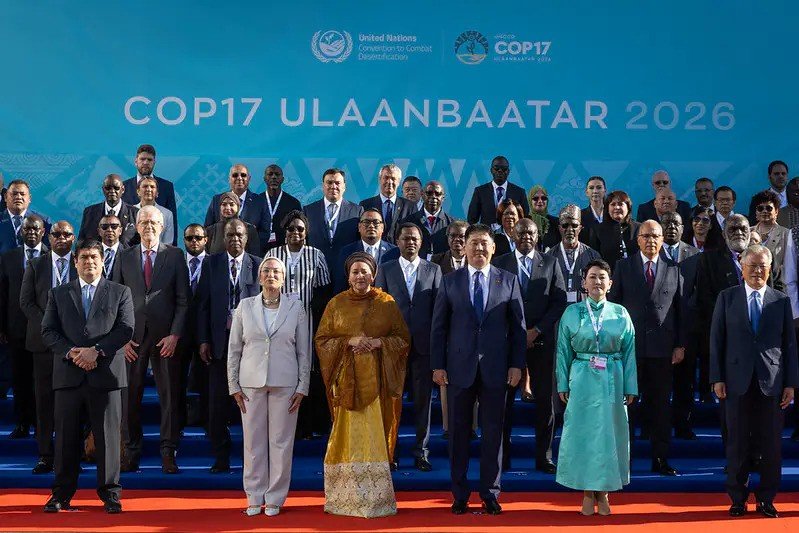
ULAANBAATAR, Aug 28, 2026: The 17th Conference of the Parties to the United Nations Convention to Combat Desertification (UNCCD COP17) concluded in Ulaanbaatar on Friday with new financing commitments, scientific evidence and policy initiatives aimed at accelerating land restoration, strengthening drought resilience and moving global commitments from pledges to implementation.
Held over two weeks, the conference brought together representatives of the 197 Parties to the UNCCD to address the growing challenges of desertification, land degradation and drought. Rangelands, which cover about 54% of the world’s land surface and support the livelihoods of nearly two billion people, were placed at the center of the global land agenda.
$1.3 Billion Package for Land and Drought Resilience
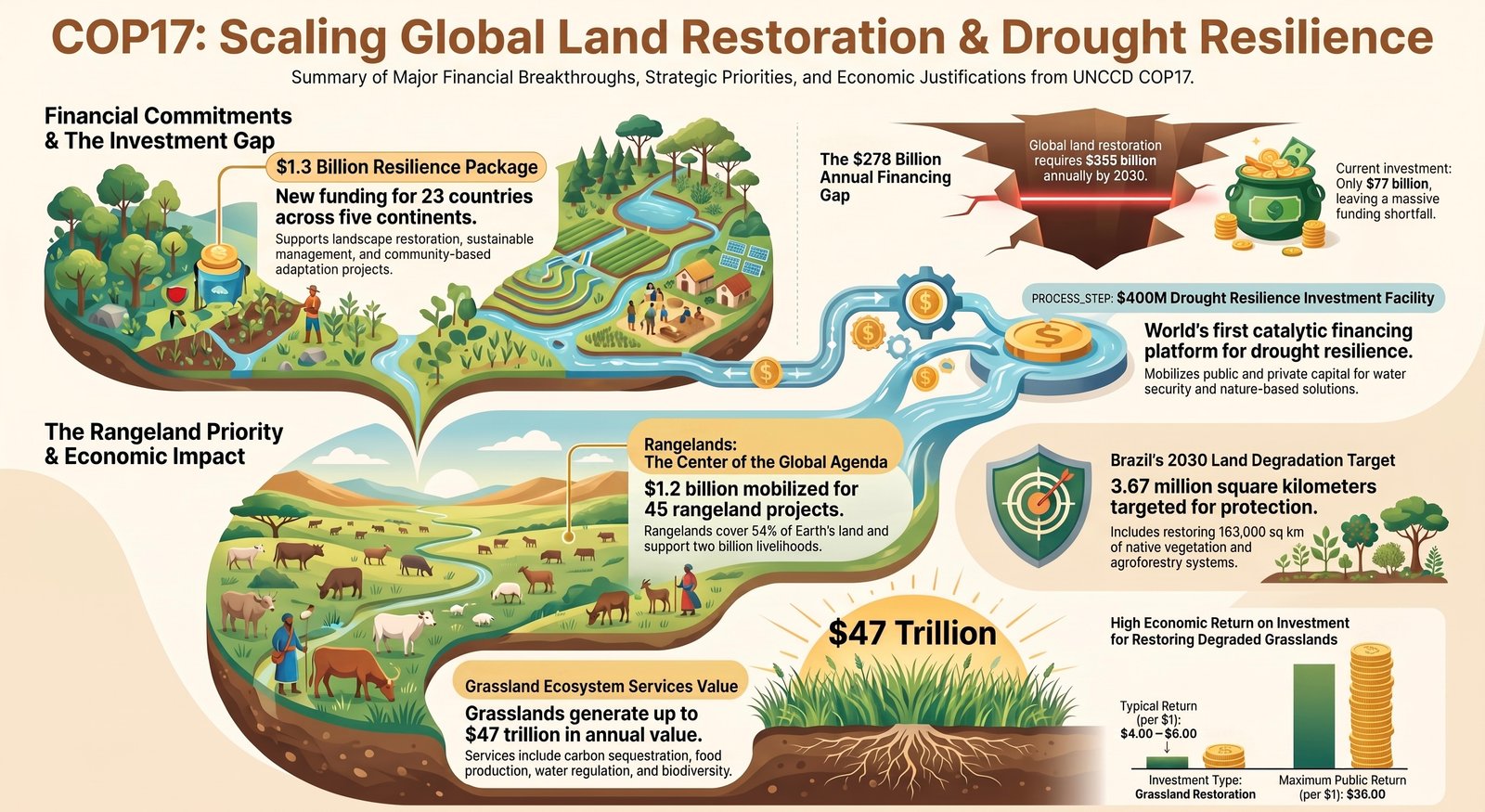
One of the major outcomes of COP17 was a $1.3 billion financing package for 23 countries across five continents to support land restoration, drought resilience and community-based adaptation.
The package includes $644.5 million in new financing, of which $216.4 million has already been committed and is moving towards implementation.
The financing will support projects covering rangeland and landscape restoration, drought resilience, sustainable land management and measures to strengthen the capacity of vulnerable communities.
The conference also highlighted the substantial financing gap facing global land restoration. An estimated $355 billion is required annually by 2030, compared with only about $77 billion currently being invested each year, leaving an annual gap of approximately $278 billion.
Private-sector investment currently accounts for only around 6% of global financing for land restoration.
$1.2 Billion Rangelands Initiative
Rangelands received unprecedented attention at COP17 under the Rangelands Flagship Initiative, launched in Ulaanbaatar as part of the International Year of Pastoralists and Nomadic Pastoralists.
The initiative is mobilizing $1.2 billion across 45 projects, making it the largest investment in the rangelands sector in the history of the UNCCD.
The initiative aims to promote sustainable rangeland management, restore degraded pasturelands and strengthen the livelihoods of pastoralist communities.
A new economic study presented at the conference estimated that grasslands generate between $21 trillion and $47 trillion in ecosystem services every year, including food production, water regulation, carbon sequestration and biodiversity benefits.
The study found that every dollar invested in grassland restoration can typically generate a return of $4–6, with the potential return rising to as much as $36 when wider public benefits are taken into account.
New Push for Global Drought Resilience
COP17 also advanced international efforts to strengthen drought preparedness and resilience.
The Riyadh Global Drought Resilience Partnership, launched by Saudi Arabia at COP16, moved closer to implementation in Ulaanbaatar. Its first Assembly of Partners advanced proposals for establishing a joint fund to support capacity building, investment-ready programmes and drought-resilience financing in around 70 low- and middle-income countries.
Parties agreed to continue negotiations at COP18 on effective drought-risk management through prevention at all levels. Drought will remain a separate agenda item at COP18 and subsequent regular sessions.
$400 Million Drought Investment Facility
UNCCD and Luxembourg also launched the Drought Resilience Investment Facility (DRIF), described as the world’s first catalytic financing platform dedicated to drought resilience.
The facility aims to mobilize up to $400 million in public and private capital for investments in water security, sustainable agriculture, nature-based solutions and land restoration.
A strategic partnership with the Global Environment Facility will explore ways to leverage additional private and philanthropic financing.
Meanwhile, the second phase of the International Drought Resilience Monitoring System introduced a Drought Resilience Index, providing countries with a new tool to assess drought risks, strengthen preparedness and better target policies and investments.
Brazil Announces 2030 Land Degradation Target
COP17 also recorded progress towards the global Land Degradation Neutrality (LDN) target.
Brazil announced a voluntary 2030 LDN target supported by 17 sub-targets aligned with national policies and programs.
The commitment includes the restoration of more than 163,000 square kilometres of land, including through native vegetation restoration and agroforestry systems.
Another 3.51 million square kilometers will be protected from degradation through conservation and sustainable land management. Together, the 17 targets cover approximately 3.67 million square kilometers.
Central Asian countries also reported progress on LDN. More than 80 million hectares in Central Asia—over one-quarter of the region’s total land area—are already degraded, affecting approximately 24 million people. All five Central Asian countries have voluntarily adopted LDN targets, with half of those targets already achieved.
Science Highlights Economic Cost of Land Degradation
COP17 took place amid growing evidence of the economic and social consequences of land degradation and drought.
Up to 40% of the world’s land is degraded, while countries have committed to restoring more than one billion hectares by 2030.
More than 70 countries now have national drought plans, compared with only three in 2013. However, delegates stressed that financing, technical capacity and implementation remain far behind the scale of the challenge.
New research presented in Ulaanbaatar examined the impacts of land degradation and drought on food and water security, livelihoods and national economies. The studies also highlighted particular vulnerabilities among Small Island Developing States and Central Asian countries.
Approximately 18.8 million hectares of land in Small Island Developing States is already degraded, according to the research.
Pastoralists Recognized as Key Land Custodians
The conference placed greater emphasis on the role of pastoralists and nomadic communities in protecting rangelands.
Parties recognized pastoralists as important custodians of rangeland ecosystems and highlighted the value of traditional knowledge, sustainable grazing practices and transboundary migration.
Despite their importance, rangelands remain underrepresented in national policies. Only 24 countries have included rangelands in their national climate plans, compared with 181 countries that have included forests.
The Pastures Priority Initiative launched at COP17 seeks to convert the economic value of rangelands into investment by bringing together projects focused on sustainable management, restoration and pastoralist livelihoods.
The World Wide Fund for Nature is supporting the initiative through a $3.3 million UNCCD COP17 Heritage Fund project. The fund has also approved more than $300 million for over 50 projects benefiting pastoralist communities during the past four years.
Greater Role for Indigenous and Local Communities
COP17 marked the first formal meetings of the UNCCD Indigenous Peoples’ Consultative Group and Local Communities’ Consultative Group.
The conference also saw the largest representation of Indigenous peoples in the history of UNCCD COP meetings.
Participants called for stronger land and migration rights, greater direct access to finance and meaningful participation in decision-making.
The conference further highlighted the role of women and young people, calling for increased investment in youth leadership and greater participation in land restoration and drought-resilience programs.
Business and Investment Move Up the Agenda
COP17 also sought to strengthen private-sector participation in land restoration and sustainable investment.
Mongolia established its first national Business4Land Hub, incorporating sustainable finance principles and a national green taxonomy, with a target of achieving 10% green lending by 2030.
Russia has also established a national hub, while Luxembourg is working to establish a Business4Land Foundation and Germany is supporting a Business4Land Finance Expert Group.
The initiatives are designed to help turn land restoration projects into investment-ready opportunities and encourage greater use of guarantees, insurance, first-loss funds and project-development financing.
Mongolia Calls for Action Beyond COP17
Mongolian officials said the conference had provided international support for the country’s Steppe Agenda, which seeks to promote sustainable management of grasslands and strengthen cooperation and investment.
The government launched several international initiatives covering steppe ecosystems, grassland management, integrated water and land management, and sustainable infrastructure using nature-based solutions.
Mongolia’s Environment and Climate Change Minister Ts. Sandag-Ochir said the next priority would be to translate decisions, partnerships and financial commitments made at COP17 into measurable action.
COP18 to Continue the Momentum
UNCCD Executive Secretary Yasmine Fouad said COP17 had aimed to become a conference focused on implementation rather than commitments alone.
She stressed that the success of the conference would ultimately be judged by whether countries become better prepared for drought, restore degraded lands and rangelands, develop viable projects and improve the lives of communities that depend on land resources.
The next UNCCD Conference of the Parties, COP18, is expected to be held in Egypt in 2028. It will assess progress on land restoration and drought resilience and continue efforts to strengthen integrated approaches to food and water security.
The Ulaanbaatar conference has therefore laid out a broader framework combining policy, science, finance, private investment and community participation to address the accelerating global challenges of land degradation, desertification and drought.