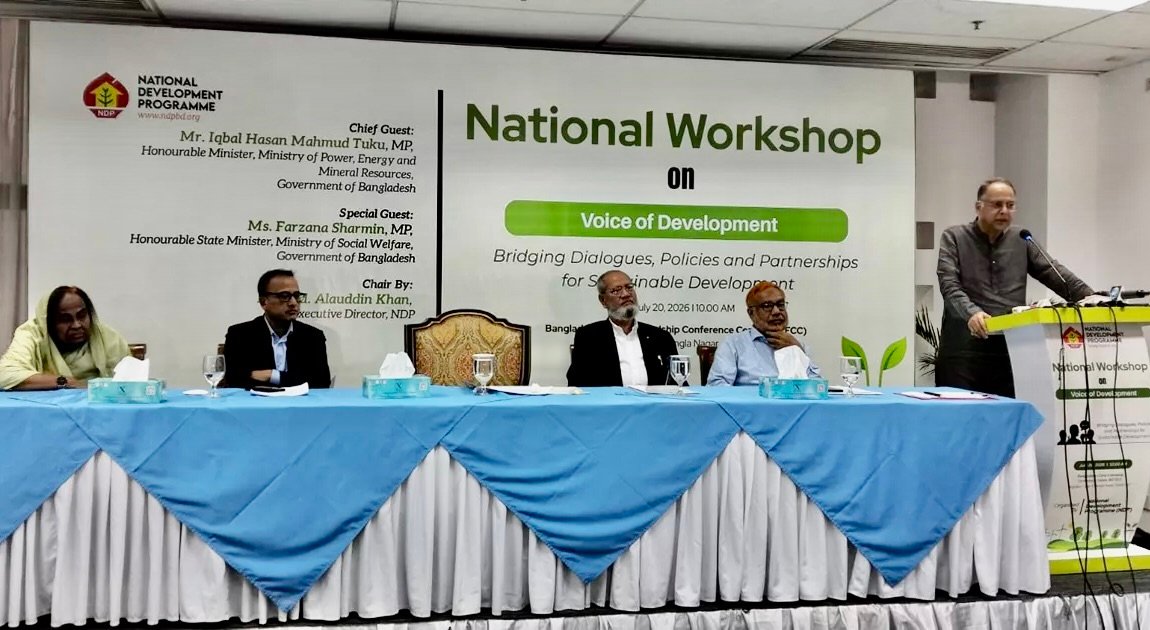
Dhaka, July 20, 2026 (PR) - Power, Energy and Mineral Resources Minister Iqbal Hassan Mahmud has called on non-governmental organizations (NGOs) to invest in Bangladesh’s renewable energy sector, emphasizing that greater private participation can help reduce fuel imports, strengthen energy security, and promote sustainable rural development.
Speaking as the chief guest at the “Voice of Development” national workshop, organized by the National Development Program (NDP) at the Bangladesh-China Friendship Conference Center in Dhaka on Monday, the minister said NGOs have significant opportunities to expand solar power projects, particularly in rural areas.
He noted that increasing the country’s renewable energy capacity would reduce dependence on imported fuels, enabling the government to redirect savings toward national development initiatives. “Prime Minister Tarique Rahman is working to build a welfare-oriented state, and reducing energy import costs is essential to achieving that goal,” he said.
The minister said the government aims to increase renewable energy generation capacity to 10,000 MW, adding that several policy measures have already been introduced to accelerate the development of solar and other renewable energy technologies.
He encouraged NGOs to implement cluster-based rooftop solar projects in rural communities, explaining that investors could recover their investments by selling surplus electricity to the national grid under the net metering system.
Iqbal Hassan Mahmud also highlighted the commercial potential of solar-powered irrigation, saying it could become a profitable business model in the same way that owners of deep tube wells currently sell irrigation services to farmers.
Referring to financing opportunities, the minister said that the World Bank and other international development partners are increasingly interested in funding renewable energy projects. In the current global climate context, he added, financing for fossil fuel-based projects has become increasingly difficult.
Citing a successful grassroots example, the minister mentioned a woman in Faridpur who produces biogas from livestock waste and supplies cooking gas to neighboring households. He said the initiative demonstrates the strong commercial potential of renewable energy at the community level.
The minister also noted that Bangladesh has spent substantial foreign currency on importing fuel since the current government assumed office, putting pressure on the country’s foreign exchange reserves. He said global geopolitical conflicts have further intensified energy security challenges, making renewable energy expansion more urgent than ever.
He added that declining domestic natural gas production has forced Bangladesh to import larger volumes of liquefied natural gas (LNG), significantly increasing the government’s subsidy burden.
Criticizing the previous administration, the minister said that despite claiming success in securing Bangladesh’s maritime boundary, it failed to take meaningful steps to explore offshore energy resources. Meanwhile, neighboring countries have made considerable progress in offshore oil and gas production.
He informed the workshop that the government has already invited international bids for offshore oil and gas exploration, although such initiatives will require substantial investment.
To encourage renewable energy investments, the government has introduced tax incentives for solar panels and batteries, he said.
The minister urged NGOs to move beyond donor dependency and instead utilize concessional international financing to develop commercially viable renewable energy projects.
“Why depend solely on grants? Secure financing, invest, operate commercially, and repay the funds. Concessional financing is available for renewable energy projects,” he said.
He also encouraged NGOs to take advantage of the government’s tax holiday and other policy incentives by investing in solar energy, biofuels, and other renewable energy technologies, saying such investments would not only improve rural livelihoods but also strengthen the long-term financial sustainability of NGOs.