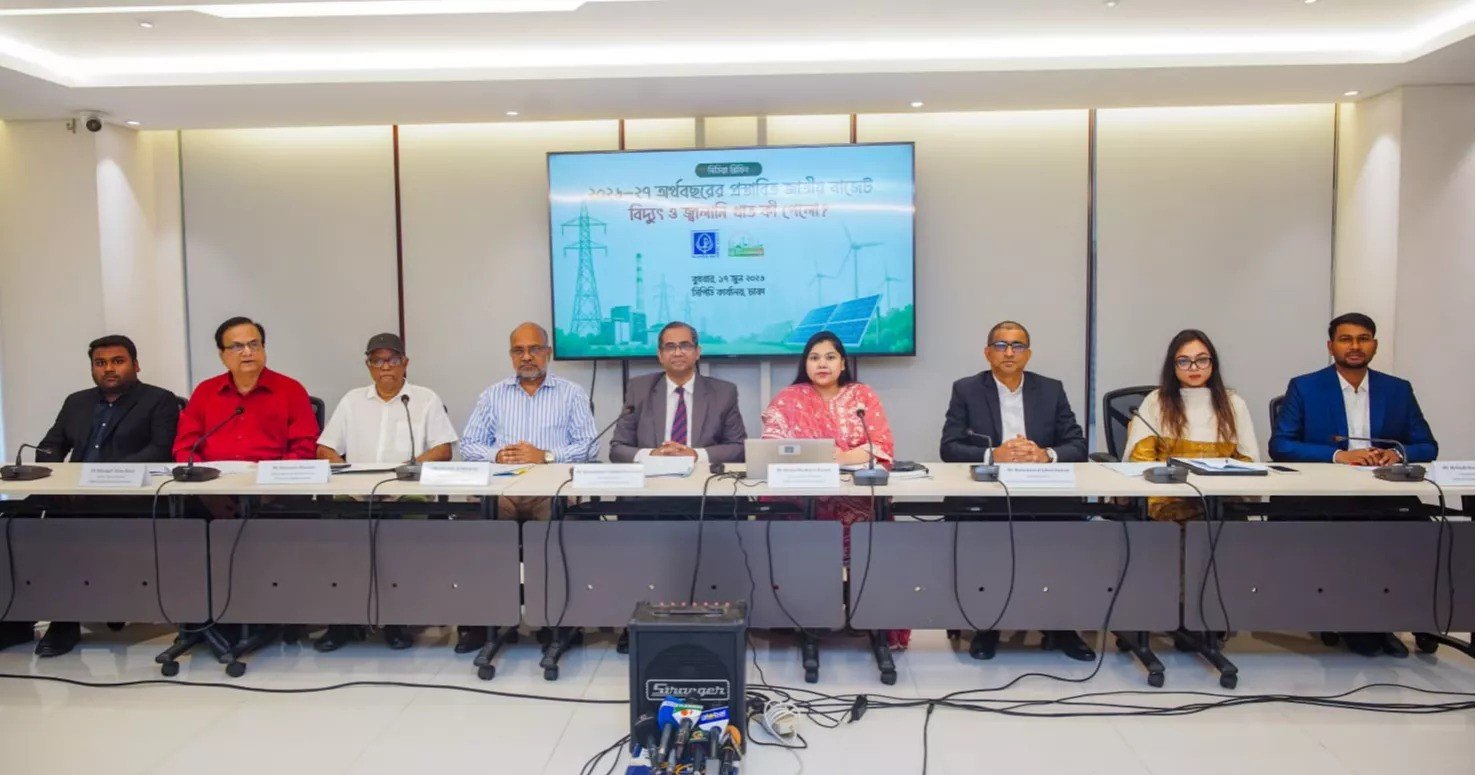
Dhaka, June 17, 2026: The Centre for Policy Dialogue (CPD) has welcomed several renewable energy incentives proposed in Bangladesh’s FY2026-27 national budget but cautioned that continued fiscal advantages for fossil fuels could undermine the country’s long-term energy transition goals.
CPD Senior Research Associate Helen Mashiyat Preoty presented these observations in a paper titled “Proposed National Budget for FY2026-27: What is There for the Power and Energy Sector?” at a discussion held at the organization’s Dhanmondi office on Wednesday. The session was chaired by CPD Research Director Khondaker Golam Moazzem.
Budget Allocation for Power and Energy
The proposed budget allocates Tk 17,345 crore to the Ministry of Power, Energy and Mineral Resources, representing a modest 2.3% increase from the revised FY2025-26 budget. Of this amount, Tk 17,193 crore is allocated for development expenditure, while Tk 152 crore is designated for operational expenditure, which has increased by 7.8%.
However, CPD highlighted a concerning long-term trend: the ministry’s share of the national budget has steadily declined from 6.87% in FY2015-16 to 1.85% in FY2026-27.
The Power Division received Tk 14,996 crore, a 3.9% decrease from the revised allocation, while the Energy and Mineral Resources Division saw a significant 72% increase to Tk 2,349 crore, mainly due to higher development spending.
.jpeg)
Stronger Support for Solar Energy
CPD acknowledged that, for the first time, the budget offers substantial fiscal support for solar power development.
The government has proposed:
• A 0% corporate tax rate for the solar power sector until 2035;
• A 5% tax rebate for consumers paying solar electricity bills;
• Elimination of import duty, regulatory duty, supplementary duty, and advance tax on essential solar equipment until June 2030.
Tax incidence on assembled solar panels is expected to decline from 28.7% to 22.2%, while taxes on lithium-ion batteries—essential for energy storage—will be reduced significantly from 61.8% to 26.3%.
Nevertheless, CPD warned that these incentives are tied to restrictive conditions that primarily benefit selected solar power companies and firms operating under the RESCO model. As a result, approximately 63% of electricity consumers, including households, small businesses, and solar irrigation farmers, remain excluded.
“The proposed budget will encourage private sector investment in renewable energy, but fiscal restructuring is needed to ensure benefits reach end users,” the report stated.
Continued Preference for Fossil Fuels
Despite the government’s commitment to reducing dependence on imported fossil fuels, CPD noted that LNG imports continue to enjoy full VAT exemptions, resulting in a relatively low Total Tax Incidence (TTI) of 9.5%.
Coal imports for power generation will also continue receiving concessionary duty benefits until June 2030.
CPD recommended restoring the 15% VAT on LNG imports, arguing that the current tax policy artificially enhances LNG competitiveness and causes significant revenue losses for the National Board of Revenue (NBR).
The organization also expressed concern over renewed emphasis on domestic coal production, including a target of 600,000 metric tonnes in FY2026-27 and new projects at Barapukuria Second Phase and Dighipara Coal Field.
“Providing fiscal advantages to coal directly contradicts Bangladesh’s energy transition objectives,” the report stated.
Renewable Energy Receives Minimal ADP Support
An analysis of the FY2026-27 Annual Development Program (ADP) revealed that 98% of generation-sector allocations are directed toward fossil fuel projects, while only 2% are allocated to renewable energy initiatives.
Only five renewable energy projects received funding:
• Three under the Power Division;
• Two under the Energy Division.
No new solar or renewable energy projects were added to the ADP.
Meanwhile, 11 renewable energy projects remain unapproved, including:
• Seven solar projects with a combined capacity of 640 MW;
• Three grid modernization projects;
• One 25 MWh Battery Energy Storage System (BESS) pilot project.
CPD warned that achieving the government’s target of 20% renewable energy by 2030 will be extremely challenging. Bangladesh would need to install approximately 1,662 MW of solar capacity annually between January 2026 and December 2030.
Grid Infrastructure Faces Heavy Tax Burdens
The report found that grid and transmission equipment continue to face some of the highest tax burdens in the energy sector, with TTI ranging from 33.6% to 93.2%.
Only two categories of grid components received tariff reductions in the proposed budget, while critical equipment such as transformers, conductors, transmission towers, and electricity meters remain heavily taxed.
CPD urged the government to eliminate import, customs, supplementary, and regulatory duties on all grid infrastructure components, estimating that such measures could reduce TTI by approximately 30 percentage points and lower the cost of expanding the grid for renewable energy integration.
Positive Measures for Electric Vehicles
CPD praised the government’s initiatives to promote electric vehicles (EVs).
Key measures include:
• Reducing import duties on EVs from 93% to 64–80%, depending on vehicle category and price;
• Eliminating import duties on EV charging equipment, reducing taxes from 39.75% to zero;
• Reducing annual income tax on EVs from a flat Tk 200,000 to Tk 25,000–100,000, depending on power capacity.
At the same time, taxes on internal combustion engine (ICE) vehicles have increased, with one category of reconditioned vehicles now facing a TTI of 159.8%.
Limited Attention to Solar Irrigation
CPD expressed disappointment over the limited emphasis on solar irrigation for marginal farmers.
The budget only mentions:
• Installation of 98 solar-powered irrigation pumps;
• Installation of 27 solar-powered dug wells.
In addition, a solar irrigation project that has already achieved 40% completion received no allocation in the current ADP.
“There is very little support for solar irrigation in the proposed FY2026-27 national budget,” the report concluded.
Rising Electricity Subsidies
The government has proposed Tk 37,000 crore in electricity subsidies, up from Tk 36,000 crore in the revised FY2025-26 budget. The subsidies are mainly intended to offset losses incurred by the Bangladesh Power Development Board from purchasing electricity from Independent Power Producers (IPPs), rental plants, and quick rental power plants.
CPD warned that future subsidy rationalization should not translate into higher electricity tariffs for consumers. Instead, the government should gradually phase out capacity payments to fossil fuel-based power plants.
CPD Recommendations
CPD urged the government to:
• Increase allocations for projects nearing completion;
• Approve additional renewable energy projects through the revised ADP;
• Replace the restrictive entity-based fiscal system with an open, component-based zero-tariff framework;
• Introduce targeted subsidies for solar irrigation farmers;
• Establish dedicated green grants for energy transition and smart grid development.
According to CPD, these measures are essential for accelerating Bangladesh’s transition toward a cleaner, more sustainable energy future.