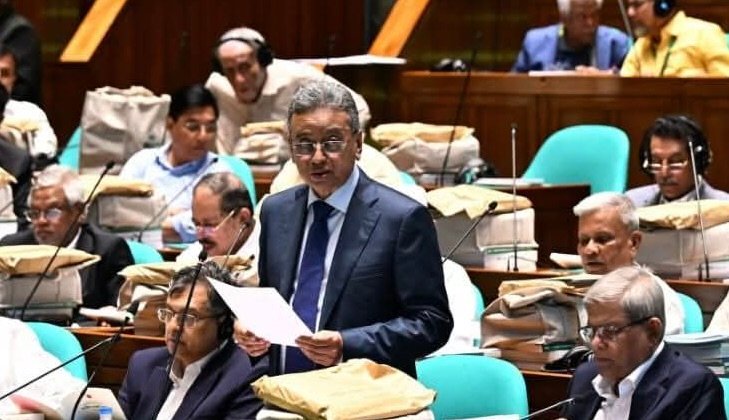
Dhaka, June 11, 2026 — The government has set a target to raise Bangladesh’s electricity generation capacity to 35,000 megawatts (MW) by 2030, alongside expanding the national transmission network to 25,000 circuit kilometers, Finance Minister Amir Khosru Mahmud Chowdhury announced while presenting the FY2026-27 national budget in Parliament.
The finance minister said the government is implementing a comprehensive strategy to strengthen the country’s energy security through intensified oil and gas exploration, increased domestic energy production, expansion of petroleum refining capacity, and diversification of fuel import sources.
“Our government is committed to building a self-reliant, affordable, uninterrupted, environmentally sustainable and modern power system,” he told the Jatiya Sangsad.
To support the clean energy transition, the government will provide incentives for local manufacturing of renewable energy equipment, including solar panels, wind power components and battery storage systems. Plans are also underway to retire inefficient power plants, modernize existing facilities and adopt a least-cost power generation strategy.
The budget outlines measures to improve financial transparency in the power sector through a review of capacity payments and power purchase agreements. Special initiatives will also be taken to expand electricity access in remote and island regions while promoting competitive bidding for new power projects to keep electricity prices affordable.
Highlighting the decline in domestic gas reserves, the finance minister emphasized the need to increase the share of renewable energy in the national energy mix. The government will strengthen rooftop solar programs, conduct wind resource assessments in coastal areas, and promote large-scale solar projects.
Additional initiatives include the development of a National Energy Storage Roadmap, pilot projects for waste-to-energy generation, enhanced grid flexibility, and expanded energy-efficiency programs through audits and the adoption of energy-saving technologies.
The minister also provided an update on the Rooppur Nuclear Power Plant, stating that construction of the 2,400MW facility is progressing rapidly. Fuel has already been loaded into one reactor, with around 300MW expected to be connected to the national grid by August 2026 and the first 1,200MW unit scheduled for full operation by January 2027.
The government believes these initiatives will help ensure reliable energy supplies, support economic growth and strengthen Bangladesh’s long-term energy security.