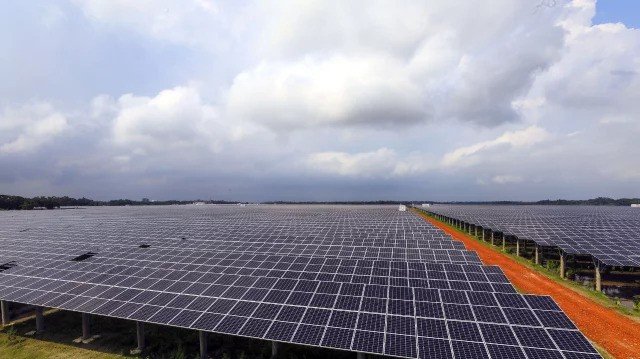
Syed Shukur Ali Shuvo, BSS
The government has signed contract with 12 independent power producers (IPPs) to generate 918-MW electricity at an average cost of 7.80 cents (Tk 9.12) per kilowatt-hour, with officials saying amount was roughly 2.5 cents lower than previous such costs.
Bangladesh Power Development Board (BPDB) Chairman Engineer Rezaul Karim told BSS that the recent deals were part of an extensive energy mix campaign to maximize renewable energy generation reducing dependence on traditional and particularly on imported fossil fuel sources.
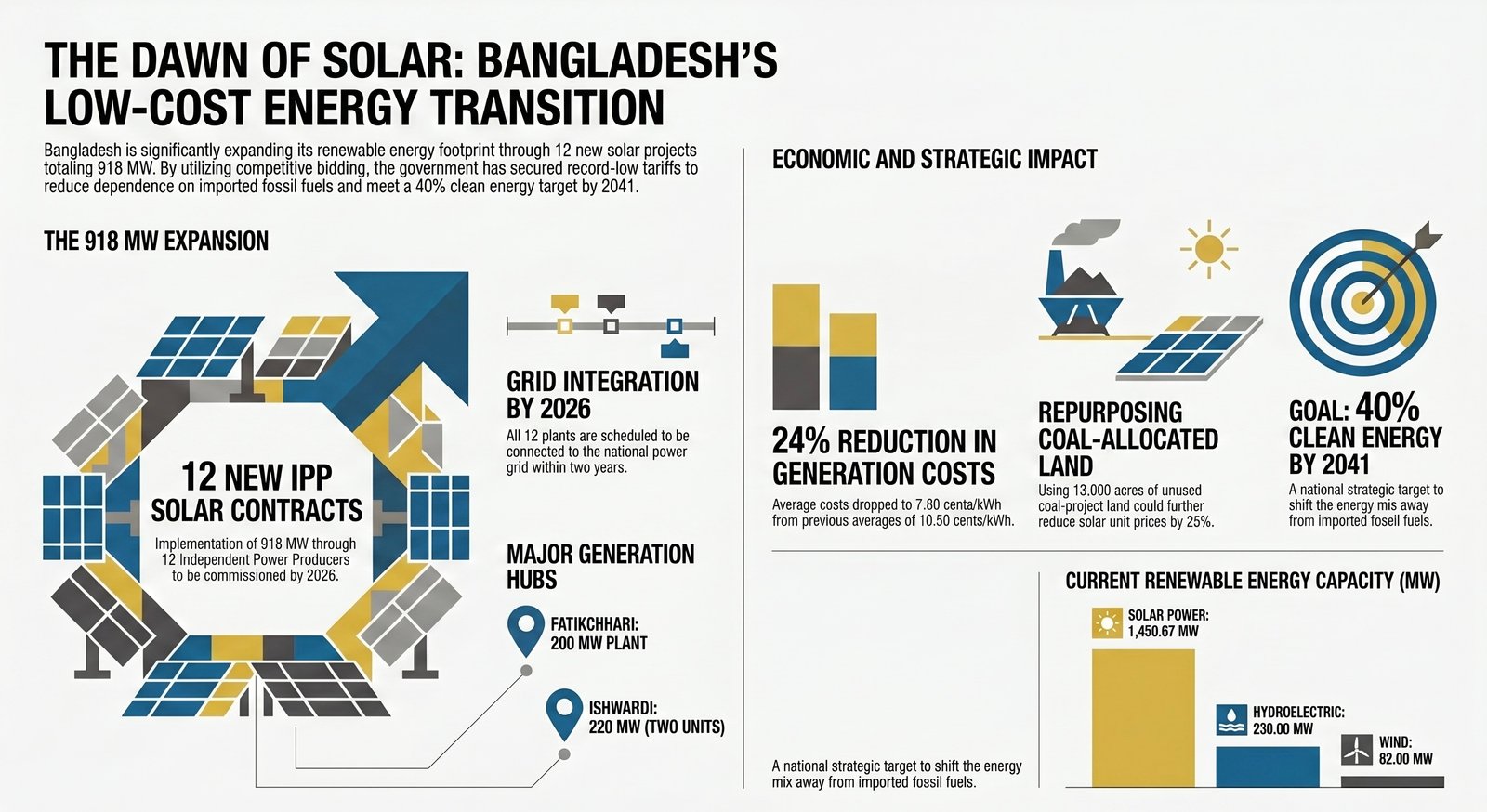
“The tariff drop of 2 to 3 cents means the average generation cost will fell significantly from earlier average prices that hovered around 10.50 cents per kilowatt-hour,” he said.
BPDB officials said as part of the campaign the new government annulled a past interim regime decision to scrap earlier adopted six power projects alongside taking six new projects to get the 918 MW electricity at lower tariffs.
They said the 12 plants under the signed 12 projects were expected to be commissioned in next two years while all of them would be connected to the national power grid.
The officials said of the 12 plants, the biggest one would be constructed at Fatikchhari in Chattogram to produce 200-MW followed by a 150 MW plant to be installed in Ishwardi of Pabna.
They said two units would be set up in Cox’s Bazar and each of them would generate 100 MW while a third 100-MW capacity solar plant would be constructed at Mongla of Bagerhat.
A 70 MW solar plant would be installed as well at Ishwardi of Pabna.
The rest of the plants would set up at Bibiana of Moulvibazar, Joldhaka of Nilphamari, Fatikchhari of Chattogram, Moulvibazar Sadar of Molvibazar, Hathazari of Chattogram and Sudharam of Noakhali with generation capacity ranging from 50 to 10 megawatts.
A BPDB official said the government signed contracts with 12 IPPs securing lower rates through competitive open tenders.
One of the IPP operators Imran Karim said three of his private entities were awarded contracts to produce a total of 400-MW power and a piece of land was by now procured to set up one of the plants.
“The process is underway to purchase land for two other power plants. Our three solar plants will be raided for commercial production from 2028 to 2029,” said Karim who is the chairman of Confidence Power.
Energy analysts said that the rooftop solar and other renewable projects could significantly reduce Bangladesh’s reliance on imported fuel.
According to BPDB estimates the currently generated 1,451-MW solar power now accounted for some 5.01 percent of the country’s total installed capacity of all sorts of power plants.
BPDB officials said soon after coming to power in 2024 the interim regime had canceled 31 renewable power projects 27 being solar ones which were to produce 2,724 MW.
Of the remaining projects four were previously adopted to produce wind and hydro-power while those were abandoned at their different construction stages.
“We are implementing the government’s integrated plan to boost renewable energy, cut carbon emissions and strengthen energy security in the country,” the BPDB chairman said.
Officials said apart from the 12 projects a campaign was underway to set up rooftop solar and other renewable projects.
Bangladesh currently produces 1,450.67-MW solar electricity while 1,073.5 MW are connected to the national grid and 377.17 MW are off-grid.
Sustainable and Renewable Energy Development Authority (SREDA) studies suggest Bangladesh currently has about 1743.76 MW of installed renewable power generation capacity.
Apart from the solar power, 230-MW comes as hydroelectricity, 62-MW is produced from wind, 0.69-MW from biogas and 0.4 MW from biomass.
Leading energy analyst Shafiqul Alam suggested the government should develop a comprehensive energy master plan to ensure policy consistency as it was needed to rebuild investors’ confidence.
“Bangladesh currently experiences stagnation in renewable energy development as no initiative was taken in the past interim government,” said Alam, who serves at independent Institute for Energy Economics and Financial Analysis (IEEFA).
Coastal Livelihood and Environmental Action Network (CLEAN) chief executive and energy expert Hasan Mehedi said if the government could encourage people to install rooftop solar at their households the government investment would not be required.
Mehedi said some 13000 acres of land was acquired earlier to construct coal-fired power plants which remained unused so far and so instead of new land acquisition, these pieces of land now could be used to set up solar plants which would reduce price per unit by 23-25 percent.
Bangladesh in 2021 set a target to generate 40 percent of power from clean energy by 2041.
International Renewable Energy Agency’ (IRENA) latest report suggests China emerged as the number one solar energy producer generating 12,02,178.8-MW followed by the USA producing 2,11,610.1 MW and India producing 1,35,501.5 MW.
As far as the national grid connection is concerned Vietnam currently provide 8700 MW solar power to its grid, Philippine 2,600 MW, Sri Lank 1000 MW and Pakistan 800 MW.