The International Energy Agency (IEA) has issued a detailed warning that the ongoing Middle East conflict has triggered a severe global energy crisis, with unprecedented disruptions to liquefied petroleum gas (LPG) supplies threatening cooking fuel access for billions of people, particularly in developing economies.
According to the IEA’s commentary (May 2026), daily oil supply losses from the conflict in March 2026 exceeded the combined peak disruptions seen during the 1970s oil shocks. The crisis has had especially severe consequences for LPG markets, a fuel used by around 3.4 billion people globally for cooking, making it one of the most essential household energy sources worldwide.
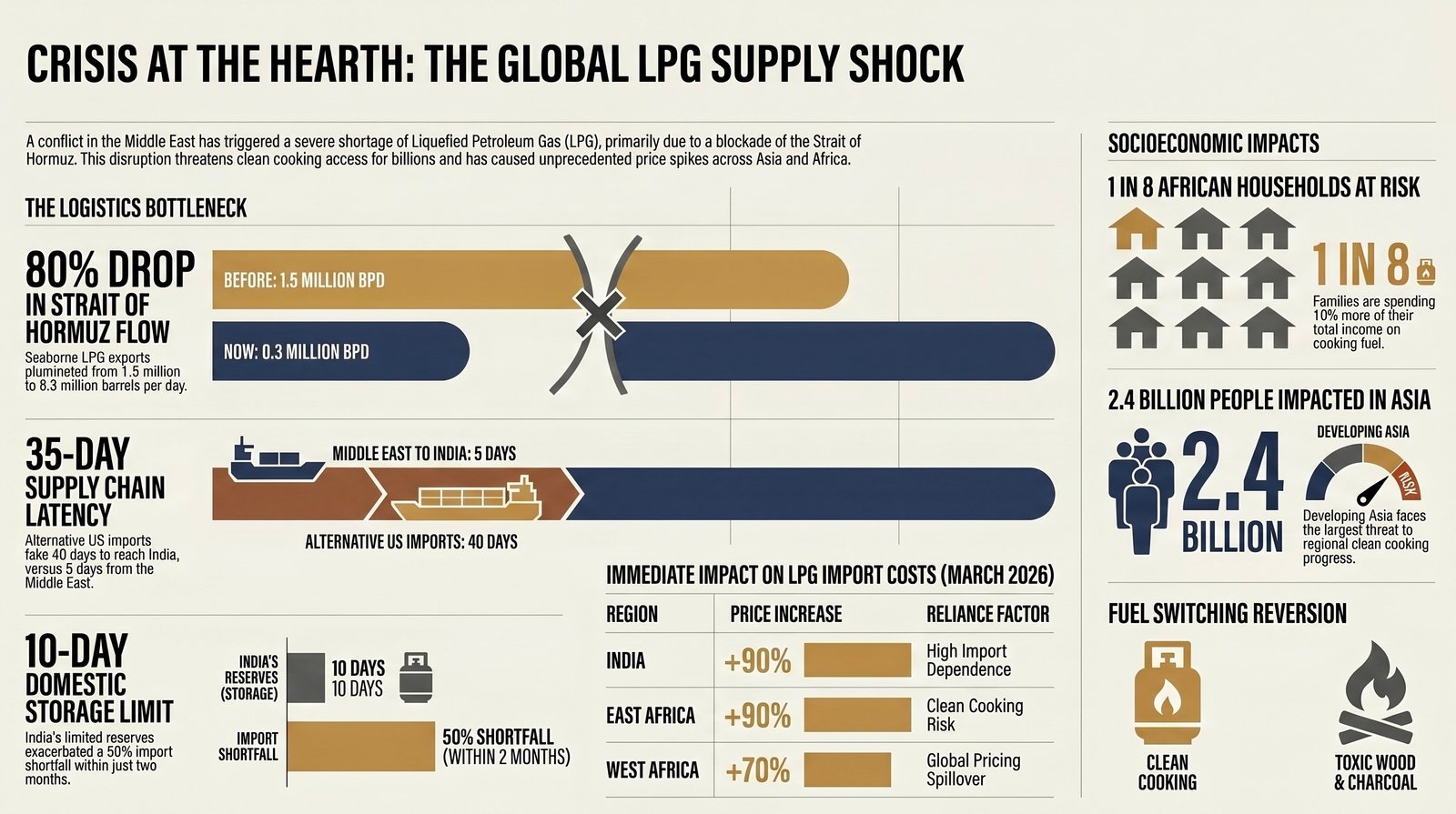
A key vulnerability is the Strait of Hormuz, through which roughly 30% of global seaborne LPG exports flowed as of 2025. The escalation of conflict has sharply reduced maritime traffic, cutting LPG flows through the strait by about 80%—from roughly 1.5 million barrels per day to just 0.3 million barrels per day in March 2026. This sudden disruption has created widespread shortages, particularly in Asia, which receives nearly all LPG exports from the Middle East.
Severe impact on Asia and developing economies
Developing Asia is the largest consumer region for LPG cooking fuel, with around 2.4 billion people relying on it. Countries such as India and Indonesia have made major progress in expanding clean cooking access through large-scale LPG adoption programs, shifting hundreds of millions away from traditional fuels like wood, charcoal, and kerosene.
However, both countries remain heavily dependent on imports. In India, nearly two-thirds of LPG supply previously transited through the Strait of Hormuz. Following the disruption, imports reportedly fell by more than 50% within two months, creating a supply gap of roughly 430 kb/d. Although domestic refineries increased output by around 180 kb/d and emergency demand management measures were introduced, supply constraints remain significant.
India’s limited storage capacity—covering just over 10 days of consumption—has further exposed its vulnerability. As a result, commercial users in particular have faced reduced allocations, with reports indicating they are receiving around 70% of pre-crisis LPG volumes. Meanwhile, households and businesses have experienced rising prices in unregulated markets, alongside localized shortages.
Logistics constraints have worsened the situation. Alternative LPG imports from distant suppliers such as the United States can take around 40 days to reach Indian ports, compared with only 4–5 days from the Middle East, significantly delaying supply rebalancing.
Global price shock and spillover effects
The LPG crisis has not remained confined to Asia. Global LPG markets are tightly interconnected, meaning disruptions in one region quickly affect prices worldwide. In March 2026, LPG import prices surged sharply across all major benchmarks, rising by around 90% in India and East Africa and about 70% in West Africa compared to 2025 averages.
Importantly, West Africa’s price spike occurred even without direct dependence on Middle Eastern LPG, demonstrating the global nature of pricing mechanisms. As a result, both deregulated and subsidized markets in Africa have come under pressure, forcing governments to absorb higher fiscal costs or pass increases onto consumers.
Risks to clean cooking progress in Africa
The IEA highlights that the crisis is undermining progress in clean cooking access, particularly in sub-Saharan Africa. Around 45% of LPG users in the region are now spending a larger share of their income on cooking fuel, while poorer households face the most severe impacts.
One in eight households has seen LPG costs rise by at least 10% of their income, increasing the risk of fuel switching back to traditional biomass such as charcoal or wood. This trend threatens to reverse years of progress in reducing indoor air pollution and improving health outcomes.
Before the crisis, LPG was considered the most cost-effective clean cooking solution for more than 60% of households in sub-Saharan Africa. However, rising prices are now slowing new adoption and discouraging governments and donors from scaling LPG-based clean cooking programs.
Infrastructure damage and supply constraints
The IEA also reports that known damage to LPG-related infrastructure in Qatar, Oman, and Iran has already resulted in production losses of around 170 kb/d. Additional sites in the region are believed to have been affected, although full assessments are still underway.
These losses add further pressure to already constrained global supply chains, especially given the concentration of LPG production in the Middle East.
Policy responses and emergency measures
In response to the crisis, the IEA and its member countries have activated emergency measures, including the largest coordinated release of strategic oil stocks in history, aimed at stabilizing markets and supporting fuel availability, including LPG.
The agency has also issued policy guidance encouraging governments to prioritize household access to cooking fuels, improve LPG storage capacity, and implement targeted subsidies or price stabilization mechanisms.
Many countries have introduced short-term interventions such as price caps, direct subsidies, and fuel allocation controls. However, the IEA emphasizes that these measures often carry significant fiscal costs and are not always effectively targeted to the most vulnerable households.
Structural shift toward electric cooking
The crisis is also accelerating interest in alternative cooking technologies, particularly electric cooking solutions. Countries such as India and Indonesia have introduced programs to reduce upfront costs of electric cookstoves, leading to increased adoption in some regions.
Across Africa, about 80% of households using LPG already have access to electricity, but only about one-third benefit from reliable supply. This reliability gap remains a key barrier to large-scale transition to electric cooking.
The IEA notes that improving electricity reliability, combined with reducing appliance costs—such as through VAT exemptions on clean cookstoves—could significantly expand access to clean cooking solutions across sub-Saharan Africa.
Outlook and international coordination
To address the growing crisis, the IEA is continuing to coordinate international policy responses and monitor fuel supply disruptions. It is also organizing a second Clean Cooking Summit in Nairobi (9–10 July 2026), aimed at mobilizing investment and policy commitments to strengthen clean cooking access and energy security in developing economies.
The first summit raised USD 2.2 billion in commitments, with USD 470 million already disbursed. The upcoming summit will focus on scaling financing, improving fuel resilience, and accelerating the transition to cleaner cooking technologies globally.