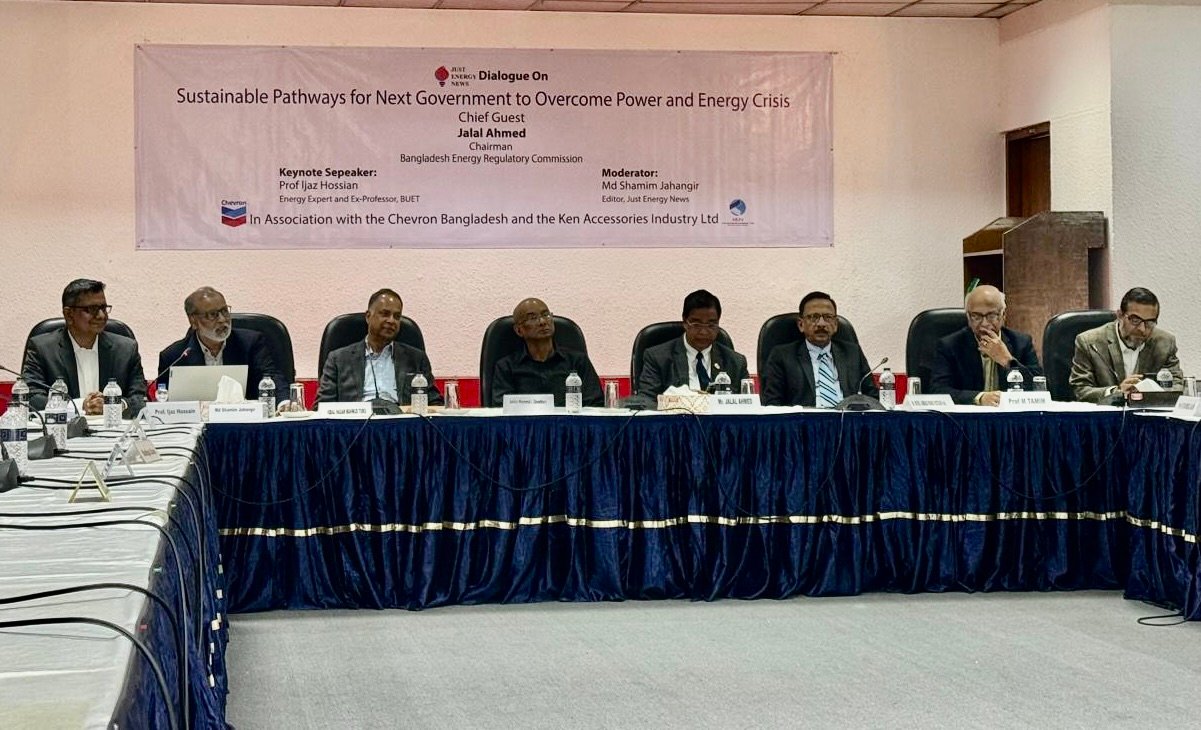
Bangladesh’s power and energy sector is currently facing a deep crisis. Despite having excess generation capacity, the sector is under severe financial and structural strain due to high costs, heavy reliance on fuel imports, dollar shortages, subsidy pressure, and a lack of good governance. Analysts have advised that, alongside immediate actions by the new government, realistic and sustainable long-term planning is essential to address the crisis.
Speakers at the event said that demand forecasting must move away from past exaggerated projections and instead be based on data-driven planning. They emphasized the need to stop installing unnecessary power plants, reduce dependence on LNG and oil, strengthen domestic gas exploration, and establish clear policies for a balanced use of coal and renewable energy.
These views were shared on Tuesday at a discussion titled “Sustainable Pathways for the Incoming Government to Address the Power and Energy Crisis,” held at the CIRDAP auditorium in the capital. The event was organized by the English online news portal Just Energy News and moderated by its Editor, Shamim Jahangir.
In his keynote address, Bangladesh Energy Regulatory Commission (BERC) Chairman Jalal Ahmed said, “Bangladesh’s energy crisis is primarily the result of long-standing neglect of primary energy. In the case of LNG imports, there is a major capacity limitation of the FSRUs that is often overlooked. With the existing two FSRUs, it is not possible to increase imports beyond their designated capacity, even in emergencies.”
He added, “No realistic reservoir management study has been conducted in the country since 2001. Gas exploration has remained stagnant for the past 16 years. While budget allocations for the energy sector have been limited, massive spending has been directed to the power sector. Sustainable power supply is not possible without investment in primary energy. There has been no progress in the coal sector, and no new integrated energy policy has been formulated since 1996. Considering the country’s actual electricity demand, a large portion of the existing generation capacity is unnecessary, and the financial burden is being borne by the people.”
Jalal Ahmed further said that instead of building new thermal power plants, priority should be given to efficient utilization of existing assets and alternative fuels. He stressed that policy support must be ensured immediately to increase the use of renewable energy in the ready-made garments export sector to 42.5 percent by 2030, in line with European Union requirements. He added that overcoming the current crisis is not possible without increased investment, policy reform, and budgetary allocation in the energy sector.
The keynote paper was presented by former BUET professor Dr. Ijaz Hossain, who said, “Around 97 to 98 percent of Bangladesh’s total energy supply is dependent on fossil fuels. In light of climate change and the Paris Agreement, this is an extremely negative picture for us. At the same time, about 60 percent of energy and electricity supply is currently import-dependent, and this share has increased further over the past year. The resulting economic and foreign exchange pressures are easy to anticipate.”
He added, “The gas sector presents an even more alarming picture. Current daily gas demand is no less than 4,000 million cubic feet, while average daily supply is around 2,500 to 2,600 million cubic feet, of which about 59 to 60 percent is used for power generation and captive power. Household gas consumption is officially shown as around 11 percent, but in reality, it is no more than 5–6 percent. Notably, system loss in gas transmission and distribution is reported at around 8.5 percent, although such losses should not technically occur in the gas sector. In reality, this reflects theft and irregularities. Even after excluding technical losses, around 10 percent of gas is effectively being stolen or wasted. In the past, this was seen as a loss of domestic gas, but the situation has changed—currently, 30 to 33 percent of total gas supply is imported LNG. This means that the 10 percent loss now represents a direct loss of LNG, amounting to several billion dollars annually. Stopping this waste could save a significant amount of foreign currency.”
As a special guest, BNP National Standing Committee member and former State Minister for Power, Iqbal Hasan Mahmood Tuku, said, “Electricity is not a simple issue. On one hand, it is a commercial commodity; on the other, it is a public service managed by the state. The government must balance production and costs while also ensuring affordable electricity for the people. Maintaining this balance requires deep thinking and a long time—something that cannot be achieved within five years.”
He said, “For the past 17 years, democracy has effectively been suspended in the name of development. The country was run on the philosophy that ‘development alone is enough.’ But today, the real burden of that development has fallen on the people. The same picture is evident in the power sector.”
Tuku added, “During my tenure, there was a clear policy in the power sector—65 percent of generation would remain in government hands, and 35 percent would be allocated to the private sector on a PPP basis. This allowed the government to maintain control over the market and provide affordable electricity to the people. However, this policy was not followed later.”
He further said that there had been a plan to address the government’s financial constraints by bringing power plants to the capital market. This would have allowed citizens to benefit both as electricity consumers and as shareholders through dividends, while also increasing transparency in management. However, that opportunity was not utilized; instead, the capital market was weakened.
Iqbal Hasan Mahmud Tuku said that making the Power System Master Plan entirely gas-dependent was a major policy mistake. No country can plan its power sector based on a single fuel source. When a fuel crisis occurs, the entire power system collapses.
He alleged that by bypassing the Public Procurement Rules (PPR) and awarding power plants through one-to-one negotiations, the door was opened to corruption and plunder. Over the past 17 years, instead of effectively utilizing BAPEX, an import-dependent fuel policy has been pursued.
Tuku said that despite having coal reserves, no realistic decision has been taken to extract them, further weakening energy security. At the same time, regular payments are being made in the name of capacity charges even when electricity is not generated, placing enormous pressure on foreign currency reserves.
He stated, “No matter which government comes to power in the future, ‘business as usual’ will not work. The country is facing a deep financial crisis. There is no alternative to national consensus, structural reforms, and accountable governance to overcome this situation.”
Regarding the demand to cancel the Adani power purchase agreement, energy expert and Vice Chancellor of Independent University, Bangladesh (IUB), Professor M. Tamim said that the country will soon have to deal with a major energy and power crisis. Before canceling any power contract, it is essential to verify and review it in its current operational context; otherwise, supply disruptions could occur, causing public hardship.
He said that domestic gas provides the lowest-cost electricity generation in Bangladesh and remains significantly cheaper than international market prices. Without domestic energy sources, it is not possible to supply electricity at below Tk 10 per unit.
Professor Mushtaq Hussain Khan of the Department of Economics at SOAS, University of London, said, “Bangladesh’s economy is facing several severe unresolved crises that could trigger a collapse. Nearly 35 percent non-performing loans in the banking sector and the deep financial crisis in the power sector pose the biggest risks.”
He said, “Last year, nearly USD 5 billion in subsidies had to be provided to the power sector, a large portion of which was paid in foreign currency. This loss cannot be sustained through borrowing or printing money, as it would create the risk of hyperinflation. If subsidies are withdrawn, electricity prices would have to be increased by nearly 86 percent, which would make the industrial sector unsustainable and trigger de-industrialization.”
According to him, the root cause of the crisis in the power and energy sector is not a lack of policy, but institutionalized corruption since 2010. Although power generation capacity has increased fourfold, costs have risen elevenfold and capacity charges have increased twentyfold. Ignoring the master plan and entering into irrational contracts created this crisis. Unless corruption is stopped, no policy reform will be effective, he added.
Bangladesh Jamaat-e-Islami Assistant Secretary General Ahsanul Mahbub Jubayer said that consensus among all political parties and relevant stakeholders is essential on national issues. Frequent policy shifts with changes in government have not solved problems; instead, they have worsened them. Commitment and accountability are crucial in addressing key national issues such as health, education, anti-corruption efforts, and the implementation of patriotic policies.
In his closing remarks, Mohammad Wahid Hossain, Chairman of the Bangladesh Energy and Power Research Council (BEPRC), said, “The upcoming government will face formidable challenges, particularly in the power and energy sector. It is better to speak uncomfortable truths and take difficult decisions early, as governments usually need to reset their strategies within three to four years.”
Professor M. Shamsul Alam, Energy Adviser to the Consumers Association of Bangladesh (CAB), said, “When irregularities continue for years under state patronage, no institution can function properly. The regulatory commission—the sole regulator of the sector—has failed in its duties and has become a tool for individuals involved in irregularities and corruption.”
Dr. Md. Rafiqul Islam, Additional Secretary and Member (Innovation) of the Bangladesh Energy and Power Research Council, said, “To ensure the country’s energy security, alongside natural gas, the potential of solar, wind, hydropower, biomass, and the blue economy must be effectively utilized. This requires short-, medium-, and long-term planning, along with time-bound roadmaps, action plans, and accountability.”
He added that there is no immediate solution to the problems of the power and energy sector; long-term and integrated efforts are required. Research-based and implementable policies must prioritize renewable energy, energy efficiency, and conservation.
Others who spoke at the event included former Justice Moinul Islam Chowdhury, convener of the National Review Committee; former IMED Secretary Abul Mansur Md. Faizullah; former BERC member Md. Mizanur Rahman; M. Zakir Hossain Khan, Executive Director of Change Initiative; Shafiqul Alam, Lead Energy Analyst at IEEFA; Md. Sirajul Mawla, President of the LPG Autogas Owners Association; Humayun Rashid, Vice President of LOAB; Farhan Noor, Secretary General of the CNG Refueling Station Owners Association; and Shahid Alam, Chief Corporate Affairs Officer of Robi, among others.