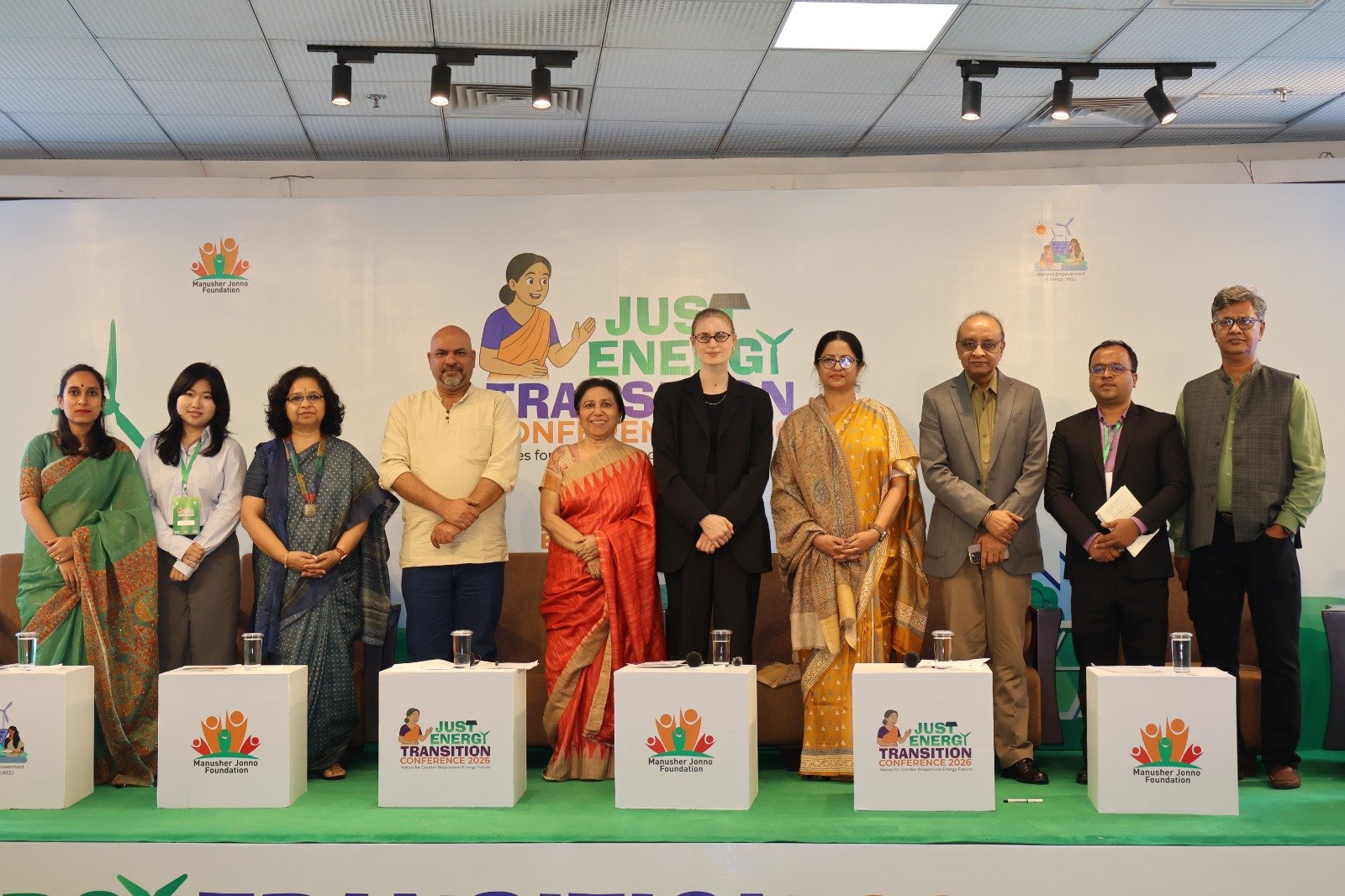
Key Takeaways from the MJF Conference
Manusher Jonno Foundation (MJF) hosted the Just Energy Transition Conference 2026 on February 1 at the Military Museum in Dhaka. The national-level conference, themed “Voices for a Gender-Responsive Energy Future,” focused on the social dimensions of energy transition, including equity, inclusion, and justice, alongside technology and finance, with an emphasis on turning grassroots realities into policy and investment recommendations.
Delivering the welcome remarks, Shaheen Anam, Executive Director of MJF, said the organization has worked for service access at the grassroots for 23 years, and warned that climate vulnerability disproportionately affects women and persons with disabilities. A renewable transition, she said, must respond to these realities, particularly in areas such as household cooking where women face long hours and serious health risks. “So, energy will be clean, it will be green, and it will be for the people’s welfare,” she said, urging that renewable energy remain a priority regardless of who forms the next government.
.jpeg)
In the first session, “Energy Policy and Governance in the frame of Women Empowerment,” chaired by Banasree Mitra Neogi, Director, Rights and Governance Programs, MJF, posed a central question: “Just transition for whom?” She said a transition cannot be called just if it excludes any community.
Presenting a paper, M Zakir Hossain Khan, Executive Director, Change Initiative, argued that Bangladesh must define “negotiable” and “non-negotiable” energy needs and treat safe, clean indoor cooking energy as non-negotiable for women’s health. He called for Bangladesh-driven renewable energy guidelines, decentralized funding, community grids, and regular public reporting, including quarterly publication of the Gender JET Dashboard.
Tanzina Dilshad, program manager, Environment and Energy, European Union Delegation to Bangladesh, said women remain underrepresented in implementation roles in the energy sector. She stressed the need for women-friendly policies that recognize career breaks and remove structural discrimination so women can participate without being penalized. She referred to Shoktikonna as an initiative supporting young women’s entry into the transition space. Prithibi Chakma was there from Shoktikonna.
.jpeg)
Hasan Mehedi, chief executive of CLEAN, recommended decentralized and democratized energy governance, affordable financing including low or no-interest lending mechanisms, and stronger incentives for hiring women, proposing recruitment targets that exceed 10 percent.
The second session, “Power-Equality-Business,” was chaired by Dilruba Haider, program specialist, Climate Change, DRR and Humanitarian Action, UN Women. She said the accelerating climate crisis makes renewable energy an urgent pathway, and added that women’s empowerment in the sector requires active engagement from men as well.
Fredrika Noren, second secretary, Inclusive Economic Development, Embassy of Sweden, said gender-responsive transition requires changes across multiple layers of society, including skills development and access to finance. She recommended making investment access easier for women and establishing decentralized funds at the sector level, not only at the national level, while treating gender responsiveness as a core element of financing discussions.
Navid Hasan, founder of For the Light, said women remain largely absent from renewable entrepreneurship and ownership and recommended strengthening financial policies to address gender equality in the energy sector, including targeted green financing and training.
Mollah Amzad Hossainn, Editor, Energy and Power, said Bangladesh’s renewable share remains low and many installed solar panels are not fully utilized. He recommended expanding technical training for women, developing solar irrigation into a viable business model, and increasing women’s participation with support from the local government.
A third session, “From Dialogue to Commitment: Holding Political Parties Accountable for a Gender-Responsive Energy Future,” was chaired by Shaheen Anam.
Among the discussants, Sharif Jamil, member secretary, Dhoritri Rokhhay Amra (DHORA), said the transition should move from dialogue to commitment, and that election manifestos should clearly address renewable energy in view of Bangladesh’s climate vulnerability.
Fahima Nasrin Munni, Assistant Secretary for International Affairs, BNP, said women remain constrained in participation across sectors and are particularly invisible in the energy sector. She said decision-making is still dominated by men and argued that the changing climate context makes inclusion more urgent. Her party will definitely look into the crisis faced by women in the energy sector if they are in power.
Navid Nowroz Shah, Joint Chief Coordinator, NCP, spoke about women’s security and rights, and said the party would seek to strengthen women’s empowerment in the upcoming days.
Bonni Bepari, vice-president, Jatiya Sangskritik Party, Jatiya Party nominated candidate of Dhaka-10 constituency, referenced biogas as a practical option and said she would work within party discussions to advance renewable energy and gender responsiveness.