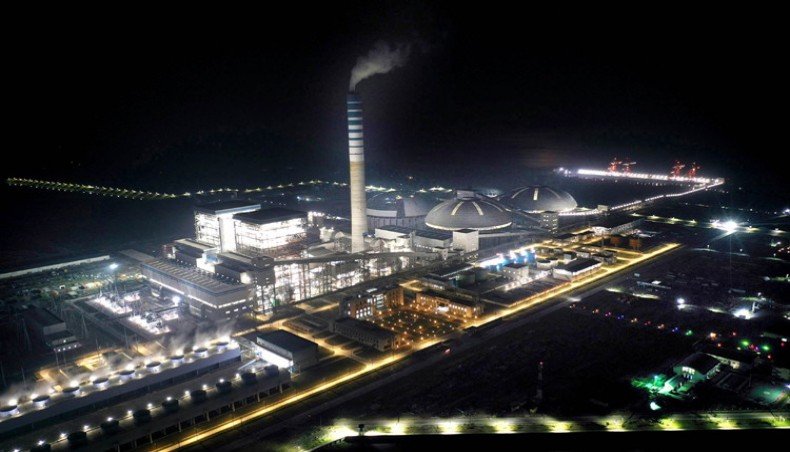
Japan International Cooperation Agency (JICA) and The Institute of Energy Economics, Japan (IEEJ) working in close association with the Ministry of Power, Energy and Mineral Resources of Bangladesh have formulated and released the Integrated Energy and Power Master Plan 2023 (IEPMP). As the background and purpose of the study, the plan highlighted the Bangladesh government's commitment to pushing forward economic growth aggressively under Vision 2041. The aim is to achieve high-income country status by the 70th anniversary of Bangladesh’s independence. Bangladesh at COP26 held in Glasgow, UK announced that the country would strive to achieve 40% contribution of clean energy to its power generation mix. The master plan targets a low-carbon economy with a secure and affordable energy supply. While developing the master plan, the following documents were reviewed alongside engaging with relevant stakeholders. Power System Master Plan 2016 (Revisiting PSMP 2016), Energy Efficiency and Conservation Master Plan 2016 (EECMP2016), and Gas Sector Master Plan 2017 (GSMP2017). The objective was to consolidate them into a comprehensive national plan setting out a tangible and practicable development roadmap.
A Bird’s Eye View
Bangladesh could not implement PSMP 2010, nor could it follow PSMP 2016. To confront the crisis, it adopted the Speedy Supply of Power and Energy (Special Provisions) Act which bypassed the National Procurement Law. The tenure of the contingency law has been extended several times and is still in force. Bangladesh could not follow the Gas Sector Master Plan (GSMP 2017). Against the backdrop, it is highly unlikely that IEPMP 2050 will be followed and achieved. The philosophy of formulating such a long plan in the dynamic energy world where innovations are happening rapidly is not considered wise. Experts suggested adopting plans for five years and annual reviews and adjustments based on evolving circumstances.
According to IEPMP 2050 power demand by 2050 will grow to 71,512 MW and for that, the plan suggested achieving a generation capacity of 1,11,000 MW (staggering 55% reserve margin). Stress has been given to Gas and LNG as well as in the name of clean energy on the import of hydropower, green hydrogen, and Ammonia. If followed the country will grow to an exclusive primary fuel depended on economy. For the dollar crisis Bangladesh in 2022-23 suffered a primary fuel supply crisis (import of coal, LNG, and liquid fuel). The present crisis has completely been ignored while formulating and approving IEPMP 2050.
Emphasis on solar and wind energy has not been given, battery storage has been ignored. Vietnam planned and successfully implemented 10,000 MW solar power generation capacity in a short time. Whereas, according to the IEPMP 2050, Bangladesh will have to wait till 2050 to reach 6,000 MW of solar power generation target. A very prospective option like rooftop solar power generation has also not been given due attention. US$300 billion investment has been estimated by 2050 for implementing the plan. US$179 billion will be required for constructing the infrastructure. In the plan, the cost of setting up new power plants has been estimated at US$118.6 billion. If the plan is followed, Bangladesh will not only grow as an exclusive primary fuel importing country over the long term but also will be trapped in a huge foreign debt burden. It will be impossible for Bangladesh to achieve sustainable energy security and grow and survive as a developed economy.
A Close Look at the IEPMP 2050
As stated in the document, IEPMP aims to establish a clean and efficient energy supply/demand system as the platform for the sustainable development of Bangladesh. It aims to develop a long-term energy plan up to 2050 with a concept of “S plus 3E” representing Safety, Energy security, economics, and environment as the central pillars, each element of which denotes the following:
1)Safety: energy must be supplied safely and stably.
2)Energy Security: maximize the use of indigenous energies and prepare energy import infrastructure.
3)Economic Efficiency: provide modern/convenient energies at minimum/affordable cost.
4)Environment: secure sound environmental conditions and lower the GHG emissions to the lowest possible level.
We do not disagree with the above. But while formulating the plan and suggesting the appropriate options for Bangladesh we are not sure the challenges and struggle of Bangladesh in maximizing the use of indigenous energies and geographical constraints of setting up enabling infrastructure for import have been duly considered. Challenges of Bangladesh's economy in absorbing the price shock of the volatile global fuel market and possibilities of supply chain disruptions for global geopolitics have also not been duly considered. Import dependency cannot create economic efficiency, providing modern/convenient energies at a minimum/affordable cost. We can not agree that IEPMP 2050 meets the objectives.
Discussion on Energy Demand and Supply
While discussing energy demand the plan stated that in 2020-21 the primary energy supply was 331 kg in oil equivalent - one-fifth of the world average (1801 KgOe in 2020). Firewood and natural gas together contribute more than 50%, followed by electricity and petroleum products. Electricity consumption stayed at 560kWh/year in 2020-21 – 17.4% of the world average at 3212kWh/year in 2020. The plan rightly stated that electricity consumption will grow exponentially as a key driver of economic development.
In Bangladesh, the domestic sector consumed 48% of the total energy in 2020. 55% of this was biomass, 26% natural gas, and 19% electricity. The government has regulated the domestic supply of pipeline gas. Consequently, the LPG market is widening. The plan suggested a right balance of city gas, LPG, and Electricity to accommodate the modernization of energy in the domestic sector for the overall development plan of metropolitan areas. The industry sector is the second largest consumer of energy at 29%. Natural gas contributes 45%, while the contributions of coal and electricity are 42% and 12% respectively. The consumption of energy in the transport sector is relatively low. The master plan aimed at introducing Electric Vehicle (EV) proactively targeting the share of EVs in the vehicle stock to be 40% for passenger light vehicles and 10% for tracks and buses.
The master plan noted that in 2020, electricity contributed 23% to the energy consumption. 45% was used in the residential sector and 43% in the industries considering grid and captive power generation.
Energy Supply:The master plan noted that signs of peaking in natural gas production created concern about a stable supply of energy and power. This led to the import of coal and LNG in 2018. The import ratio jumped to 33.2% in 2019. Master plan duly recognized the necessity of the implementation of efficient and low carbon use of energy for dealing with the adverse impacts of global warming.
Energy Demand Outlook
The master plan developed an econometric model for the projection of the energy demand outlook. Energy demand has been estimated by applying demand functions and external assumptions projections for future GDP. Energy price scenarios and other factors. GDP growth rate, population growth, energy price assumptions, and evolution of technology progress have impacted projections.
It has been assumed that the industry sector will lead the country’s economic growth. Energy consumption will rapidly grow even after introducing significant energy efficiency and conservation measures. Transport sector fuel consumption will grow fast to reflect the increasing demand for mobility. Growth of consumption in the domestic sector will remain relatively low as traditional biomass will be replaced with electricity and LPG accompanied by efficiency improvement. Commercial sector energy consumption will grow but at a slower pace.
The agriculture sector will continue consuming energy for irrigation and machines. Three cases have been examined in the plan for the GDP projections.
· PP 2041 Case based on projections of the Perspective Plan 2041 that seeks optimistic economic growth for achieving high-income country status by 2041.
· IMF Extension Case based on the projections by IMF World Economic Outlook envisaging moderate growth.
· In-between Case is a projection in-between the above two cases representing a steady development.
The master plan adopted the Perspective Plan (PP) 2041 GDP case as the basis for the present national development. It has been assumed that Bangladesh's population would grow from 168 million in 2020 to 191 million in 2030 210 million in 2041 and 214 million in 2050 at a rate of 0.9% per annum.
Energy Supply
The master plan has rightly identified natural gas as the preferred transition fuel for its environmentally benign nature. It has been estimated that gas consumption will expand 2.8-fold between 2019 and 2050 for the PP 2041 GDP case and 1.7-fold for the in-between case. The power sector will remain the main driver of the gas demand growth followed by industry. The consumption in the domestic sector will gradually reduce for replacement options and national policy.
Master plan has correctly assumed that in near terms supply from own fields may not grow quickly though the government has taken various measures for increasing gas supply from onshore and offshore prospects. Over the medium to long term imported LNG and import of gas from neighboring sources may fill in the gap. However, all high-risk potentials must be materialized with appropriate plans and implementation strategies.
Fuel Mix IPEMP 2050
The master plan discussed Delta Plan 2100 (BDP 2100). Perspective Plan 2021-2041, and 8th Five Year Plan July 2020 June 2025 (8FYP) mainly to review targets of renewable energy. The statement of the Bangladesh Prime Minister at COP26 in November 2021 stating "We hope to have 40% of our energy from renewable energy by 2041” has been noted. It has been mentioned that Bangladesh should consider not only renewable energy but also various clean energy options like nuclear power, hydrogen, and CCS.
The main objectives as set out of PP 2041 noted in the master plan are:
· Reducing capital investment costs
· Phasing out high-cost liquid fuel-based power stations and moving to lower-cost fuels
· Moving away from overreliance on fossil fuels
· A balanced mix of low-cost fuel-based power generation and renewable energy
· Use of imported hydropower and solar power from India, Nepal and Bhutan
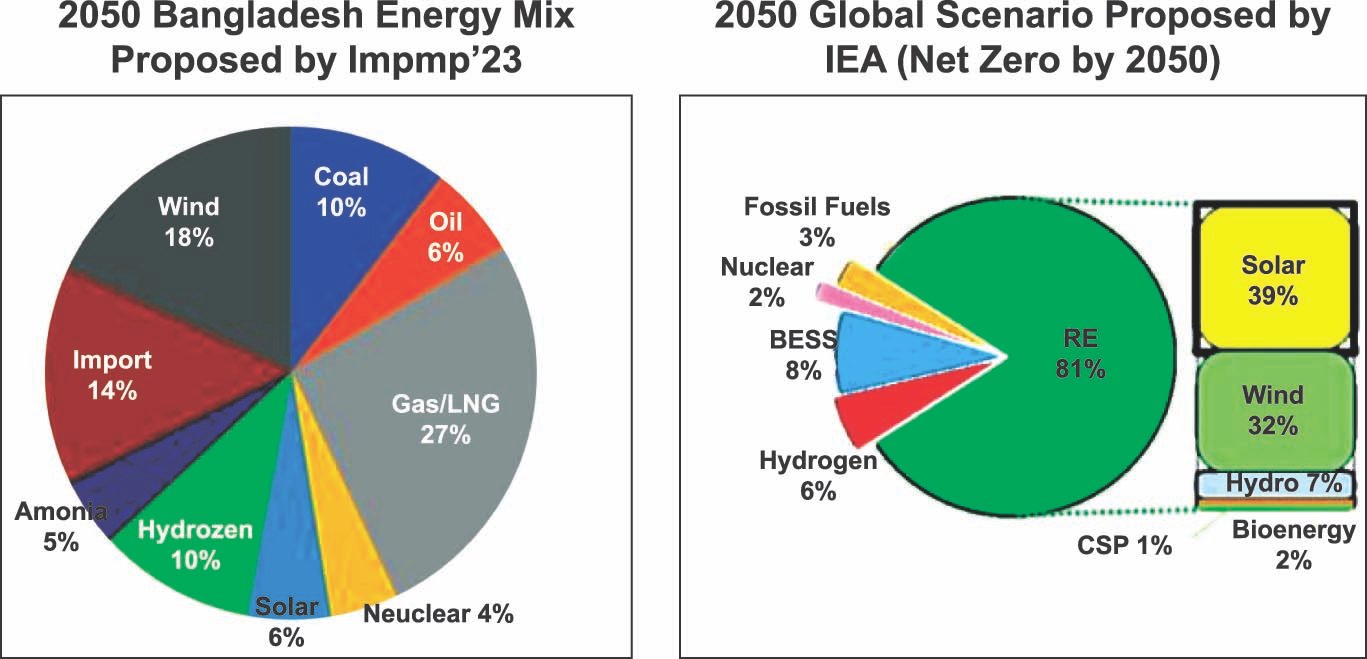
The fuel mix suggested in IEPMP 2023 states of 11,500 MW (10%) generation from coal, 6,700 MW (6%) from liquid fuel, 29,300 MW (27%) from Gas and LNG, 4,800 MW (4%) from Nuclear, 20,000 MW (18%) from wind energy, 6,000 MW (6%) from Solar Energy, 11,200 MW (10%) from hydrogen, 5,000 MW (5%) from Ammonia, 1,000 MW (01%) from hydropower and 15,700 MW (14%) from import.
The fuel mix suggested in IEPMP mentions about (10%+5%) 15% contribution from Hydrogen and Ammonia. These two are very much in the research and development stages in countries of advanced economies. Bangladesh has done nothing yet. The reality in Bangladesh is very different. It can not develop facilities for such high contributions from green Hydrogen and Ammonia. As such plan for such a high contribution from Green Hydrogen and Ammonia appears unrealistic and non-achievable.
The contribution of solar has been shown as 6%. The global solar contribution shown by IEA is 39%. Bangladesh has introduced net metering. Solar Rooftop, Solar irrigation, and floating solar have huge prospects. Subject to providing required fiscal and financial incentives, battery storage can facilitate a greater contribution of solar in Bangladesh's fuel mix. Of course, required actions must be taken to integrate solar power and nuclear in the national grid. IPEMP has suggested for 18% contribution from wind energy. This may be achievable if Bangladesh can successfully exploit offshore wind resources. Bangladesh must explore and exploit its superior quality coal resources and set up mine-mouth High-Efficiency Low Emission (HELE) coal power plants. Bangladesh is globally considered a tier three country of small flat land and, a huge population where a lot needs to be done to facilitate greater contribution of renewables. It must exploit all its primary fuel resources to develop its economy to a level where it can absorb the price shock of expensive fuel. Fossil fuel using advanced technology and nuclear power generation must be preferred options for the medium term. Bangladesh can go for one or two more nuclear power plants to provide base loads. Based on the above, the fuel mix suggested in IEPMP 2023 must be reviewed. The plan must be made for 5 years with the provision of review and adjustment every two years based on changing circumstances.
According to the plan, the demand in 2030 will grow to 27,087 MW, and the generation capacity is suggested to be 41,400 MW which is 52.84% higher than the demand. The demand in 2050 has been assessed as 50,364 MW and for that generation capacity has been suggested as 74,300 MW.
From the present trend in 2023, it is highly unlikely that demand in 2030 and 2041 will grow as high as has been suggested. Such reserve margin will complicate issues for Bangladesh. Many plants will remain idle. In some cases, BPDB will have to account for capacity charges as well. Moreover, we must think about seasonal demand as well. The power demand is still mostly from lighting and cooling loads. The demand projection appears unreasonable and unrealistic.
In the plan, natural gas is expected to contribute 40% to the fuel mix in 2041. But as the main source of supply, imported LNG has been identified as the source. According to the plan of the 4000 MMCFD gas demand in 2041, own gas may contribute 1700 MMCFD. For the remaining 2300 MMCFD, the gas supply chain must rely on imported LNG. By 2050 this will grow to 5300 MMCFD. We are not sure whether the economy would achieve such resilience to absorb the price shock of the global fuel market.
JICA's suggestions for 20,000 MW generation of wind power by 2050 appear aggressive. There is a possibility for it if especially offshore wind prospect is exploited. However, the plan has completely ignored battery storage facility inclusion for solar energy. The government must review the possibility of the greater contribution of solar. Rooftop solar, solar irrigation, floating solar, and where feasible hybrid solar with micro wind turbine have huge prospects. Battery technology is advancing fast across the world. Bangladesh must review import tax, VAT, and other fiscal and financial incentives for solar. Solar power must contribute to distributed off-grid generation in a bigger way. If grid-connected solar with battery added can make a greater contribution if managed well. In the future, Bangladesh may set up battery and solar panel manufacturing facilities if the market expands.
Bangladesh must rely on import mostly if it follows Hydrogen and Ammonia contribution to the fuel mix as suggested in IEPMP. Wherefrom the huge foreign currency required will come. However, Bangladesh should set up some pilot projects to assess the viability of green Hydrogen and Ammonia. Bangladesh and countries like Australia can carry on extensive research. Offshore wind and some solar plants can be used for generating green hydrogen.
We must also keep an eye on global development. The world is going green; Bangladesh must not remain an isolated island. While Bangladesh exploits its primary fuel as much as practicable it also must not increase emissions. Bangladesh cannot afford to grow as an exclusive primary fuel-importing country. JICA's developed plan must be reviewed and amended. It must be discussed extensively with relevant stakeholders. Such an ambitious and somewhat unrealistic plan may not work. Bangladesh must develop an integrated master plan for the foreseeable future of 5 years and review and adjust at regular intervals. Technology and circumstances are changing rapidly. We can not look too much ahead. Bangladesh does not have obligations to reduce emissions. We must make the optimum utilization of our fuel resources of fossil fuel adopting state-of-the-art modern technologies. We must also be part of all research and development processes of modern energy. Solar with batteries and wind energy should be given the required emphasis and all incentives must be provided for steady growth. The power grid must be developed into a smart grid for integration of nuclear power and Renewable Energy. SARRC Power Grid with the provision of free flow of electrons as and when required must be set up.
Engr. Khondkar Abdus Saleque, Energy Analyst
Special Article PDF//userfiles/Special_Article.pdf