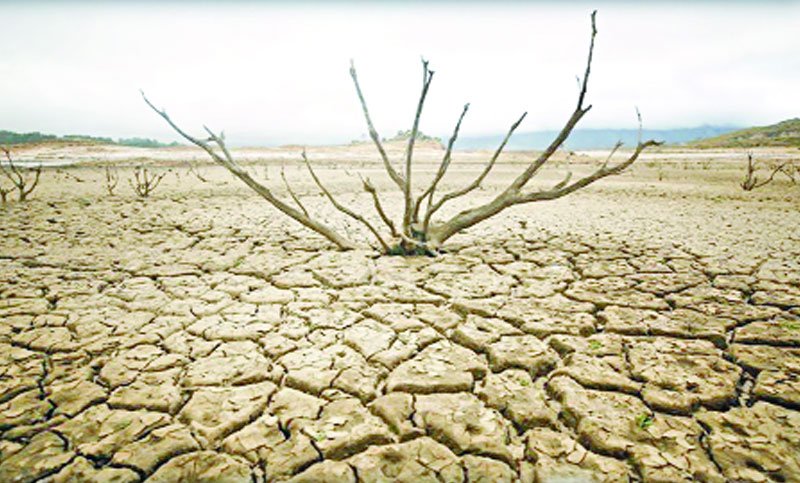
Introduction: In the United Nations Framework Convention on Climate Change (UNFCCC), loss and damage have emerged as a third key pillar of climate policy, together with mitigation and adaptation, to address increasing climate change impacts in developing countries that are particularly vulnerable to the adverse effect of climate change.
While there is no commonly agreed definition, loss and damage is most commonly understood as the adverse effects of climate change that are not or cannot be avoided by mitigation and adaptation efforts (van der Geest and Warner 2015). This definition implies that there are two types of loss and damage: those that exceed adaptation limits and those that can be minimized by taking adaptation efforts and finance. The limits to adaptation are the points at which adaptation fails to avert intolerable climate impacts.
Opportunities for averting, minimizing, and addressing loss and damage can be found across a spectrum ranging from reducing GHG emissions to disaster risk management, climate change adaptation, and addressing residual loss and damage (see figure below). Reducing global warming can help to avert losses and damages while disaster risk management and climate change adaptation actions can help minimize them.
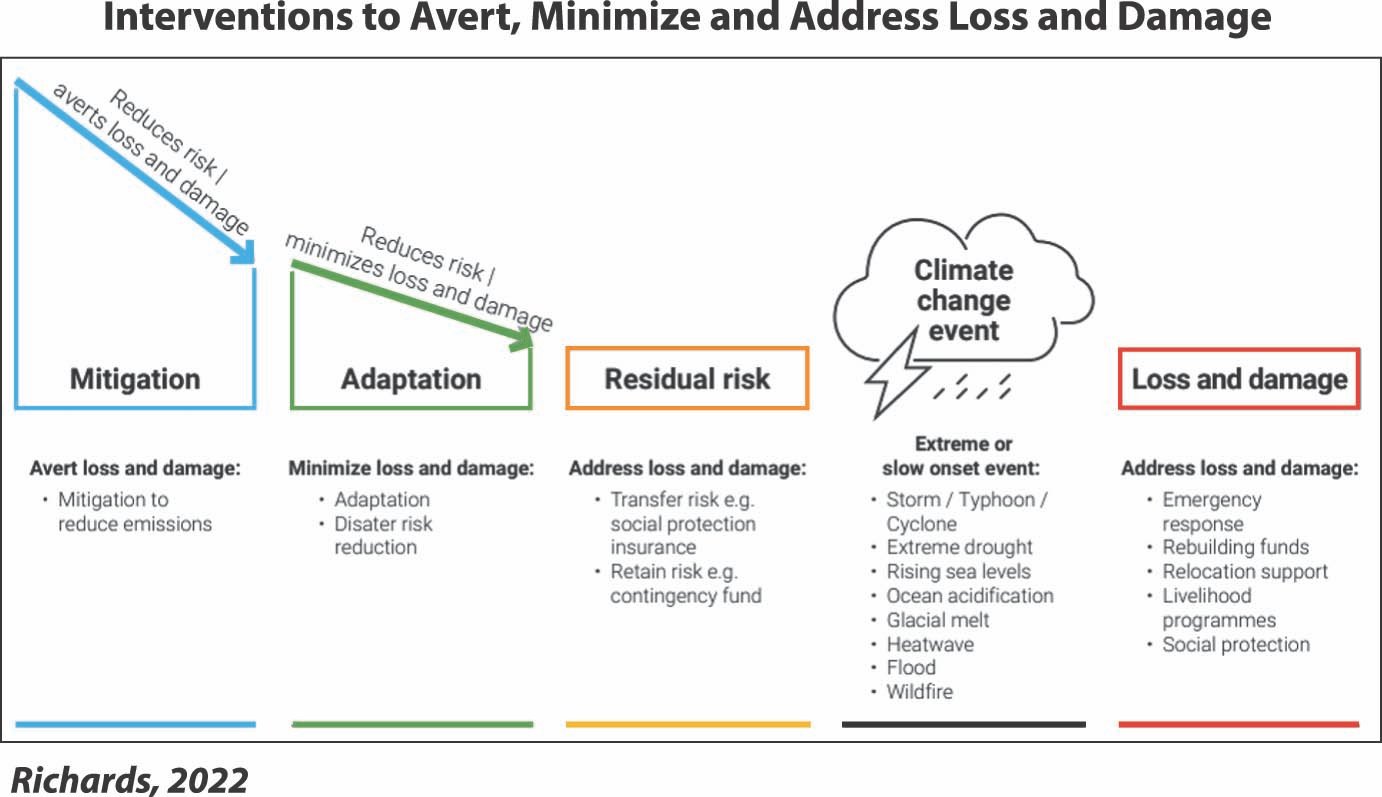
Interventions to avert, minimize and address loss and damage
Richards, 2022
Adaptation Limits and Loss & Damage
Loss and damage from climate change arise when efforts to avert or minimize climate impacts through mitigation and adaptation fail. The points at which adaptation fails to avert climate impacts are called the ‘limits’ to adaptation. Research on adaptation limits commonly refers to hard and soft limits. Hard limits are those that arise in physical systems, and which cannot be averted through adaptation action but rather only through mitigation of GHGs. Soft limits are those that can be avoided or minimized through more concerted adaptation efforts. Thus, the more the adaptation gap is reduced, the fewer soft limits will be crossed and the less loss and damage there will be.
Hard Limits to Adaptation
Even if the temperature goal of the Paris Agreement is achieved, there will still be between 1.5°C and 2°C of warming above pre-industrial levels (Meinshausen et al. 2022). At 1.5°C of warming, widespread changes in highly climate-sensitive ecosystems such as coral reefs and tropical glaciers are likely. It is in natural systems such as these, where the limits to adaptation seem hard in the sense that there are few options available to humans to avoid the points at which they are fundamentally damaged and some or all their unique and valued characteristics are lost (Intergovernmental Panel on Climate Change [IPCC] 2022).
Many studies indicate the risks of changes in ecosystems resulting from climate change (Zommers et al. 2016; van der Geest et al. 2018). For example, the coral reefs of the Indian Ocean are threatened with collapse due to marine heating (Obura et al. 2022); beaches and wetlands in California may be lost due to rising sea levels (Barnard et al. 2021); the West Antarctic ice sheet may progressively melt due to warming (Pattyn and Morlighem 2020); many mountain glaciers may tip into irreversible melting beyond 2°C of warming (Hock et al. 2019); parts of the Amazon rainforest are at risk of turning into savannahs because of drying, heat and fire; and changes in the West African monsoon may lead to shifts in vegetation cover in the Sahel (McKay et al. 2022).
Climate-sensitive ecosystems facing hard limits have both intrinsic and extrinsic value to people. Extrinsic (or instrumental) values are those that arise from the goods and services provided by ecosystems to people whose livelihoods depend on them. The loss of the goods and services provided by ecosystems that exceed their limits to adaptation often flows into loss and damage in social systems. For example, migration and mobility in response to water insecurity can enhance conflict and disrupt the cohesion of families and communities (Heslin et al. 2019); the loss of reefs undermines the livelihoods of fishers, human health, and in extreme cases the sovereignty of whole countries (Martyr-Koller et al. 2021). Changes in vegetation cover can increase hunger and malnutrition (Kogo, Kumar, and Koech 2021).
Climate-sensitive ecosystems that face hard limits also have intrinsic value in that people value them for their existence. Intrinsic values are revealed, for example, in World Heritage listings, and people’s attachments to places and landscapes (Adger et al. 2013; Barnett et al. 2016). There are no commensurable substitutes for the loss or damage of things that are intrinsically valued, and so these can be catastrophic to people’s identity and well-being (Adger et al. 2022). Hard limits can only be avoided by deep cuts in GHG emissions that allow ecosystems to slowly adapt in ways that retain their instrumental and intrinsic values (IPCC 2022).
Soft Limits to Adaptation
In some cases, loss and damage to climate-sensitive ecosystems can be avoided or at least greatly delayed through reductions in non-climate stressors. For example, human diversions of water are often a larger driver of change in wetlands than climate; poorly sited and designed structures can have a bigger impact on coastal erosion than sea level rise; and logging and habitat fragmentation can have a bigger impact on biodiversity losses in forests than climate drivers. In these cases, there are actions that humans can take to avert and minimize loss and damage. So the limits to adaptation may be called soft in the sense that known practices and technologies can be effective, even if they are not immediately available. Their application seems unlikely (Barnett et al. 2015).
The soft limits to adaptation arise from development processes that expose some groups to climate change risks, constrain their adaptive capacities, or impede adaptation responses. A range of adaptations exists that can be made to avert and minimize loss and damage to resource-dependent livelihoods, most often through a combination of technologies, ecosystem management, changes in livelihoods, and improvements in social and economic opportunities (Valdivia et al. 2012; Janzen et al. 2021). These include practices that reduce people’s dependence on climate-sensitive resources or enhance their freedoms to adapt, such as social protections and income guarantees in times of crisis, industrial restructuring programs, improvements in infrastructure, and improvements in social opportunities. They also include technologies and practices that reduce vulnerability and exposure to climate hazards, such as coastal defenses, irrigation, risk-sensitive land-use management, and improved designs for infrastructure. While these adaptations are theoretically possible, some carry the risk of maladaptation, all entail trade-offs among competing values, and most face barriers due to costs, governance systems, or social norms (Boyd et al. 2021; Henrique et al. 2022).
Therefore, identifying the limits of adaptation is important to help avert, minimize, and address loss and damage. People’s sense of ‘intolerable losses’ can be ascertained using diverse social science methods, including those associated with the elicitation of values (Barnett et al. 2016). Doing so in the context of climate risks brings to the fore benchmarks of loss whose avoidance and minimization can serve as the goals of adaptation. Careful and committed co-production of knowledge and strategies to identify, avert, minimize and, if necessary, address loss and damage can remove feelings of powerlessness and injustice, build relationships of care and responsibility, help affected populations come to terms with loss, stimulate collective action and responsibility, and change expectations of the future in ways that transform perceived losses to something less existentially troubling over time (Barnett et al. 2016). Averting, minimizing, and addressing loss and damage therefore involves foresight to identify adaptation limits and their consequences. This can be done at any sectoral or spatial scale using established methods for investigating future conditions (Cook et al. 2014).
The risk that adaptation fails increases with GHG emissions. The more warming there is, the less time there will be for adaptation to take effect. Slowing the rate of warming allows more time for soft limits to adaptation to be overcome. Given enough time, adaptation action may indeed overcome some soft adaptation limits in ways that avoid and minimize some loss and damage. Nevertheless, climate extremes are already causing significant loss and damage, and this trend will continue despite even the most effective adaptation and well before anticipated limits to adaptation have been reached.
Categorizing loss and damage
Although many conceptualizations of loss and damage exist, there is a general agreement that it can be categorized as economic or non-economic, an understanding that also is shared by the UNFCCC’s overview of the issue (Boyd et al. 2017).
Economic loss and damage include impacts that can be assigned a monetary value, such as damage to infrastructure or loss of earnings or productivity. Non-economic loss and damage encompasses a spectrum of outcomes that are not easily assigned a monetary value and are not typically subject to market transactions. They include the loss of life, health, rights, territory, cultural heritage, Indigenous or local knowledge, biodiversity loss, and loss of ecosystem services.
While there are methodologies that attempt to quantify the economic loss and damage, non-economic losses, and damages are more difficult to assess and thus are often disregarded or undervalued (Boyd et al. 2021). However, failure to consider non-economic losses and damages means that quantitative estimates of loss and damage underestimate the extent of climate impacts, particularly for low-income regions where there is a lack of systematic monitoring or reporting of non-economic losses and damages (Thomas and Benjamin 2020; Chandra et al. 2023).
Another approach is to categorize loss and damage as avoidable or unavoidable – a way of differentiating between loss and damage that may or may not be prevented by adaptation and mitigation (Verheyen 2012; van der Geest and Warner 2015). Avoidable loss and damage can theoretically be prevented through implementing mitigation and/or adaptation measures and can be further categorized as unavoided if such measures are not implemented. Unavoidable loss and damage refers to impacts that occur despite mitigation and adaptation, such as loss and damage resulting from extreme events where no adaptation efforts would have been able to prevent impacts. Unavoidable loss and damage are closely linked to an understanding of adaptation limits and thresholds. Categorizing loss and damage as avoidable or unavoidable allows for identifying different approaches to respond to loss and damage, including the need for transformative approaches to address the inevitable impacts of climate change, such as loss of territory due to long-term sea level rise (Mechler and Schinko 2016; Heslin 2019; Mechler and Deubelli 2021).
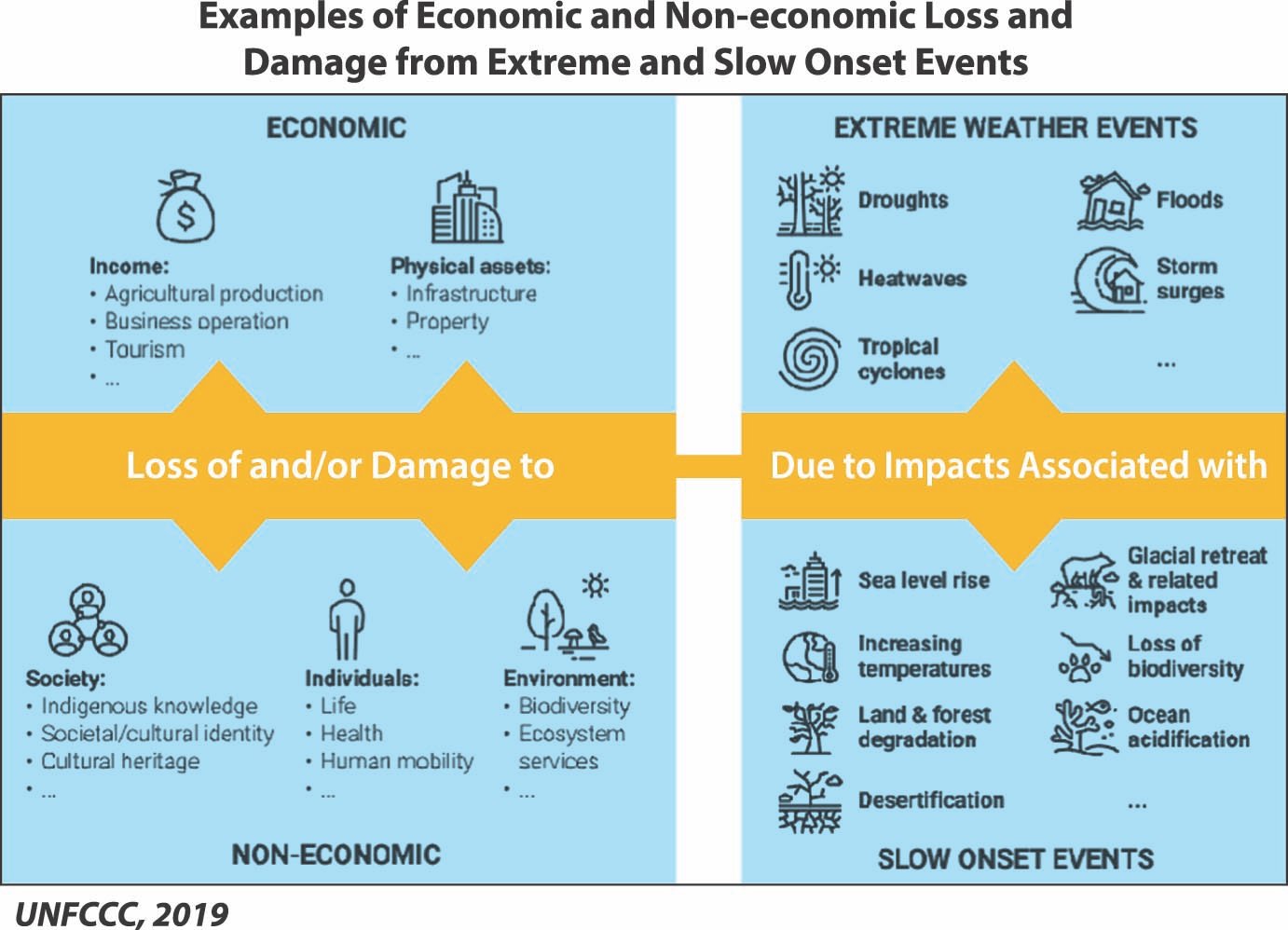
Examples of economic and non-economic loss and damage from extreme and slow onset events
UNFCCC, 2019
Finance to Address Loss and Damage
The decision to establish a dedicated fund to assist developing countries in responding to economic and noneconomic loss and damage associated with climate change was a historic move agreed upon at COP 27 in 2022. The decision acknowledged “the urgent and immediate need for new, additional, predictable and adequate financial resources to assist developing countries that are particularly vulnerable to the adverse effects of climate change in responding to economic and non-economic loss and damage associated with the adverse effects of climate change, including extreme weather events and slow onset events.” (UNFCCC 2022).
At COP 27, a Transitional Committee agreed it was responsible for operationalizing both the new funding arrangements and the fund for consideration and adoption at COP 28 in Dubai; an ongoing process. Key considerations raised during the discussions include questions related to the sources of funding, access to funding, the types of activities and options to be funded, and the structure and governance of the fund and the funding arrangements. Another key question is how to prioritize countries that are highly vulnerable and have low capacity to finance climate action. Different understandings of vulnerability and interpretations in climate negotiations mean these discussions are complex (Chhetri, Schaefer and Watson 2021).
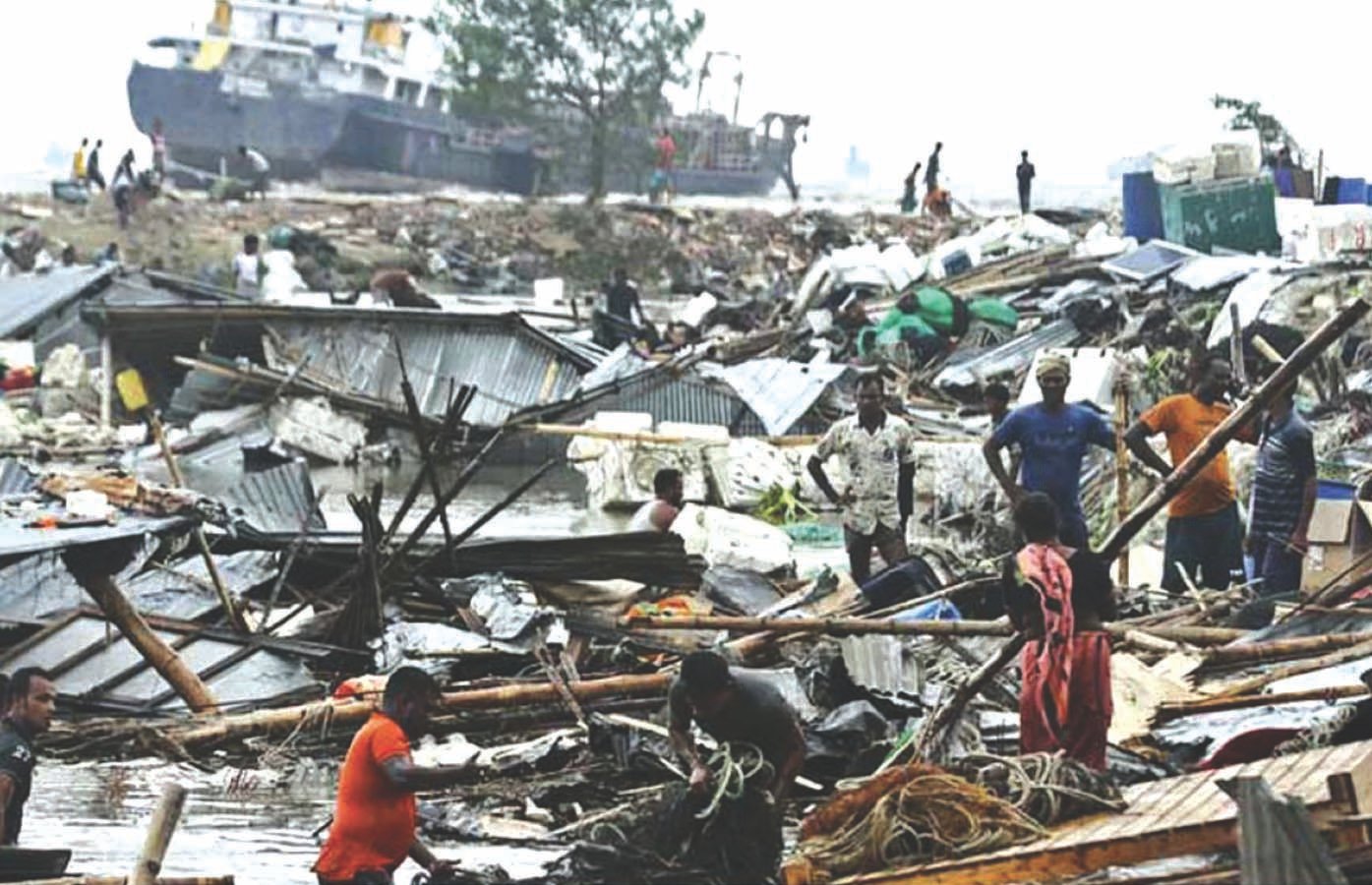
The funding for loss and damage will be wide-ranging and the needs of countries, as informed by national assessments, will vary across space and over time. Countries will experience different conditions for similar climatic events, non-economic and economic needs will also differ, and there will be varying financial requirements for addressing loss and damage from extreme weather events and slow onset events. Adequate climate information services and needs assessments are crucial for informed planning and addressing loss and damage. Similarly, support to develop appropriate financial tools, including social protection, insurance, and measures to assist those displaced by loss and damage, is crucial.
As we know, overall climate finance is very limited compared to the needs. Financial need per year is USD 215 billion to USD 387 only for adaptation (Adaptation Gap Report 2023) and currently, we are getting around 20 billion USD. More than 50% of that funding is loan. There is no universally accepted definition of climate finance and accounting of climate finance is not transparent. According to a report of OXFAM financing for adaptation is 7.92% and access to adaptation finance is very slow and complicated compared to mitigation financing. In maximum cases adaptation (also applicable for loss and damage financing) financing does not generate any revenue and a grant is the suitable option (if not the only option) for adaptation financing. These challenges are also applicable (maybe more) for the L & D financing. Furthermore, only 1-2% of money flows through the UNFCCC channel (such as GCF, GEF, LDCF, and SCCF), and that channel is the most suitable for the vulnerable countries as all the groups have representation in the governance of the UNFCCC channel. Maximum money flows through the bilateral channel and there are big questions on the quality of that bilateral climate financing. The observation of the Oxfam study was that vulnerable countries, particularly African countries might fall into a new debt trap due to loan-based adaptation financing (Climate Finance Shadow Report, Oxfam, 2020). Considering the previous experience with adaptation financing, we may not be very optimistic about the quantity and quality of L & D financing. However, vulnerable developing countries should work together with the common goal of getting a commitment from the developed countries to ensure adequate, predictable, new, and additional loss and damage financing, and that funding should be easily and quickly accessible.
Dr. Fazle Rabbi Sadeque Ahmed, Deputy Managing Director (Environment and Climate Change), PKSF, Frsa1962@yahoo.co.uk
Click Here to Download Analysis as PDF//userfiles/EP_21_11_Analysis_Loss and Damage_Concept and Financing_Dr Fazle Rabbi Sadeque Ahmed.pdf
References:
Adger,W.N.,Barnett,J.,Heath,S.andJarillo,S.(2022).Climatechangeaffectsmultipledimensionsofwell-beingthrough impacts,informationandpolicyresponses.NatureHumanBehaviour6(11),1465–1473.https://doi.org/10.1038/s41562-022-01467-8.
Barnard, P.L., Dugan, J.E., Page, H.M., Wood, N.J., Hart, J.A.F., Cayan, D.R. et al. (2021). Multiple climate change-driven tipping pointsforcoastalsystems.ScientificReports11(1),15560.https://doi.org/10.1038/s41598-021-94942-7.
Barnett, J., Evans, L.S., Gross, C., Kiem, A.S., Kingsford, R.T., Palutikof, J.P. et al. (2015). From barriers to limits to climate change adaptation:pathdependencyandthespeedofchange.EcologyandSociety20(3).www.jstor.org/stable/26270227.
Barnett,J.,Tschakert,P.,Head,L.andAdger,W.N.(2016).Ascienceofloss.NatureClimateChange6(11),976–978.https://doi.org/10.1038/nclimate3140.
Boyd,E.,Chaffin,B.C.,Dorkenoo,K.,Jackson,G.,Harrington,L.,N’guetta,A.etal.(2021).Lossanddamagefromclimate change:Anewclimatejusticeagenda.OneEarth4,1365–1370.https://doi.org/10.1016/j.oneear.2021.09.015.
Boyd,E.,James,R.A.,Jones,R.G.,Young,H.R.andOtto,F.E.L.(2017).Atypologyoflossanddamageperspectives.Nature ClimateChange7,723–729.https://doi.org/10.1038/nclimate3389.
Chandra, A., McNamara, K.E., Clissold, R., Tabe, T., Westoby R. (2023). Climate-induced non-economic loss and damage: understandingpolicyresponses,challenges,andfuturedirectionsinpacificsmallislanddevelopingstates.Climate11(3),
74.https://doi.org/10.3390/cli11030074.
Chhetri,R.P,Schaefer,L.andWatson,C.(2021).Exploringlossanddamagefinanceanditsplaceintheglobalstocktake.In FinancingClimateAction:iGSTDiscussionSeries.London:OverseasDevelopmentInstitute.https://www.climateworks.org/wp-content/uploads/2022/04/Loss-and-Damage-Finance-iGST.pdf.
Cook,C.N.,Inayatullah,S.,Burgman,M.A.,Sutherland,W.J.andWintle,B.A.(2014).Strategicforesight:howplanningforthe unpredictablecanimproveenvironmentaldecision-making.TrendsinEcology&Evolution29(9),531–541.https://doi.org/10.1016/j.tree.2014.07.005.
Henrique,K.P.,Tschakert,P.,duCoudray,C.B.,Horwitz,P.,Krueger,K.D.C.andWheeler,A.J.(2022).Navigatinglossandvalue trade-offsinachangingclimate.ClimateRiskManagement35,100405.https://doi.org/10.1016/j.crm.2022.100405.
Heslin, A. (2019). Climate migration and cultural preservation: the case of the Marshallese diaspora. In Loss and Damage fromClimateChange:Concepts,MethodsandPolicyOptions.Mechler,R.,Bouwer,L.M.,Schinko,T.,Surminski,S.and Linnerooth-Bayer, J. (eds.). Chapter 16. 383–391. Berlin and Heidelberg: Springer. https://doi.org/10.1007/978-3-319-72026-5_16.
Heslin, A., Deckard, N.D., Oakes, R. and Montero-Colbert, A. (2019). Displacement and resettlement: understanding the role ofclimatechangeincontemporarymigration.InLossandDamagefromClimateChange:Concepts,MethodsandPolicy Options.Mechler,R.,Bouwer,L.M.,Schinko,T.,Surminski,S.andLinnerooth-Bayer,J.(eds.).Chapter10.237–258.Berlin andHeidelberg:Springer.https://doi.org/10.1007/978-3-319-72026-5_10.
Hock,R.,Rasul,G.,Adler,C.,Cáceres,B.,Gruber,S.,Hirabayashi,Y.etal.(2019).Highmountainareas.In:IPCCSpecialReport on the Ocean and Cryosphere in a Changing Climate. Pörtner, H.-O., Roberts, D.C., Masson-Delmotte, V., Zhai, P., Tignor, M.,Poloczanska,E.etal.(eds.).Cambridge,UKandNewYork,NY,USA:CambridgeUniversityPress.73–129.https://doi.org/10.1017/9781009157964.003.
IntergovernmentalPanelonClimateChange(2022).AnnexII:Glossary.In:ClimateChange2022:Impacts,Adaptationand Vulnerability.ContributionofWorkingGroupIItotheSixthAssessmentReportoftheIntergovernmentalPanelonClimate Change. Pörtner, H.-O., Roberts, D.C., Tignor, M., Poloczanska, E.S., Mintenbeck, K., Alegría, A. et al. (eds.). Cambridge, UKandNewYork,NY,USA:CambridgeUniversityPress.2897–2930.https://www.ipcc.ch/report/ar6/wg2/.
Janzen,S.,Emerton,L.,vanderGeest,K.,Narvaez,L.andSebesvari,Z.(2021).Assessinglossesanddamagestoecosystem services:currentstateandopportunitiesfortheWarsawInternationalMechanismoftheUNFCCC.ClimatePolicy21(7), 912–926.https://doi.org/10.1080/14693062.2021.1947177.
Kogo,B.K.,Kumar,L.andKoech,R.(2021).ClimatechangeandvariabilityinKenya:areviewofimpactsonagricultureand foodsecurity.Environment,DevelopmentandSustainability23,23–43.https://doi.org/10.1007/s10668-020-00589-1.
Martyr-Koller, R., Thomas, A., Schleussner, C.-F., Nauels, A. and Lissner, T. (2021). Loss and damage implications of sea- levelriseonsmallislanddevelopingStates.CurrentOpinioninEnvironmentalSustainability50,245–259.https://doi.org/10.1016/j.cosust.2021.05.001.
McKay, D.I.A, Staal, A., Abrams, J.F., Winkelmann, R., Sakschewski, B., Loriani, S. et al. (2022). Exceeding 1.5°C global warmingcould trigger multiple climate tipping points. Science 377(6611). https://doi.org/10.1126/science.abn7950.
Mechler, R. and Deubelli, T.M. (2021). Finance for loss and damage: a comprehensive risk analytical approach. Current Opinion in Environmental Sustainability 50, 185–196. https://doi.org/10.1016/j.cosust.2021.03.012.
Mechler, R. and Schinko, T. (2016). Identifying the policy space for climate loss and damage. Science 354(6310), 290–292. https://doi.org/10.1126/science.aag2514.
Meinshausen,M.,Lewis,J.,McGlade,C.,Gütschow,J.,Nicholls,Z.,Burdon,R.etal.(2022).RealizationofParisAgreement pledgesmaylimitwarmingjustbelow2°C.Nature604(7905),304–309.https://doi.org/10.1038/s41586-022-04553-z.
Obura,D.,Gudka,M.,Samoilys,M.,Osuka,K.,Mbugua,J.,Keith,D.A.etal.(2022).Vulnerabilitytocollapseofcoralreef ecosystems in the Western Indian Ocean. Nature Sustainability 5(2), 104–113. https://doi.org/10.1038/s41893-021-00817-0.
OrganisationforEconomicCo-operationandDevelopment(2021).ManagingClimateRisks,FacinguptoLossesandDamages.
Paris.https://doi.org/10.1787/55ea1cc9-en.
Pattyn,F.andMorlighem,M.(2020).TheuncertainfutureoftheAntarcticIceSheet. Science 367(6484),1331–1335. https://doi.org/10.1126/science.aaz5487.
Richards, J.A. (2022). How does loss and damage intersect with climate change adaptation, DRR, and humanitarian assistance?,10 October. The Loss & Damage Collaboration. https://www.lossanddamagecollaboration.org/stories-op/how-does-loss-and-damage-intersect-with-climate-change-adaptation-drr-and-humanitarian-assistance.
Thomas,A.andBenjamin,L.(2020).Non-economiclossanddamage:lessonsfromdisplacementintheCaribbean.Climate Policy 20(6), 715–728. https://doi.org/10.1080/14693062.2019.1640105.
UnitedNationsFrameworkConventiononClimateChange (2019). Elaboration of the Sources of and Modalities for Accessing Financial Support for Addressing Loss and Damage. 14 June. FCCC/TP/2019/1. https://unfccc.int/documents/196468.
UnitedNationsFrameworkConventiononClimateChange (2022).FundingArrangementsforRespondingtoLossandDamageAssociatedwiththeAdverseEffectsofClimate Change, Including a Focus on Addressing Loss and Damage. 20 November. Decision 2 CMA.4 FCCC/PA/CMA/2022/10/ Add.1.https://unfccc.int/sites/default/files/resource/decision%202%20CMA%204.pdf.
Valdivia,C.,Seth,A.,Gilles,J.L.,García,M.,Jiménez,E.,Cusicanqui,J.andNavia,F.(2012).Adaptingtoclimatechangein Andean ecosystems: landscapes, capitals, and perceptions shaping rural livelihood strategies and linking knowledge systems.AnnalsoftheAssociationofAmericanGeographers100(4),818–834.https://doi.org/10.1080/00045608.2010.500198.
vanderGeest,K.andWarner,K.(2015).Vulnerability,copingandlossanddamagefromclimateevents.InHazards,Risks,and DisastersinSociety.Shroder,J.F.,Collin,A.E.,Jones,S.,Manyena,B.andJayawickrama,J.(eds.).Chapter8.121–144. Amsterdam:Elsevier.https://doi.org/10.1016/B978-0-12-396451-9.00008-1.
van der Geest, K., de Sherbinin, A., Kienberger, S., Zommers, Z., Sitati, A., Roberts, E. and James, R. (2018). Impacts of climate change on ecosystem services and resulting losses and damages to people and society. In Loss and Damage from Climate Change: Concepts, Methods and Policy Options. Mechler, R., Bouwer, L.M., Schinko, T., Surminski, S. and Linnerooth-Bayer, J. (eds.). Chapter 9. 221–236. Berlin and Heidelberg: Springer. https://link.springer.com/chapter/10.1007/978-3-319-72026-5_9.
Verheyen,R.(2012).Loss&Damage:TacklingLoss&Damage–ANewRoleFortheClimateRegime? Cape Town: Climate and Development Knowledge Network. https://uploads-ssl.webflow.com/605869242b205050a0579e87/6177e4737a0b95c54c2a6bad_Tackling%20loss%20and%20damage%20(Verheyen).pdf.
Zommers,Z.,vanderGeest,K.,deSherbinin,A.,Kienberger,S.,Roberts,E.,Harootunian,G.etal.(2016).LossandDamage: The Role of Ecosystem Services. Nairobi: United Nations Environment Programme. www.unep.org/resources/report/loss-and-damage-role-ecosystem-services.