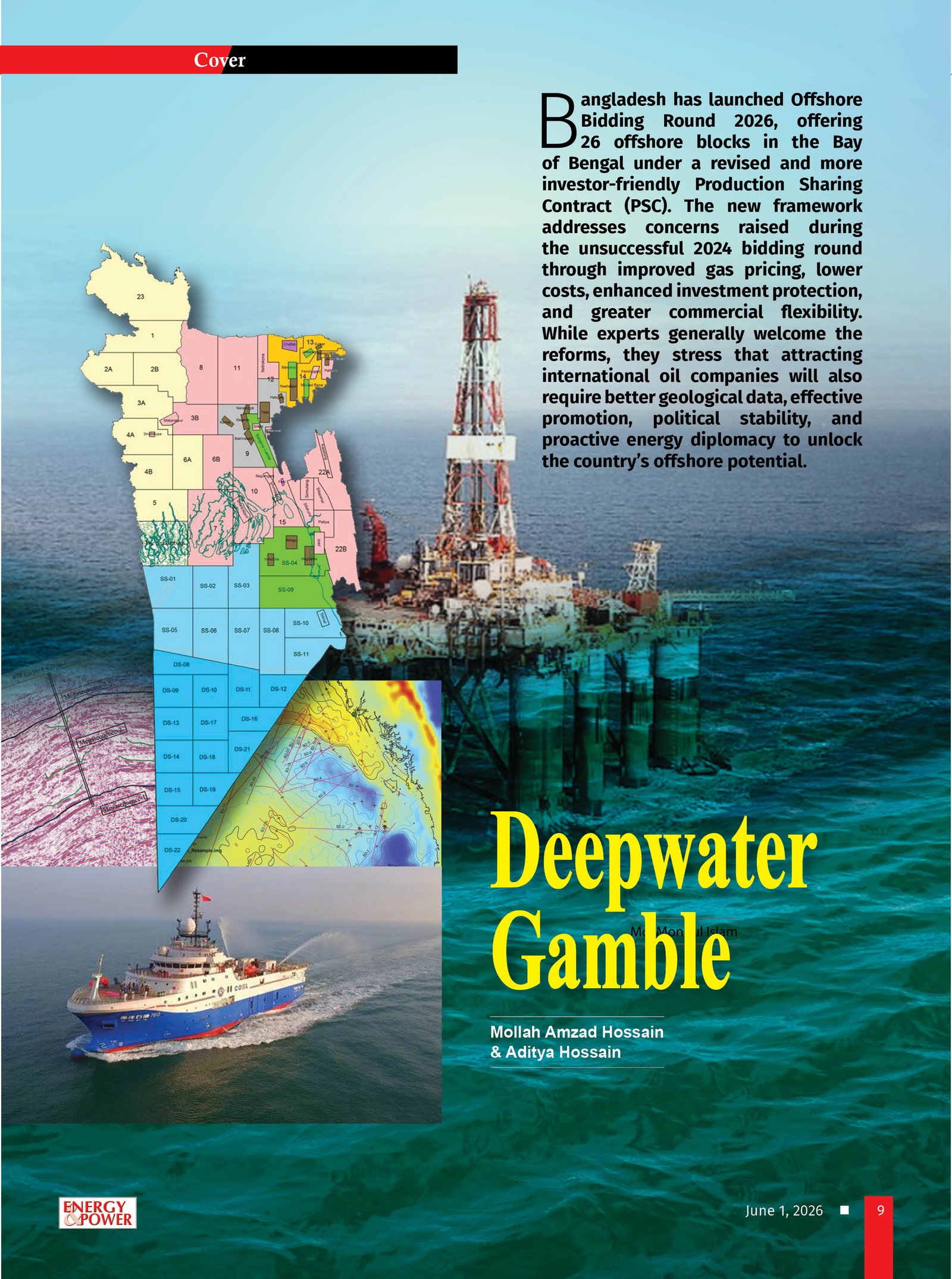
Bangladesh has launched its most ambitious offshore energy initiative in years, offering 26 oil and gas blocks in the Bay of Bengal under a revamped and investor-friendly Offshore Bidding Round 2026. With domestic gas reserves declining and dependence on imported fuel rising, the government is betting that improved contract terms, stronger investor protections, and aggressive international outreach can finally unlock the country's largely unexplored offshore potential.
Yet attractive fiscal terms alone may not be enough. The real test will be whether Bangladesh can convince international oil companies that its offshore prospects, investment climate, and political stability justify the billions of dollars and years of risk required for deepwater exploration.
Through a public notice and press conference, the Energy and Mineral Resources Division has formally announced November 30, 2026, as the deadline for bid submissions.
At the launch event, Power, Energy and Mineral Resources Minister Iqbal Hasan Mahmood said that although the previous government frequently highlighted Bangladesh's maritime boundary victories, it failed to take effective steps to explore and develop the Bay of Bengal's hydrocarbon resources. While efforts were made toward the end of its tenure to attract offshore investment, no investors ultimately participated.
The minister said the BNP-led government is working to ensure a favorable investment climate. He recalled that Bangladesh's 1993 bidding round under former Prime Minister Khaleda Zia attracted significant international investment and led to major oil and gas discoveries. According to him, fields developed under those PSC arrangements still account for around 60 percent of the country's domestic gas production.
The Energy Division says a new Offshore Model Production Sharing Contract (PSC) 2026 has been approved after extensive revisions. Compared with the Offshore Model PSC 2023, the new version is designed to be more investor-friendly while protecting national interests. Officials hope the revised terms will encourage international oil companies (IOCs) to participate in offshore exploration.
Petrobangla noted that during the previous bidding round, the submission deadline was extended until December 2024. Although seven IOCs purchased tender documents and two companies bought data packages, no bids were ultimately submitted.
Subsequent consultations with international companies, industry experts, and consultants identified several reasons behind the failure. These included concerns over gas pricing, pipeline tariffs, the Workers' Profit Participation Fund (WPPF), limited geological data, and the high cost of acquiring data packages. However, investors' lack of confidence in the political environment at the time was widely viewed as the most significant factor.
In response, the government revised the PSC framework and secured approval for the new model. Petrobangla has already begun distributing bid notices to IOCs and has made the Offshore Model PSC 2026 publicly available on its website. A separate publication highlighting Bangladesh's hydrocarbon potential, gas market, and broader energy sector is also being prepared.
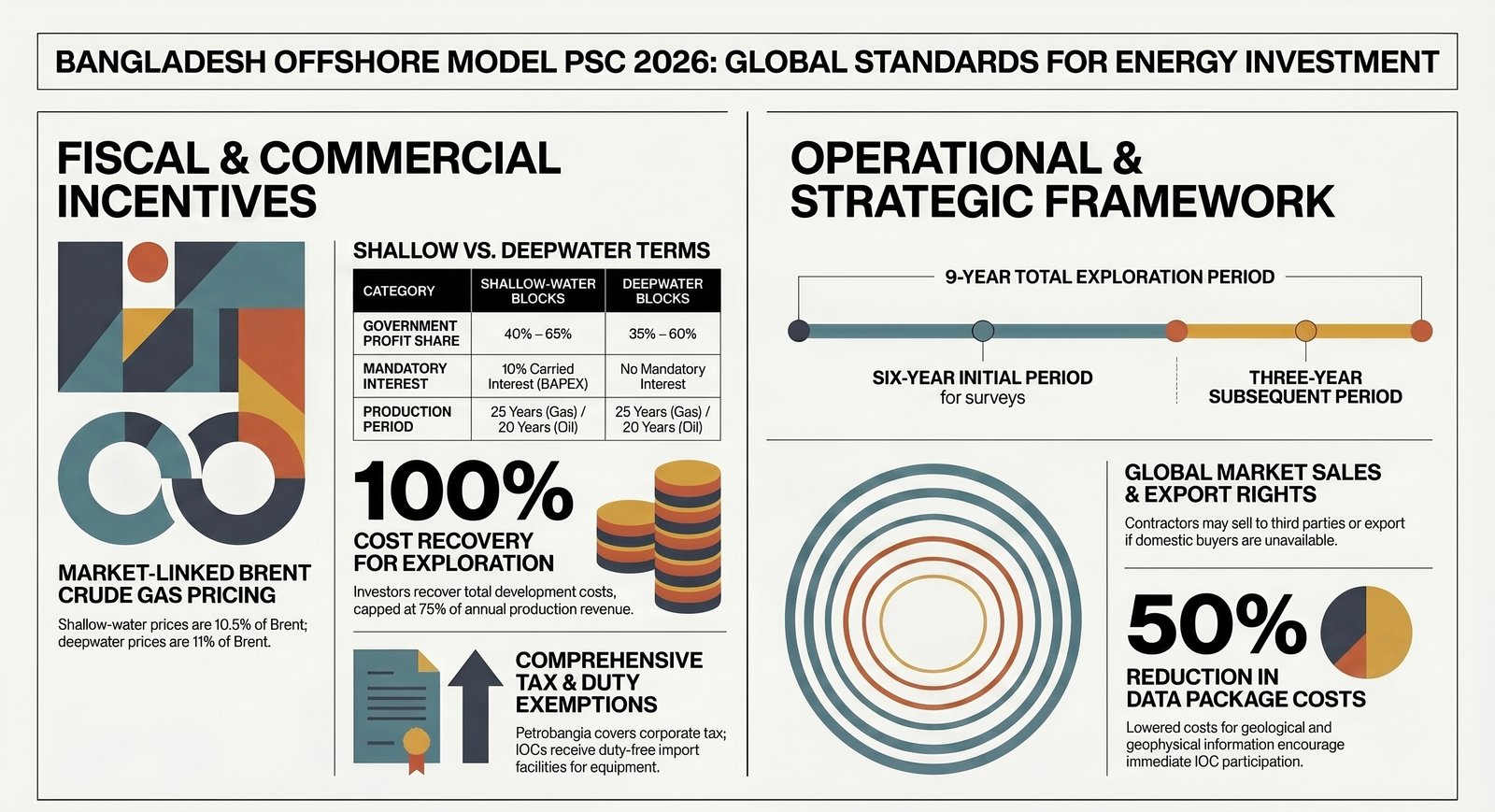
Key Features of Offshore Model PSC 2026
Officials from Petrobangla and the Energy Division say the revised contract reflects international best practices and incorporates provisions commonly used in leading hydrocarbon-producing countries.
Gas Pricing
Natural gas prices will be linked to international Brent crude oil prices.
- Shallow-water blocks: 10.5 percent of Brent crude price
- Deepwater blocks: 11 percent of Brent crude price
To protect both investors and the government from extreme market volatility, floor and ceiling price mechanisms have been introduced.
Deepwater Pipeline Tariff
A new provision allows Petrobangla to pay transportation tariffs for petroleum moved through privately constructed subsea pipelines. The measure is intended to improve project economics for offshore developments requiring major infrastructure investments.
Reduced WPPF Rate
The Ministry of Labour and Employment has reduced the WPPF contribution rate for fully foreign-owned energy companies from 5 percent to 1.5 percent.
Lower Data Costs
To encourage participation, the cost of geological and geophysical data packages has been reduced by 50 percent.
Exploration Period
The total exploration period will be nine years:
- Initial exploration phase: six years
- Four years for geological, geophysical, and seismic surveys
- Two years for drilling
- Subsequent exploration period: three years
Only seismic surveys are mandatory under the minimum work program, while additional seismic and drilling commitments will be determined through bidding.
Bank Guarantees
Required guarantees include:
- Geological and geophysical work: US$3 million
- Drilling phase: US$20 million
- Subsequent exploration phase: US$20 million
Cost Recovery and Profit Sharing
Investors will be allowed to recover up to 100 percent of exploration and development costs, subject to an annual ceiling of 75 percent of production revenue.
Government profit-sharing limits are:
• 40–65 percent for shallow-water blocks.
• 35–60 percent for deepwater blocks.
For shallow offshore blocks, a 10 percent carried interest for BAPEX will be mandatory.
Tax Benefits
Contractors will enjoy duty-free import facilities for equipment and materials used in exploration and development. Petrobangla will continue to bear contractors' corporate income tax obligations.
Oil Pricing
Any oil discovered will be priced according to prevailing fair market prices in South and Southeast Asia.
Gas Sales and Export Rights
Contractors may sell their share of gas to third parties in the domestic market, subject to Petrobangla's right of first refusal. If domestic buyers are unavailable, exports will be permitted.
Investment Protection
The PSC includes stabilization and anti-expropriation clauses to ensure investor protection.
Fees and Bonuses
• Commercial discovery bonus: US$3 million
• Production bonuses:
• Gas: US$500,000 to US$6 million
• Oil: US$500,000 to US$4 million
Research and Development Contributions
Contractors will contribute:
• US$0.10 per barrel of profit oil
• US$0.004 per MCF of profit gas
Service Fees
Annual contract service fees:
• Exploration and development phase: US$200,000
• Production phase: US$300,000
Training Grants
Annual training contributions:
• Exploration and development phase: US$150,000
• Production phase: US$200,000
Production Period
• Gas fields: 25 years
• Oil fields: 20 years
These terms may be extended by an additional 10 years if commercial production continues.
Officials believe the revised Offshore Model PSC 2026 will significantly improve investor confidence and attract international energy companies to explore the Bay of Bengal’s untapped oil and gas resources, helping strengthen Bangladesh’s long-term energy security.
Model PSC and Investor Perspectives
Industry experts generally view the new PSC as technically and commercially stronger than previous versions.
Professor Dr. Anwar Hossain Bhuiyan of the Department of Geology at the University of Dhaka described the revised PSC as balanced and attractive for both investors and the state. However, he emphasized that Bangladesh still lacks a major offshore discovery that could significantly boost investor confidence.
According to him, Petrobangla possesses approximately 66,000 line-kilometers of seismic data, but much of it has not been adequately reprocessed or interpreted. He believes improving and packaging this data should be a priority.
Dr. Bhuiyan also noted that Bangladesh's offshore geology may not support giant discoveries of 30–50 trillion cubic feet (TCF), which many major IOCs seek when evaluating investment opportunities. Beyond contractual terms, investors will also assess political stability, the investment climate, and geopolitical considerations.
Energy expert and former BUET Dean Professor Ijaz Hossain welcomed the new PSC but questioned whether it would be sufficient to attract the world's largest energy companies.
In his view, Bangladesh should focus aggressively on attracting capable mid-sized international operators while highlighting the country's investment potential and political stability.
Former BAPEX Managing Director Murtaza Ahmed Faruque said the PSC is substantially improved but argued that additional incentives should have been offered for joint ventures involving BAPEX and local companies.
According to him, greater domestic participation would help Bangladesh develop technical expertise and operational capacity in offshore exploration over the long term.
Challenges and the Road Ahead
Bangladesh lacks the financial resources, technology, and specialized workforce required to independently conduct offshore exploration. Consequently, foreign investment remains indispensable.
To attract investors, the Energy Division is considering a series of international roadshows. While details have not yet been finalized, experts recommend promotional events in major energy and financial centers, including Singapore, Europe, and North America.
Many also advocate organizing follow-up events in Bangladesh so prospective investors can directly assess the country's investment climate, regulatory environment, and political conditions.
Industry stakeholders note that the number of companies actively investing in offshore exploration worldwide is relatively small. Therefore, Bangladesh must pursue a highly targeted investment promotion strategy.
Experts suggest engaging foreign diplomats stationed in Dhaka and directing Bangladeshi missions abroad to actively promote offshore opportunities among major energy companies.
The upcoming D-8 Energy Ministers' Meeting in Baku may provide another platform for promoting investment opportunities in Bangladesh's offshore sector.
Conclusion
Many experts estimate that Bangladesh's portion of the Bay of Bengal could contain between 20 and 30 TCF of natural gas resources. However, only extensive seismic surveys and exploratory drilling can determine whether those resources actually exist and can be produced commercially.
Despite becoming one of the first countries in the region to begin offshore exploration in the 1970s, Bangladesh has discovered only one commercial offshore gas field—Sangu—which has already been depleted.
Several major international companies, including TotalEnergies, ConocoPhillips, Santos, POSCO Daewoo, and ONGC, have previously explored offshore blocks in Bangladesh but eventually withdrew after failing to achieve commercially attractive results.
The government is now offering 26 offshore blocks—11 shallow-water and 15 deepwater blocks—in what may be its most important offshore investment drive in decades.
The revised PSC has addressed many investor concerns, but contractual improvements alone may not be enough. Success will depend on how effectively Bangladesh can market its offshore potential, improve data quality, build investor confidence, and navigate an increasingly complex geopolitical landscape.
For a country facing mounting energy import costs and growing demand, unlocking the Bay of Bengal's resources could transform its energy future. Whether Offshore Bidding Round 2026 succeeds where previous efforts failed may ultimately determine Bangladesh's long-term energy security trajectory.
Download Cover As PDF/userfiles/EP_23_24_Cover.pdf